


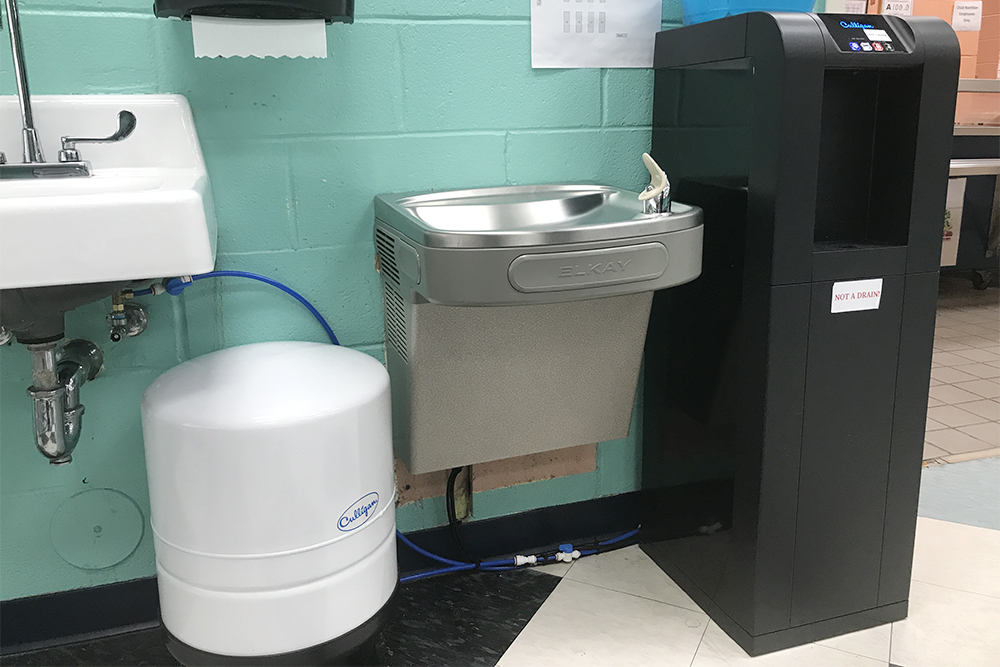
BRUNSWICK COUNTY — Installing reverse osmosis fill stations in all 19 Brunswick County Schools will reportedly cost the district less than $200,000 as the county awaits a permanent solution to filter out “forever chemicals.”
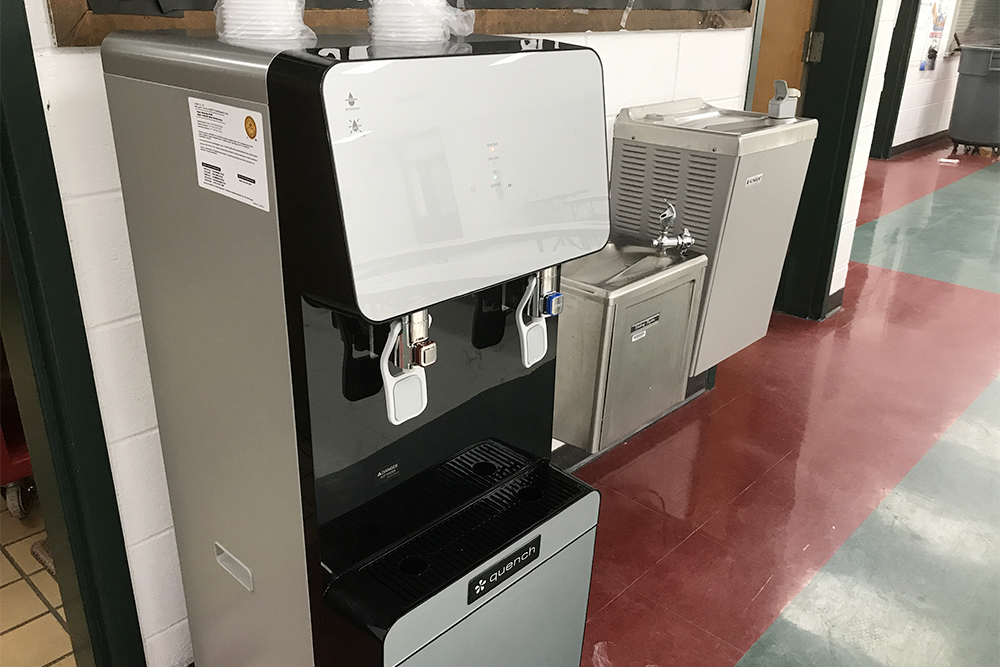
This week, BCS is pilot testing two preferred reverse osmosis (RO) vendors in Belville and Lincoln Elementary School.
Related: Temporary RO fill station solution brewing between Brunswick Schools, county
All 57 fill stations (60 when Town Creek Middle School opens in August) will be leased. This significantly cuts down on the district’s expense, costing approximately $949 per 4.6-gallon Quench unit and $795 per 4-gallon Culligan unit during the first year.
With between two and four filling stations per school, including all 60 stations and installation costs, BCS’s maximum expense would be about $170,000 with Quench and $139,000 with Culligan for three-year leases. Should county plans extend past spring 2023, a lease extension may be necessary.
BCS spokesperson Daniel Seamans said principals at each elementary school are expected to share feedback on the equipment Wednesday or Thursday.
RO-treated water will not be used for athletic water consumption. If the district orders separate gallon containers, it may be used in the cafeteria.
Road to RO
At its Operations Committee meeting Feb. 18, the school board approved a motion granting Superintendent Jerry Oates the discretion to select a vendor after testing is complete. A third-party laboratory will analyze samples before and after taken from the four filling stations.
Reverse osmosis technology has been shown to effectively remove tested per- and polyfluoroalkyl substances (PFAS) that conventional treatment systems cannot filter out of drinking water. A North Carolina-based study published earlier this month found under-the-sink reverse osmosis filters removed nearly all of the 16 PFAS tested.
Brunswick County has high concentrations of PFAS in public drinking water, with an average of 115 parts per trillion (ppt) in 2019 of combined PFAS tested. This still isn’t enough to trigger a drinking water advisory, which would only be enacted should the combination of older and phased-out PFAS chemicals, PFOA and PFOS, exceed 70 ppt.
Total PFAS tested in Brunswick County was as high as 413 ppt in a sample tested Aug. 22, 2019.
Brunswick County is currently accepting bids on its reverse osmosis upgrade and plant expansion project. It’ll cost $47.5 million to expand capacity and $89.5 million to add RO, according to the county.
Bids are due March 5. Depending on which contract Commissioners chose to award, RO-treated water will be available county-wide as early as November 2022, with final completion of this option by February 2023. The latest it could become available is May 2023, with final completion by November 2023.
Meanwhile, New Hanover County Schools is also exploring a similar solution. The board is expected to approve a contract to lease RO equipment in 30 schools at its April board meeting. Cape Fear Public Utility’s Sweeney Water Treatment Plant, which treats water from the same source as Brunswick County, is considered one of the most advanced treatment systems in the state.
Despite the advancement, CFPUA still sees high levels of total PFAS tested, with 108 ppt in finished water last month. CFPUA has invested $46 million to fund upgrades to equip its largest plant with eight new granular activated carbon filters.
Fill stations
After Belville Elementary School was named in a national study, ranking Brunswick County-treated water at the top of a 44-area list, BCS quickly announced it would provide bottled water to schools in the district that requested it. Once BCS learned from the county there would be no drinking water advisory, it walked back its offer, but was still honoring the requests on a one-time basis.
A bottled water solution would have been far more expensive than the RO filling station effort BCS is now pursuing. One pallet containing about 60 cases of water — representing about one day’s supply per school — cost $425. Counting all schools requiring a three year’s supply, bottled water could have cost the district millions.
On Wednesday Seamans said that while walking through Lincoln Elementary School, he noticed nearly a full palate of water. Just a few cases had been used, he estimated. “It’s just been sitting there,” he said.
Send tips and comments to Johanna Ferebee Still at johanna@localvoicemedia.com
