


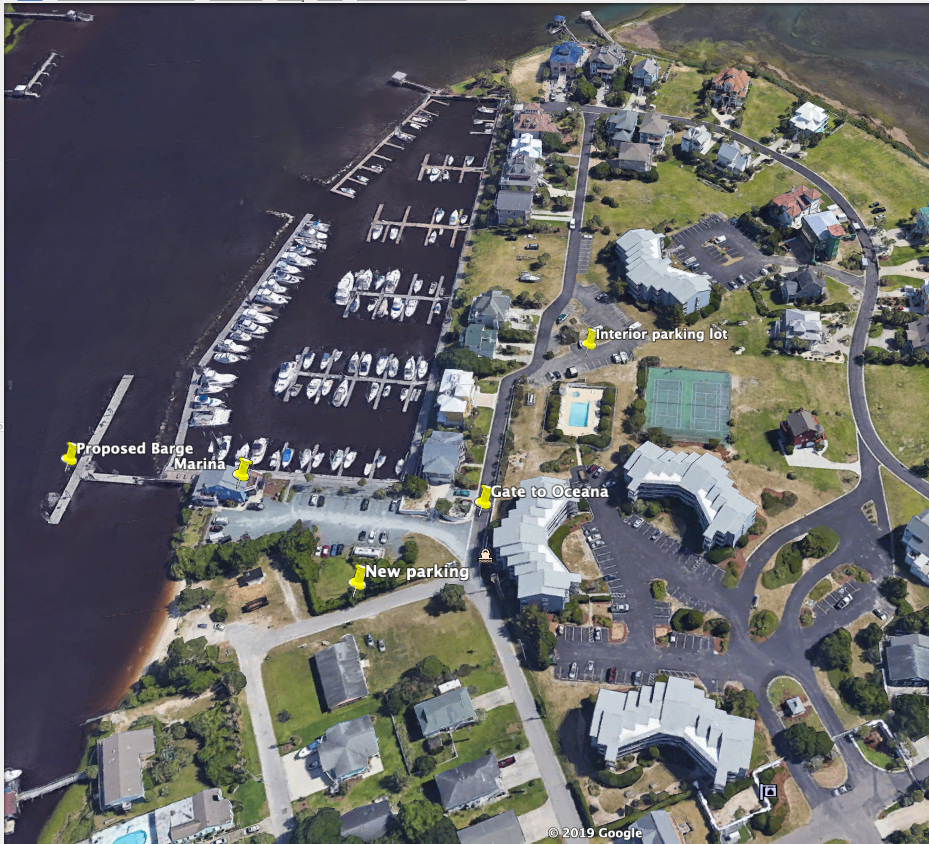
CAROLINA BEACH — After more than six hours of debate and the eventual recusal of Town Councilman Steve Shuttleworth, the Town of Carolina Beach’s Town Council was split on the application for the so-called ‘barge bar’ at the Carolina Beach Yacht Club and Marina.
The split vote without a majority means the request failed to pass — but an attorney representing the applicant has already confirmed he will be pursuing all avenues of relief after the town’s decision.
The application was for a conditional use permit, a heavily regulated process that is quasi-judicial in nature, making the proceedings much like those of a courtroom.
In order for a conditional use permit to be approved, Town Council must prove four items:
- That the use will not materially endanger the public health or safety if located where proposed and developed according to the plan as submitted and approved by the issuance of the C.U.P.;
- That the use meets all required conditions and specifications;
- That the use will not substantially injure the value of adjoining or abutting property, or that the use is a public necessity;
- That the location and character of the use if developed according to the plan as submitted and approved will be in harmony with the area in which it is to be located and in general conformity with the town’s land use plan and policies.
The request from the yacht club has been on the minds of residents in neighboring Oceana subdivision for more than a year since the request was first submitted. Although the request was pulled by the yacht club after a split Planning and Zoning Board vote in late 2018 it was resubmitted in 2019 — and finally heard by the Town Council this month.
But before the Town Council was able to hear the request from the applicant, the marina’s lawyer offered several challenges — the first being the impartiality of a Town Council member and possible ex parte communications.
Ex parte communication and impartial judges
The term ex parte communication refers to a judge having communications with any party regarding a pending issue — in this case, the Town Council can be considered the judge. The quasi-judicial nature of a conditional use permit requires an impartial judge. This means when residents send emails or try and discuss a pending conditional use permit with members of the town council, council members are typically required not to respond to (or even read) emails or other messages.
When Grady Richardson, the attorney representing the marina asked if anyone on the council had received any ex parte communication regarding the request, Councilman Steve Shuttleworth brought up an email that was sent to the entire council from a resident.
Mayor LeAnn Pierce acknowledged receipt of the email and said that no response from the council was sent, instead, it was forwarded to town staff for them to handle.
“That is standard practice, if council receives emails from parties or folks in favor of or against a conditional use permit they forward it to town staff and town staff sends a response from the town hall,” Town Attorney Noel Fox confirmed.
The email in question came from a resident of the neighboring Oceana subdivision opposing the construction of the barge, but members of the Town Council all agreed they had not read the email and had not been biased by it.
But Richardson was not so convinced that the council was an impartial judge and took issue with Councilman Steve Shuttleworth, who had just been reappointed as a councilman after a full campaign season.
During that time, Shuttleworth apparently went door-to-door speaking with residents, asking for their votes. In doing so Shuttleworth knocked on the door of an employee, Taylor Reece, of the marina who asked him about his opinion on the proposal for a barge bar — to which Shuttleworth apparently answered.
“It was a nice interaction he just told us his points and that he was campaigning. I asked him what his opinion was on putting a bar at the marina and he looked me in the eye and said ‘I am against it,'” Reece said.
After this revelation, Richardson went on to request Shuttleworth be recused and disqualified from hearing the request and being a part of the decision making process. After some discussion, Shuttleworth agreed to the request and the Town Council voted to recuse him from the meeting — while this move did remove a member who had admittedly said he was against the proposal — it also brought the number of voting members on the council to an even four.
Standing
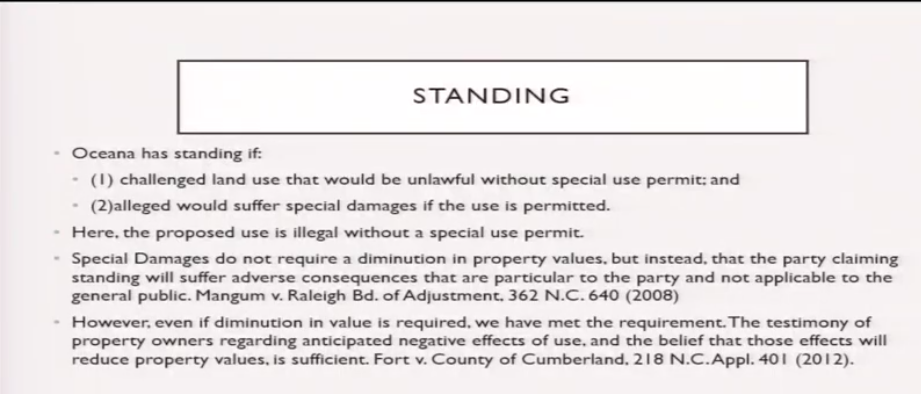
Even after the situation unfolded with Shuttleworth, Richardson was not yet ready to present his client’s case. Instead, he challenged the standing of the opposition — in this case, an attorney representing Oceana and its homeowner’s association (HOA). This was the first time the Town Council has had a challenge of standing during a conditional use permit hearing, according to Pierce.
So what is standing?
In order to be a party to a conditional use permit speaking, either in favor or against it, you must have what is called standing. Essentially, this prevents the interference of a request by those who would not be affected by the granting of a conditional use permit. Those who want to speak in favor of or against a request must be sworn (much like a courtroom in) and have proper ‘standing.’
In order to be a party with standing, individuals have to provide significant evidence that they would incur special damages due to the approval (or denial) of the request. Special damages are damages that would be specific to the individuals speaking as opposed to the public at large, Fox said.
To understand why the Oceana HOA would have standing, a little history is important. Originally the marina was a part of a larger development called Spinnaker Point which would have consisted of 376 units, a marina, and more — but plans fell through and only a portion of it was built.
Then, in the 1990s, a developer set its sights on the surrounding properties and created Oceana, thus, effectively dividing the property into three distinct parts: Oceana, the marina, and the few developed units of Spinnaker Point. Each entity operates autonomously now, but residents of both Oceana and Spinnaker Pointe claimed they would be directly affected by the request, if approved.

Residents of Oceana were brought forward, one at a time, to discuss the possible impact on their homes and reasoning they believed they had legal standing in the case. According to state statute, in order to determine if the HOA had standing, only one person who was a member of the HOA had to prove standing.
But as with other quasi-judicial hearings, those claiming standing have to prove it under oath and using substantial evidence.
According to the town code regulating conditional use permits. “All persons shall offer only competent material and substantial evidence in any presentation to the council. Competency shall be determined by the council in its decision.”
In layman’s terms, this generally means that people are not supposed to be allowed to present opinions regarding the request, instead, they have to provide fact-based evidence to support their claims.
The facts, or opinions?
The first resident that was brought forward to speak on behalf of Oceana’s HOA was Alan Perry who has a home that directly abuts the marina property.
Perry said he believes that the approval of the request would have a negative impact on his property. He claimed there would be an increase of noise as well as smell pollution if the ‘barge bar’ were approved.
Another point of contention from members of the HOA was the parking lot that is located within the gates of the Oceana subdivision. This parking lot is currently used by the marina for boat slip owners and an access code is given to them to allow entrance into the neighborhood. With the addition of a ‘barge bar,’ residents claim the parking lot will be used by marina guests and suddenly have more unknown people inside their private community.
But Richardson contended that the HOA and member of it failed to actually establish standing and provided only ‘speculation and conjecture.’
“The bottom line is tonight you’ve heard nothing about special damages, they do not have standing … Where is their standing? What have you heard tonight that has been competent, material, and substantial evidence to support that they have standing to challenge this permit application?” Richardson said.
Ultimately, the four-member Town Council voted 3-1 in favor of allowing the HOA standing after hearing all of the evidence.
What’s next?
At the end of the nearly 7.5-hour meeting, members of the Town Council failed to agree upon any motion for the request — and two were made, one in favor of the plan and another denying it.
Before taking a vote, Fox once again reminded the board that they could not make a decision based upon personal preference — only on the evidence provided during the hearing.
Pierce offered her opinion that the request failed to meet items three and four from the requirement of a conditional use permit, that is:
- That the use will not substantially injure the value of adjoining or abutting property, or that the use is a public necessity;
- That the location and character of the use if developed according to the plan as submitted and approved will be in harmony with the area in which it is to be located and in general conformity with the town land use plan and policies.
Councilman JoDan Garza made the first motion to deny the conditional use permit saying the proposal did not meet conditions three and four. Pierce and Garza voted in favor of the motion while Councilmen Jay Healy and Lynn Barbee voted against the denial.
A motion was made to approve the request and it too failed to get a majority of the council’s votes, meaning the CUP did not get approved.
Port City Daily reached out to Richardson to see what plans he and the marina have regarding the town’s decision.
“We will be pursuing all avenues of relief against this unlawful decision by the Town of Carolina Beach, including — without limitation — a full recovery of my client’s attorneys’ fees and costs. The Town Council acted well beyond the scope of its legal authority, blatantly ignored its very own ordinances for its review of my client’s application, ignored the unanimous recommendation for approval by the Town’s own experienced staff, and grossly abused its discretion,” Richardson said in an email.
Send comments and tips to Michael.p@localvoicemedia.com and follow him on Twitter and Instagram
