


Editor’s Note: “We have made this story free to read in hopes that you will see firsthand our dedication to keeping our community informed and connected. Will you consider subscribing? For just one dollar a week, you will support non-editorial local news while at the same time being rewarded with the being up to date on what is happening around you every day. Please enjoy this story, and consider enjoying more now by clicking here.”
WILMINGTON — This week, the Partnership Advisory Group aims to wrap up work on a Request for Proposals, which will shape offers to partner with or buy the New Hanover Regional Medical Center. It’s part of a contentious process that has frustrated and concerned many — but it might also provide clarity and answers, which seem to some to be in short supply.
The Partnership Advisory Group (PAG) was formed by New Hanover County commissioners to help direct exploration of options for NHRMC. A major step in that process is crafting a Request for Proposals (RFP), a formal document containing requests for numerous specific responses to questions about how a new partner or owner would handle a variety of issues — mostly pertaining to maintaining and continuing the hospital’s strategic plan.
While Navigant, the hospital’s consulting firm, will author the actual RFP, PAG members are quick to point out the substance of that document has come from a series of public meetings; at those meetings, PAG members have worked to translate 10 key hospital goals and objectives into questions for potential partners and buyers.
Despite efforts by the PAG, NHRMC, and the county to remain transparent, questions and concerns about the process remain. In particular, there are questions for the PAG, who were brought into the process to provide a surrogate voice for the community and to serve as an impartial arbiter of fact.
Find more in-depth here: Vetting the allegations, accusations, and theories surrounding NHRMC’s sale exploration
The PAG is chaired by Spence Broadhurst, a former Wilmington mayor who is currently the president of the eastern North Carolina region of First National Bank, and Barb Biehner, director of operations for Coastal Carolinas Health Alliance, and also includes 19 other community members.
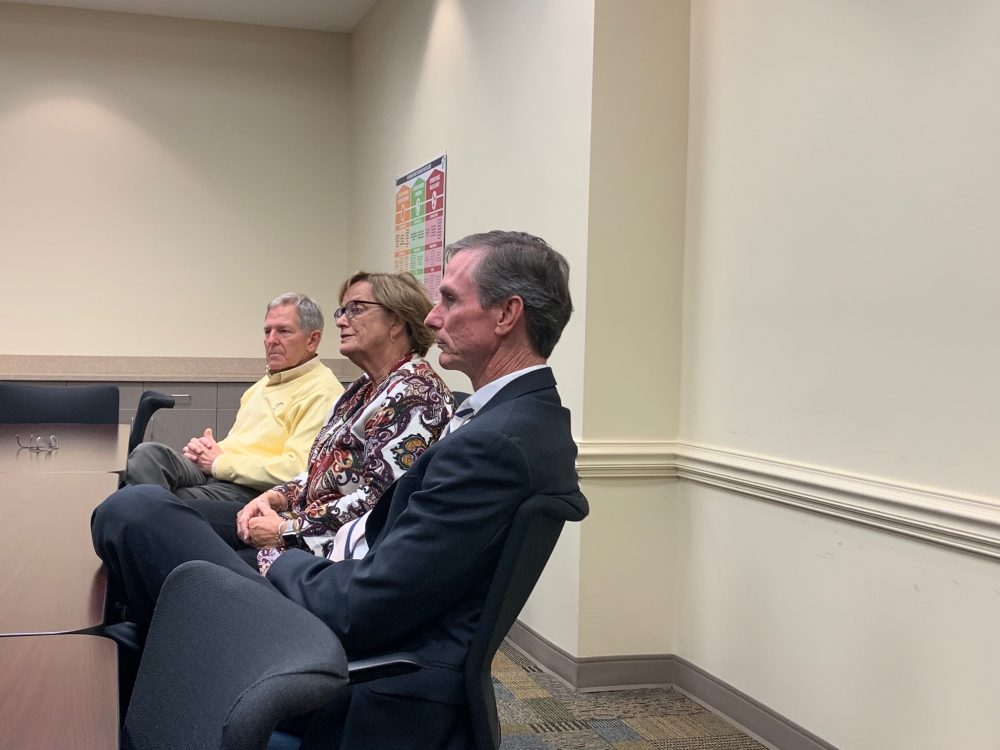
Broadhurst agreed to sit down with Port City Daily to answer a range of questions about the PAG’s role and the challenges it faces.
Why an RFP? And why first before discussing independence?
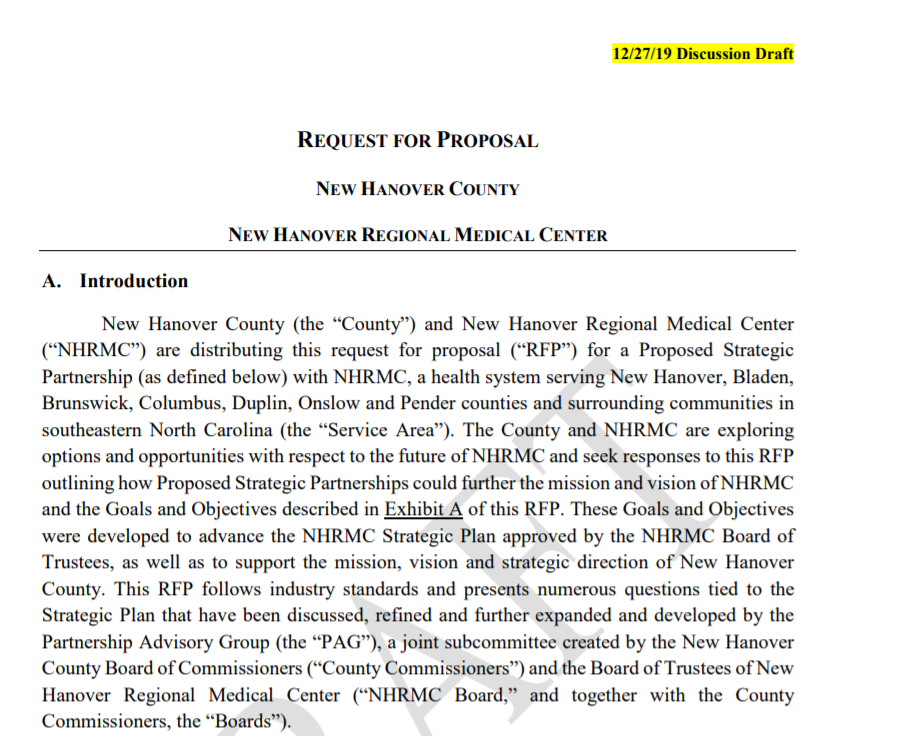
A variety of critics, including State Senator Harper Peterson and the non-profit Save Our Hospital group, have asked why NHRMC and the county could not explore options without the official “intent to sell” resolution from the county. County officials have offered their own explanation (which you can find here), but Broadhurst also addressed the issue.
“The information we get back is going to be critical in our decision. The RFP allows us to specifically and in a detailed manner ask the questions — so that we don’t get a general response back,” Broadhurst said.
Broadhurst also addressed why the RFP process was tackled first, before sustained consideration by the PAG of options for retaining independence — something the PAG has said it will do after the RFP process is complete.
“From a timeline standpoint, it makes perfect sense to incorporate the RFP first because that avoids dead time for us. Because while the RFP is out for consideration, we can discuss other issues, like how do we stay independent, what does that look like, instead of sitting around twiddling our thumbs,” Broadhurst said.
Avoiding ‘dead time’ has been, for some, part of a criticism: that the process is being rushed forward. Broadhurst said wasn’t true, but did offer a rationale for using time efficiently.
“There is no rush. The reason is that this is a huge distraction,” Broadhurst said. “I don’t mean that it’s unimportant, but I mean that this process, the uncertainty that comes with it, it’s a distraction for the medical providers, the staff, the administration. It’s a huge distraction for the 7,500 individuals. To drag this out over an extended period of time is a disservice to our hospital. I say our hospital, I mean those 7,500 providers of health care, not the institution — it’s not fair to the hospital and not fair to the community to let this thing flounder.”
Critiques of sales and mergers
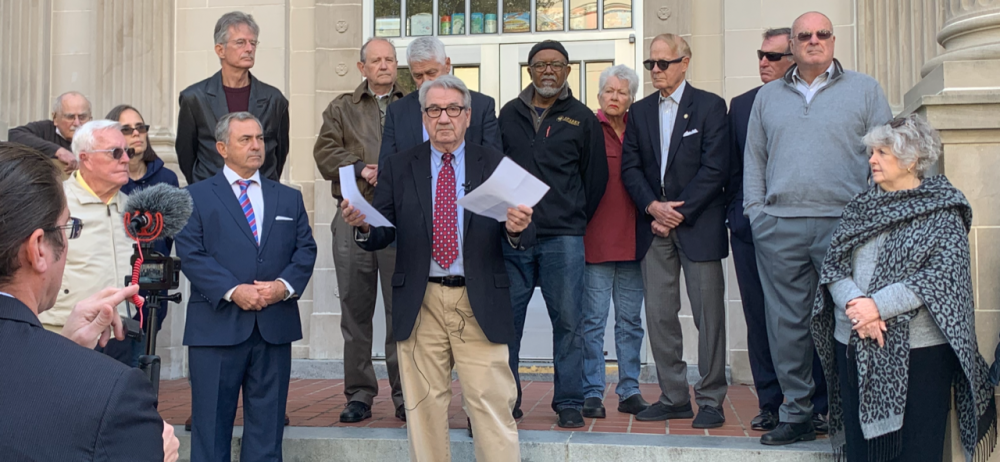
Members of the PAG have heard from community groups — like Save Our Hospital — and media outlets about a wide range of academic and real-world studies on hospital mergers and acquisitions. The prevailing consensus is that costs increase but quality of care doesn’t — in some cases, it decreases, or hospitals see some of their services relocated to larger hospitals with the networks of their new owners or partners.
NHRMC President and CEO John Gizdic said in an interview last year that he had not seen any examples of these dire predictions coming true in North Carolina.
But critics point to a 2016 lawsuit filed by the U.S. Department of Justice and the state of North Carolina against Carolina Healthcare System (now Atrium), a company that proposed to take over management of NHRMC in 2011 and currently has a buying agreement with the hospital. The 2016 lawsuit accused the healthcare company of using its size to inflate costs and was settled in 2019, blocking Atrium from future ‘anti-competitive’ behavior.
Critics have also drawn parallels to for-profit HCA Healthcare’s purchase of the non-profit Mission Hospital in Asheville. The sale was approved by North Carolina Attorney General Josh Stein, but only after increasing HCA’s obligation to rural areas — and setting up an independent agency to make sure HCA honored the deal.
Gizdic has also pointed to “intentionality” as a key factor in allowing hospitals to succeed in a partnership, merger, or acquisition — it’s an argument Broadhurst thinks is important to reiterate.
“I think it’s important, in my opinion, to recognize that I think we are very unique in this situation. I think it’s going to be very difficult to compare what we’re going through to any other opportunity in the United States,” Broadhurst said.
What makes NHRMC different?
Broadhurst said NHRMC’s experience with a potential sale or new partnership would be different because of transparency and NHRMC’s ‘position of strength’ (a phrase used by both Gizdic and County Manager Chris Coudriet since the announcement of the sale process).
In terms of transparency, Broadhurst said the deliberate and public process would give ample time for input on potential problems; he drew a contrast to Mission Health, which he viewed as having rushed its partnership with HCA.
Broadhurst reiterated a commitment to transparency also made by the county, saying that the final RFP and “every word” of proposals would be made public, unless potential partners could make a sound legal argument for redacting information (i.e. the PAG would not redact any information before making it public).
In terms of a ‘position of strength,’ Broadhurst said it would allow the PAG to “ask for the moon” — and to walk away from any partner if the offer on the table didn’t improve NHRMC’s overall quality.
“We’re approaching this from a position of absolute strength, whereas the vast majority of [hospital mergers and acquisitions] being studied were decisions made from a position of necessity,” Broadhurst said. “We’re in a position to do that, we could go through all of this and say, no, it’s not good enough, we’re better off on our own — that’s the benefit of being in a position of strength.”
Strong, but not without limits
It has struck many as something of a circular argument: NHRMC wants to look into options because it’s in a strong position — but if it’s in such a strong position, why look to sell?
“I know, it begs the question,” Broadhurst said.
There’s been much talk of ‘uncharted waters’ and ‘uncertain conditions’ in the future. One concrete issue is capital funding.
There are limits to what NHRMC — or the county — can borrow and how much debt service can be sustained. But there’s a problem that’s literally bigger, and that is that the county is restricted in what it can finance outside of the county’s boundaries.
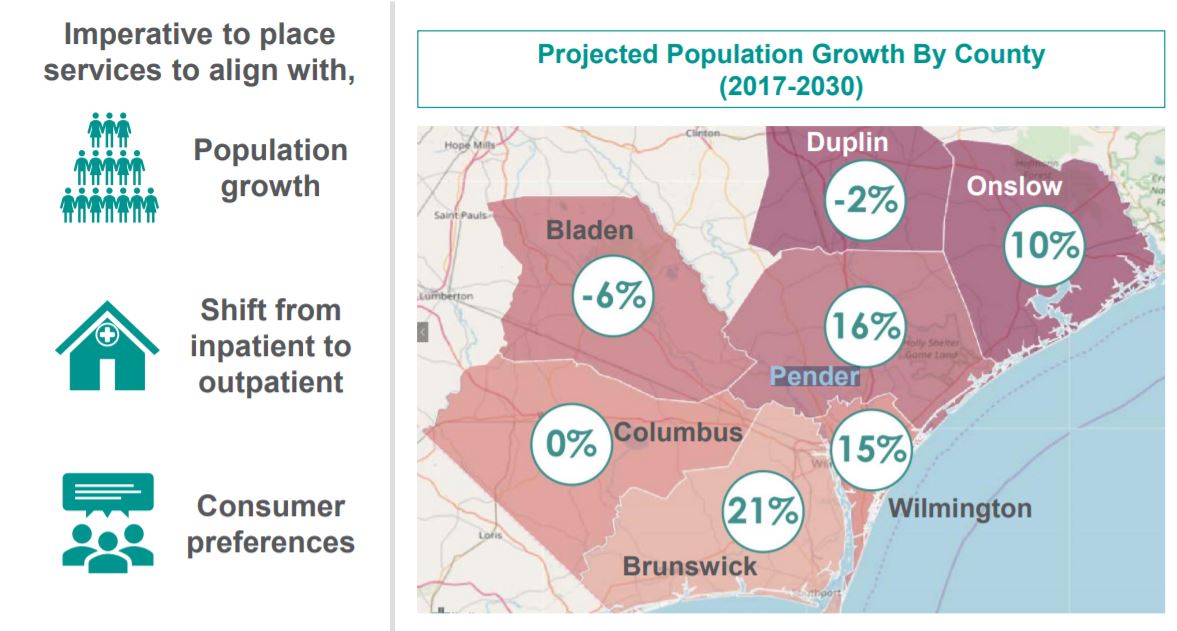
As NHRMC has grown, it has increasingly provided services to six counties beyond New Hanover, including Bladen, Brunswick, Columbus, Duplin, Onslow, and Pender counties. With millions — or billions — necessary to keep up NHRMC’s strategic plan over the coming years and decades, finding a way to fund projects outside of New Hanover County is crucial.
While this challenge is not the only one spurring exploration of new options, Broadhurst acknowledged it was a serious one — one that can’t be addressed, in his opinion, by maintaining the status quo.
“It’s insurmountable if we do absolutely nothing. It appears to me that if we do absolutely nothing, it’s going to be a great challenge to meet the strategic plan of the hospital, which includes [mainting and increasing services in other counties],” Broadhurst said.
One option includes changes in governance — changing the governmental scope of NHRMC.
“We’ve got to address governance — the hospital is owned by the county but we serve seven counties, we’ve got to address that,” Broadhurst said.
Consider the recent parallel of WAVE, which county and Wilmington officials announced this week would undergo a restructuring. One potential aspect — more buy-in and representation from other municipalities and counties, including the example of Leland, Brunswick and Pender counties given by Wilmington Mayor Bill Saffo.
So, could NHRMC see representation for — and investment from — the six surrounding counties?
“Everything’s on the table, in my opinion — I think when you look at the question of governance, there’s going to be an appetite to look into other options,” Broadhurst said. “Those things need to be talked about.”
Broadhurst said the challenges could also be addressed without a new outside partner, something the PAG will explore in-depth.
Staying independent
After the RFP is approved and sent out, the PAG will turn its attention to discussing options for staying independent. For two months, the PAG will focus on options excluding any new partners or owners.
“We’ll do an internal evaluation, what does it mean to stay independent — meaning we don’t bring in any partner of any kind,” Broadhurst said.
Much of the research of this has already been done, Broadhurst said, saying the NHRMC Board of Trustees had already commissioned a study to look at the challenges of remaining independent — and how to surmount them.
One suggestion that came out of this research, done by First Tryon Advisors on behalf of the county and NHRMC, is ‘SystemCo’ — essentially a 501(c)(3) with a county-appointed board that would become the sole corporate member of NHRMC. SystemCo could serve as an umbrella non-profit corporation for NHRMC as well as Pender Memorial Hospital and other NHRMC operations and services outside New Hanover County.
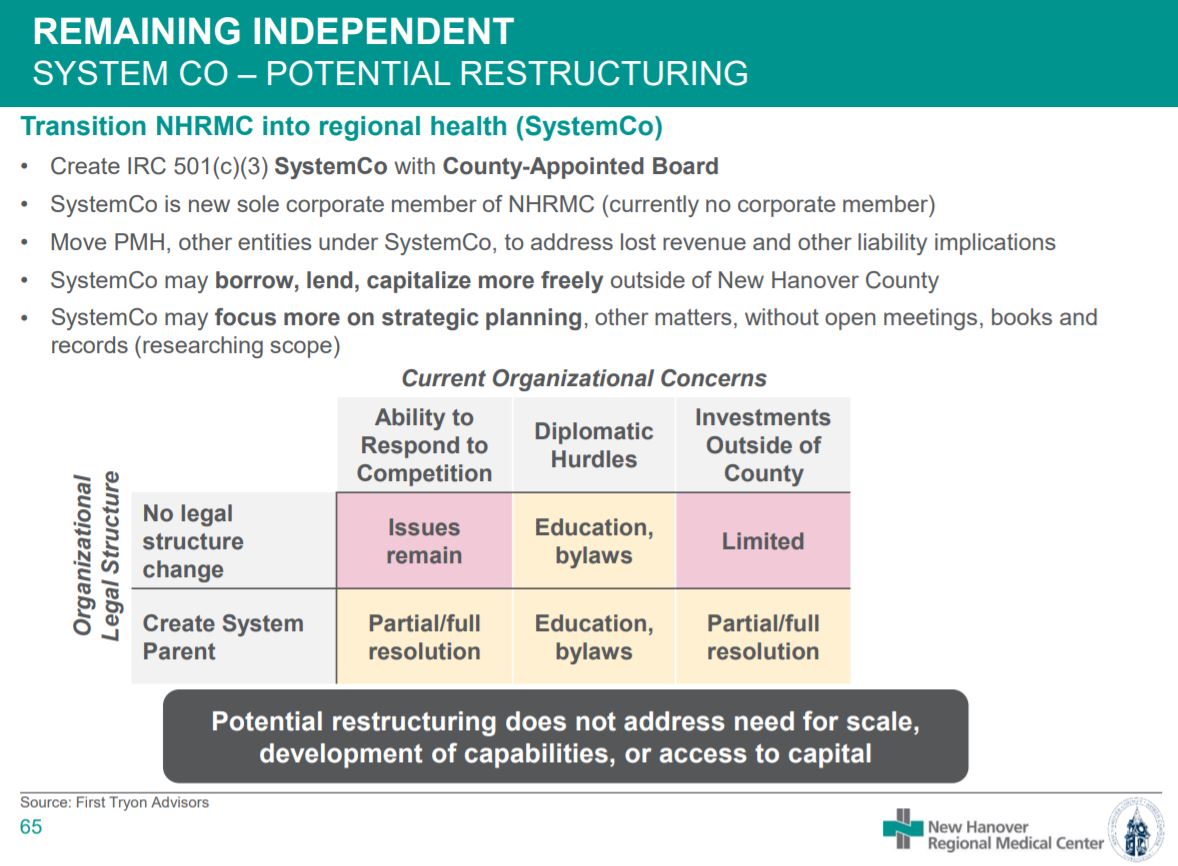
According to a presentation shown to PAG members last year in November, SystemCo would be able to borrow, lend, and capitalize more freely outside of New Hanover County. It’s also worth noting that the presentation states that SystemCO could “focus more on strategic planning, other matters, without open meetings, books and records” — a likely concern for transparency advocates.
According to that presentation, and New Hanover County, research on a ‘system parent’ eventually “found that there were still limitations for the hospital including access to capital, scale, and several other factors.” Those shortcomings, according to the county, led to the discussion of researching new partners or owners.
Despite that, Broadhurst said nothing was off the table in discussing remaining independent. In addition to SystemCo, Broadhurst said the PAG would discuss all of the challenges facing NHRMC and how they might be met without new outside partners; he cautioned against focusing solely on capital needs.
“There are challenges to meeting that plan, and capital structures is one of them — but there are ten of them, so capital issues are just one of them,” Broadhurst said, saying it was important to focus on all the issues that would challenge NHRMC in the future.
“I think it’s important not to just look at five years from now, but generations from now — we’ve been here for 52 years, we should look at 50 years from now,” Broadhurst said.
Why sell?
It’s been difficult for stakeholders — including the media — to neatly encapsulate the rationale for a sale. Broadhurst noted that arguments against the sale often lend themselves to soundbites, but the multifaceted reasons to at least explore a sale or partnership are more complicated. The need for increased financial capacity, especially across county lines, is just one, but there are also uncertainties in the direction of the health insurance industry, the growing cost of charitable care, changes in Medicare, and other issues.
While no individual challenge seems to have been convincing, the sum total of them has motivated hospital and county officials to move forward. But many of these officials have been party to conversations for years, even decades, and are familiar with the issues and their nuances. The public, including members of the PAG and the media, have had just a few months to play catch up.
“Most of what I know I’ve learned in 60 days, and I think most of the community is in the same camp,” Broadhurst said. “I was introduced to this the same way the rest of the community was, So, I thought, I want to get on the inside, and understand this thing, and make a difference”
The question then, have PAG members wrapped their heads around this complicated equation of issues and can they articulate it? And, if not, is that problematic, as the PAG is steering the RFP process and the selection of a preferred potential partner?
Broadhurst said the PAG is still developing their understanding of the issue, but that he was confident the group would be able to articulate the reasons for selling, partnering, or staying independent before making a recommendation.
“When the time comes to make a recommendation to the county commissioners and the board of trustees, we will clearly articulate the reasons for that recommendation,” Broadhurst said.
Broadhurst said he understood people’s confusion and frustration, in particular at sending an RFP while the reasons for wanting to sell or partner remained murky to some.
“We know what the hospital’s strategic plan and goals are — that’s what this is about — and so the question is, can these companies help us do that better, or are we better on our own,” Broadhurst said. “We can’t evaluate that situation without knowing what’s on the table — so we can’t articulate a recommendation without all the information yet.”
Broadhurst said he knew people would demand a compelling — and clear — reason to sell, if that’s what the PAG ultimately recommends.
“If we recommend anything other than remaining independent, we owe it to the community to make a hell of a case,” Broadhurst said.
‘Not a rubber stamp’
Broadhurst said he felt much of the attention to the hospital sale exploration had been focused on the county and NHRMC, but that there was one recurring comment about the PAG he wanted to address.
“There is a misperception on some people’s part, that the advisory group was going to be a rubber stamp part of the process — that is not the case. If the county commissioners wanted a rubber stamp group, they made a mistake, they appointed the wrong people,” Broadhurst said, adding that if there was one thing that needed to be “totally debunked” was any outside influence on the advisory group.
“We’re aware that this issue could get somewhat political for some — but that’s for somebody else. For the [PAG] there’s just 21 dedicated people working to come to the best, fact-based decision we can… politics doesn’t play into our process, from a timeline standpoint, from an influence standpoint,” Broadhurst said.
Meetings, documents, contact
The PAG will meet Thursday, January 9 from 5:30 to 7:30 p.m. at the New Hanover County Government Center, 230 Government Center Drive, Suite 135. The PAG expects to finalize the RFP this week or during the next meeting on January 23.
Information on past meetings, including presentations, documents, minutes, and streamable meeting audio can be found here. Future meeting locations, times, and dates can be found here.
Information about the PAG members can be found here, and the group as a whole can be contacted at [email protected].
Send comments and tips to Benjamin Schachtman at [email protected], @pcdben on Twitter, and (910) 538-2001
