


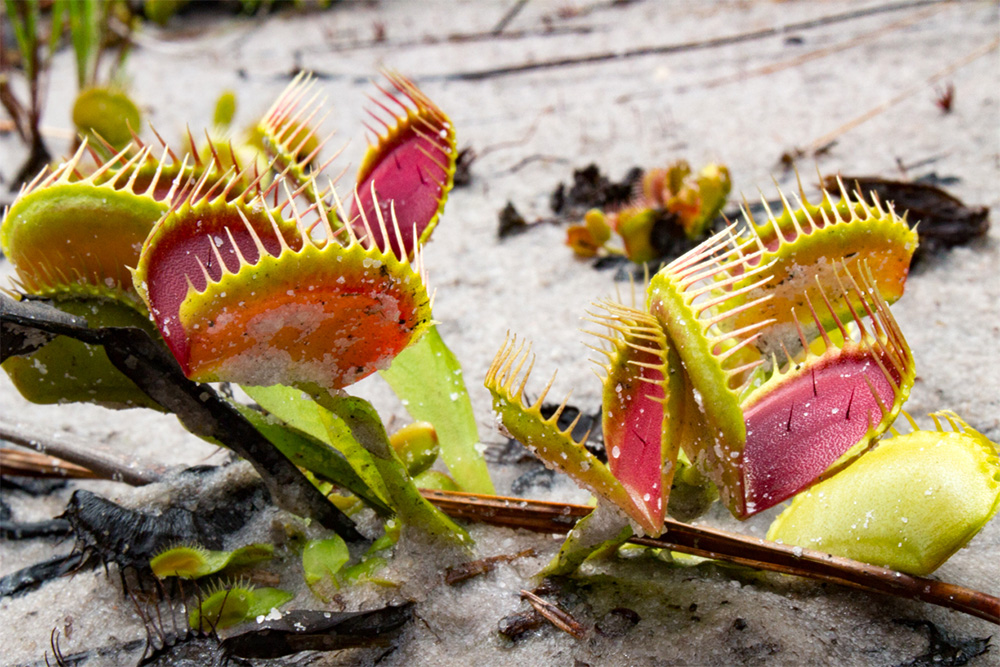
BRUNSWICK COUNTY — Archie Williams pleaded guilty to nine counts of felony taking of a Venus Flytrap earlier this month after poaching over 200 plants from the Green Swamp, public game lands in Brunswick County.
As part of a state plea agreement, Williams was sentenced to serve 60 days in custody — a threshold he already met while awaiting trial in the Brunswick County Sheriff’s Office. He was first held under a $750,000 bond in March after being charged with over 200 counts (later consolidated to 73 counts) for the felony taking.
Related: Why isn’t it illegal when developers destroy Venus Flytraps, and other reader questions
With an extensive criminal record, if Williams is convicted of any additional felonies, he will be considered a habitual felon. If Williams violates court orders, three consecutive judgments could kick in, requiring that he serve a minimum of 36 months to a maximum of 72 months in prison.
Williams’ plea agreement is the result of his cooperation with law enforcement, evaluation of having a diminished mental capacity, and his efforts to mitigate wildlife loss caused by his actions by re-planting the stolen plants.
Under the state’s maximum Class H felony sentencing guidelines, Williams could have served up to 216 years in prison.
Felon for flytrap
Prior to 2014, flytrap poachers could be charged with a misdemeanor and settle their cases by paying a small fine, $50 or less. New Hanover County Representative Ted Davis lead the local effort to strengthen punishment for the crime with Senate Bill 734. Taking a Venus Flytrap from public lands is now a Class H felony. However, since the flytrap only grows within a 60-mile radius of Wilmington, the statewide penalty has a limited effect elsewhere.
After Williams’ arrest, Davis said the change was intended to show poachers how seriously the law views the crime.
Developers or private property owners can remove flytraps, a “vulnerable” species, at their will from privately-owned lands. Vulnerable species are one-step removed from being considered “threatened,” a federally-protected designation under the Endangered Species Act.
Williams joins a short list of individuals who have been convicted under new sentencing guidelines for the crime. Assistant District Attorney Chris Thomas said though the case wasn’t typical, the state treated it practically.
“This is a unique case,” Thomas said Thursday. “But I treated as I would any other felony with the same classification level. If it’s a felony, it’s a felony.”
Thomas said Williams’ defense presented an evaluation showing he had diminished mental capacity. “He is of somewhat diminished capacity but not to the extent that he shouldn’t be held responsible,” Thomas said. “He knew exactly what he was doing. He was very specific in his statements to law enforcement.”
Re-planting
After being arrested by a Wildlife Resource Commission Officer, Williams opted to cooperate with law enforcement. He instructed officers on how he harvested the plants, according to Thomas, which provides a valuable perspective for future investigations. Also, he walked the game lands with officers and re-planted the poached plants.
“With a lot of wildlife cases, the animal is killed and can’t be replaced,” Thomas said.
As for the potential to sentence Williams up to 216 years, Thomas said the District Attorney’s Office used discretion. “We make sure we’re intentional and deliberate in the way we structure a plea to ensure we’re being fair,” he said.
By focusing on public lands, the law helps protect threatened greenspace the region has left. But Thomas said it probably wasn’t crafted so that flytrap poachers would spend life in prison.
“I think the legislature’s intent was well-purposed. We’re one of the fastest-growing areas in the country,” he said. “But I absolutely do not think it was their intent for someone to go to prison for 700 months for a non-violent offense.”
Send tips and comments to Johanna Ferebee at [email protected]
