


WILMINGTON — City Council members showed some confusion and hesitation to the newly proposed updates to the city’s noise ordinance on Monday during the council’s agenda briefing.
One of the biggest items of concern came from the revelation that noise levels permitted in specific areas are not as black and white as they might have hoped.
Simple math?
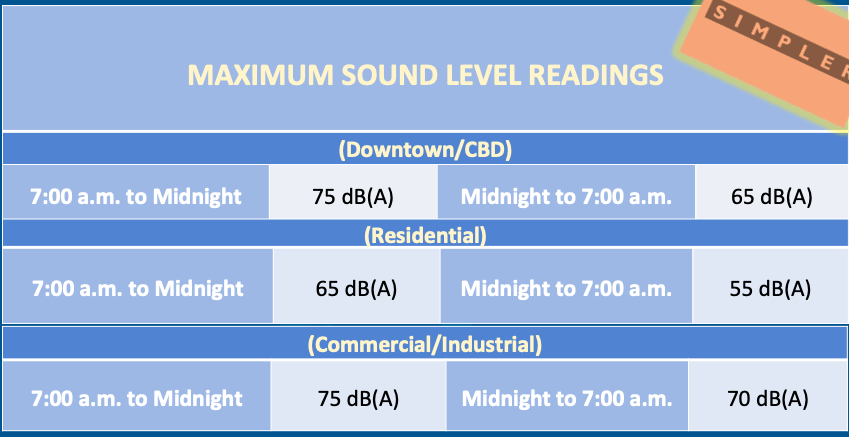
First of all, noise maximum levels have stayed the same from the current code — that means in the downtown districts the maximum level from 7 a.m. to midnight is 75 decibels (dB). In residential districts that level is 65 dB; in commercial districts it is 75 dB.
From midnight to 7 a.m. the maximums are 65 dB in downtown, 55 dB in residential, and 70 dB in commercial or industrial districts.
While this might seem like simple math, City Council members had some concerns regarding noise projected from downtown or commercial districts into residential districts.
According to Deputy City Attorney Meredith Everhart, any noise violation will be measured from the property of the complaint, not the property creating the noise. But this is where things become tricky — according to Everhart — the noise levels measured from the complainant’s property will be held to the standard of the district the noise originates from.
This means that a bar that is located across the street from a residential district in downtown cannot exceed 75 dB as measured from the residential property — in essence, they are not expected to maintain that 65 dB range that is the standard for residential districts.
Everhart went on to explain to the council that property owners in these districts are only legally responsible for sounds that violate that property’s own district-based limits — not noise levels of other zones.
“Your job [as a hypothetical bar owner] is to not project more than 75 dB onto someone else’s property in a manner that disturbs them,” she explained to Councilman Paul Lawler who posed a hypothetical question of opening a bar across the street from a residential district.
In the same breath, those in the residential districts would not be permitted to project more than 65 dB onto any other property.
Councilman Kevin O’Grady also voiced some concerns with the fact that industrial or commercial districts could generate noise that would reach residential areas at higher volumes than would be allowed if the noise came from within the residential area; in other words, some residents could, in theory, have to tolerate noise up to permitted industrial levels, even though they live in residential areas.
Ultimately, Everhart reiterated that this is the way it has always been in Wilmington and expecting business owners to be held to the standard of districts they do not operate in is not a feasible option.
Not just downtown
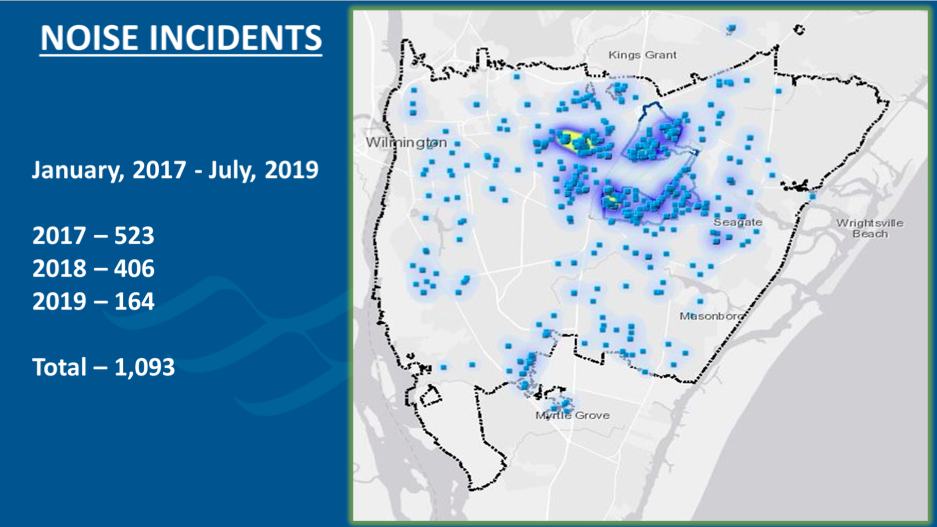
For many people, the discussion regarding noise violations has been seen as an attack on Downtown businesses — namely bars and other live music venues. But looking at a map of noise violations in the city it shows that the main focus of noise complaints originate from the areas around UNCW, not Downtown.
“There’s a lot of belief that most of our noise problems come from the Downtown area but most of our noise complaints come from around the college area. That is not to say that they are all college students, but the type of housing that is around the college area tends to be rental homes and the types of places that we do get a lot of complaints from,” Everhart said.
Because of the public’s reaction to the city wanting to change the noise ordinances, multiple public meetings were held through various groups including WDI and UNCW. Based on the input received at these meetings there was a general misconception that the city was focusing its efforts on the Downtown area, Everhart said.
The Monday meeting will likely be the last workshop before the new changes are officially presented to the City Council for approval at an upcoming, but as-of-yet unlisted meeting.
Send comments and tips to [email protected]
