



Commissioners addressed citizens’ concerns of water capacity issues and congestion in the county’s high-growth coastal corridor. Meanwhile, water restrictions in the east remain in effect for 28 days and counting.
PENDER COUNTY — Citing concerns of the county’s ongoing water shortage and increasing congestion along the coast, Commissioner David Piepmeyer said he continues to “get hit up on a building moratorium,” one that he said could result in significant litigation from developers.
Piepmeyer represents District 2, which includes the high-growth areas of Hampstead and Scott’s Hill, and he chairs the Wilmington Urban Area Metropolitan Planning Organization (WMPO).
“It’s very, very hard in a good economy to throttle back developers who are trying to meet a need,” Piepmeyer told fellow commissioners and county managers in a board meeting Monday evening. “We have people who want to move here. They’re willing to pay good money to build and move here.”
RELATED: Drought, water shortage puts focus on maxed-out infrastructure in eastern Pender County
But he also acknowledged key infrastructure issues that may challenge the county’s ability to keep up with that growth — issues that would have likely been resolved, he said, if the planned Hampstead Bypass was already completed or if a larger water pipe was installed to supply the county’s increasingly populated coastal region.
“We knew we had issues, we just didn’t think they’d get here this quick,” Piepmeyer said.
On Friday the county issued a statement that Stage 3 mandatory water restrictions remain in effect for Pender County Utilities (PCU) customers in the Hampstead and Scotts Hill areas — and are expected to remain in place until July 8 to ensure sufficient water supply is available for customers through the Fourth of July weekend.
The restrictions were set on Sunday, May 26. PCU Director Kenny Keel said that over Memorial Day weekend, the county’s water supply reached 97 percent capacity and that the resulting water shortage has affected one-fifth of the county’s total population.
Protecting property rights amid high growth
The state’s fourth-fastest growing county continues to approve development projects, overwhelmingly in the east. According to Commissioner David Williams, all but two of the 1,700 homes and businesses approved going forward are in the Topsail Township area, which encompasses the county’s entire coastal corridor surrounding U.S. 17.
Monday’s discussion came days before Pender’s neighbor to the south was forced to implement a moratorium of its own. On Friday, the North Carolina Department of Environmental Quality (DEQ) imposed a sewer line moratorium on Brunswick County — the state’s fastest growing county — that will freeze new development in its northeast region where most of the growth has occurred.
Piepmeyer said those calling for a moratorium should look at the benefits of growth, mainly the county’s ability to lower tax rates, as they did on Monday, because of the county’s expanding tax base and growth in overall wealth.
He also said a moratorium would impose on individuals’ rights to develop their own land, build, and acquire wealth. In turn, this could result in lawsuits.
“If we put this building moratorium in place, all these developers who have acquired this land and have a lot on the line, they’re going to sue the mud out of us,” Piepmeyer said.
Who’s calling for a moratorium?
It was unclear from Monday’s discussion among commissioners who was behind the push for a building moratorium.
On Thursday, Pender County Planning Director Kyle Breuer said he was unaware of any individuals or groups advocating a development freeze. County Manager Randell Woodruff said each commissioner likely believes such dramatic action would be “an absolute last resort,” and said no county employees have discussed the issue to his knowledge.
“No one has proposed a moratorium, we’re just working to deal with our peak demands on the water system,” Woodruff said. “We haven’t had any discussions among staff that I’m aware of to consider it.”
Although Piepmeyer didn’t respond to multiple attempts to clarify who was advocating a moratorium, Chairman George Brown said in an email Friday evening that it was mainly a group of Hampstead residents.
“He was taking that opportunity to let citizens know that we cannot just stop development with a county decision/moratorium,” Brown wrote. “This is nothing new as people are tired of the traffic in the Hampstead area and feel development impacts their community.”
Sarah Young, a spokesperson for the DEQ, said a moratorium was not being considered at this time by the state regulatory agency.
A balancing act between current and future residents
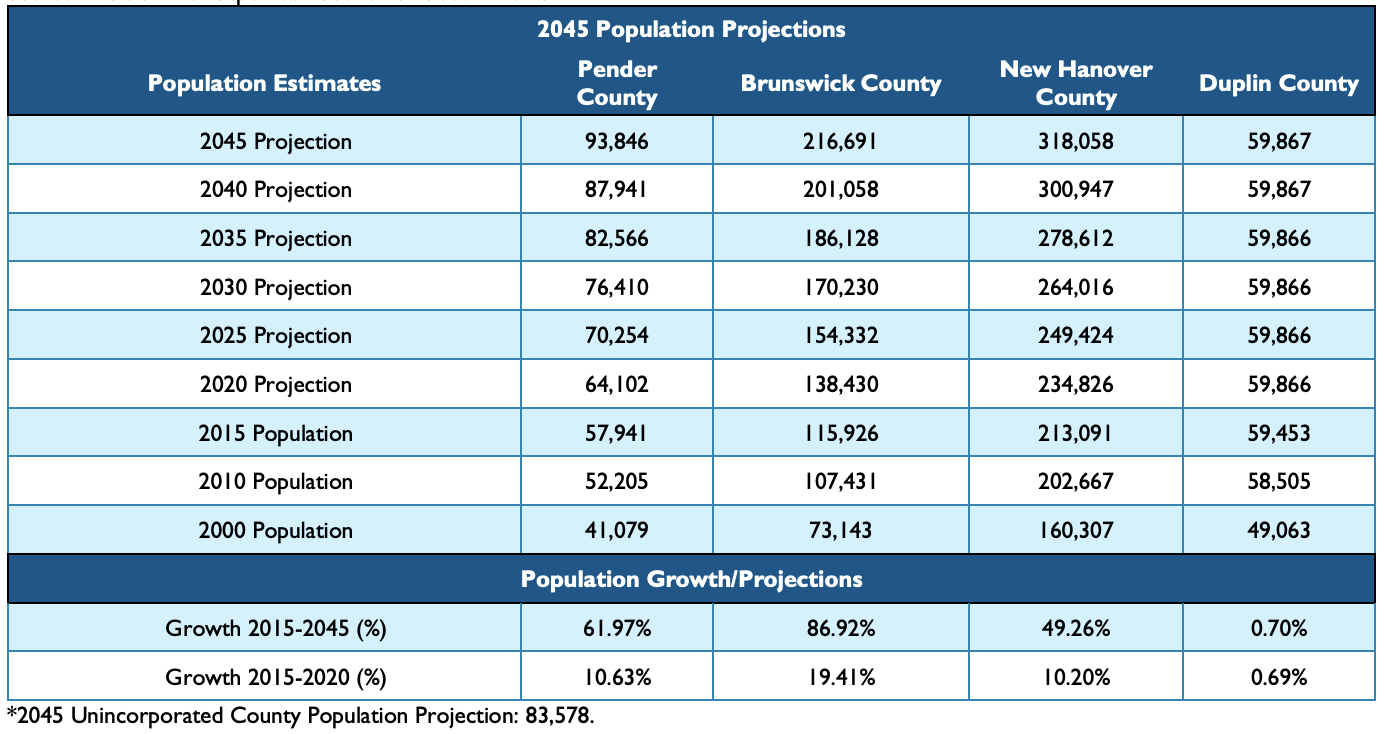
Growth is expected to continue at a rapid pace in Pender County. The county’s Comprehensive Land Use Plan, published last summer, projected a population growth rate of nearly 62% — an increase of more than 35,000 residents — by 2045. According to the report, the county’s population has more than tripled since 1970, with much of that growth occurring in the coastal areas.
“We’re not through with the growth; it’s coming,” Chairman George Brown said.
“Not by a long shot,” Commissioner Jackie Newton said. “But I think our challenge in the future is going to be better stewards for our citizens who are already here while being more participatory partners with the folks who want to develop.”
She said more long-term planning could “resolve some of the issues that folks are thinking would preclude more development.”
Because the county’s ordinance says developers must sign on to county water when it is available in a particular area, Commissioner David Williams said more options need to be available — like allowing developers to dig their own wells.
“They don’t want to be in the water business, but if it means going forward or not going forward, they have got to have options,” Williams said. “We have to be prepared. It’s not fair otherwise for us to say, ‘Sorry, we’re done, we’re closed.’ You can’t do that; that’s un-American.”
Breuer said one possibility his office has discussed with PCU is to allow “dry water lines” for developers, so that when water distribution becomes available, they can reach an agreement to connect to PCU’s water supply.
According to Woodruff, the county has studied a capital project to build a 16- to 20-inch water line to run alongside the current 12-inch line that connects Rocky Point to the Hampstead area, supplying water to the entire coastal region.
“The county’s always felt, based on our projections, that we had several more years before it was going to become a necessity,” Woodward said.
Mark Darrough can be reached at Mark@Localvoicemedia.com
