


“Wahoooooooooooo!” That’s what you say when you hook a 100 pound fish and it takes off at 60mph. In fact, I’m pretty sure that’s also what a fish going 60mph says, too.
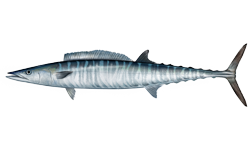
Our friend the wahoo (Acanthocybium solandri) is one of the fastest fish in the ocean, thanks to a streamlined body and retractable fins- traits that it shares with its relatives in the family Scrombridae. That illustrious family includes some of the most important – and tasty- food fishes: tunas, mackerels, and bonitos. The wahoo belongs to the tribe of Spanish mackerels.
Wahoo can grow to 6 feet long and about 100 pounds. And some grow quite a bit bigger. The all tackle world record for wahoo belongs to Sara Hayward for a 184 pound fish caught in 2005 in Cabo San Lucas. A 202 pound wahoo was caught in 2016 in Florida, but it doesn’t qualify for the world record because three anglers took turns landing it. Lesson learned: sharing isn’t always that great.
I’m just going to come out and say it: the wahoo is a damned good looking fish. It’s steel blue on the top, silvery on the sides, and a lighter blue on the bottom, with well over a score of bluish/purple vertical stripes. Sleek and aerodynamic- okay, hydrodynamic- it also has razor sharp teeth and a large, bony head.
Wahoo can be found in every subtropical/tropical ocean of the world. Off our coast, they are mainly found in the Gulf Stream. Out of Wilmington, the average run to common wahoo grounds is 60 miles. They’re most commonly found around the drop offs and ledges in 160-400 feet of water, because these areas usually have the highest concentration of smaller fish and squid, which comprises the majority of a wahoo’s diet. Occasionally, wahoo will come closer to shore, especially late in the summer and early in the fall. It is not uncommon for anglers in the ten to thirty mile range targeting king mackerel and dolphin to catch wahoo, even up to 100lbs.
Wahoo are relatively solitary- you’ll rarely see a large school of them. The most common method of fishing for wahoo is trolling with either lures, or ballyhoo rigged behind dark-colored skirts. Anglers trolling ballyhoo typically fish at a speed of about 6 mph, trying to stay close to the structure and baitfish along the edge of the break. Typical wahoo tackle consists of a 30-50lb class standup rod and reel with 30-60lb mainline. Most anglers use a 80lb class deep drop rod with 150lb spectra as a planer rod to have one outfit that can pull a ballyhoo 40 to 60 feet below the surface. A method of high-speed trolling uses lures that are very heavy and often with heavy trolling leads trolled at speeds up to 18mph, allowing anglers to cover a lot more water. This requires heavier tackle such as 80lb class rods and reels with 80-130lb line, and also burns far more fuel. Regardless of style, it is important to use wire or cable leader of at least 100lb test because of their razor sharp teeth. Sharp hooks in 7/0-10/0 sizes are also a must because of their strong, bony head.
Wahoo are a very popular gamefish among offshore anglers because they are such a fast fish. They will often make several long runs in different directions, and can put on a show on the leader near the boat. They will also often “sky” a bait, where they are swimming so fast in an upward direction to eat a trolled bait they will propel themselves several feet in the air. Their fast running, strong fighting, and unpredictable nature make them a very exciting fish to target. Seriously, there’s a reason they call it wahoo! (Actually- nobody knows why it’s called that. It was first used around 1900; interestingly enough, the first recorded use of “wahoo” as an expression of excitement comes from a few years later.) The bag limit is 2 per day, and there’s no minimum size. Any wahoo you catch can go straight to your table.
And boy, is everybody at that table lucky! Wahoo is prized for its delicate white flesh, similar to mackerel. Wahoo have very clean, translucent flesh that turns snow white when cooked. It cooks extremely fast, so it is important to take care in not overcooking it. Wahoo has a very mild taste of its own, with a consistency very similar to tuna. It is very popular as sushi and sashimi, or searing it to medium-rare similar to yellowfin tuna. Because of its unique characteristics, wahoo is best prepared grilled, pan-seared or broiled.
If you’re interested in learning more about wahoo or how to catch them- and even some hot tips on where they’re biting lately- stop by and see Ben & Arlen at Intracoastal Angler on Oleander Drive in Wilmington. October 20th to 22nd is Intracoastal Angler’s big tent sale, with most items 10 to 60% off.
Sponsored content brought to you in part by:

