


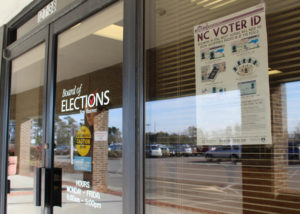
WILMINGTON — The U.S. Supreme Court Monday struck down an appeal by the state that aimed to reinstate North Carolina’s voting identification law. A lower court had previously ruled this legislature targeted African Americans “with almost surgical precision.”
The Supreme Court’s ruling blocks the state from requiring photo ID from voters, restores early voting days and same-day voter registration, as well as out-of-precinct provisional voting.
Derek Bowens, elections director for New Hanover County, said “From initial views, this appears to deny a certiorari order. Photo ID will no longer be required to vote in North Carolina.”
A certiorari order refers to the act of at least four Supreme Court Justices determining the circumstances described in the appeal are sufficient to be reviewed by the Supreme Court. By not issuing a writ of certiorari, the appeal by North Carolina is effectively invalid.
“The General Assembly could always draft new legislation,” Bowens said. “But there’s no higher court than the Supreme Court, this effectively ends Supreme Court case 16-833.
“Administratively this will make things easier for elections officials working to implement this effort,” Bowens said.
North Carolina v. North Carolina State Conference of the NAACP
In a statement released with the court order Monday morning, Chief Justice John Roberts drew attention to the uncertainty this case had left in the procedural aspect, namely the disagreement over who was authorized to file an appeal on behalf of the state.
The appeal was originally filed by Governor Pat McCrory while he was still in office. The process was muddied when newly elected Governor Roy Cooper and Attorney General Josh Stein attempted to withdraw the appeal after taking office in 2017.
Private lawyers who had worked with McCrory claimed they represented North Carolina’s Republican led General Assembly, and not the Governor, after the Democratic Gov. Cooper took office.
In 2013 the Supreme Court removed part of the Voting Rights Act, a 1965 law that first allowed African Americans to the polls. One month after the 2013 court decision, North Carolina enacted voter restriction laws.
The removal of this key piece of legislation allowed the state to change its voter laws without first seeking federal approval.
According to the United States Court of Appeals for the Fourth Circuit, “After years of preclearance and expansion of voting access, by 2013 African American registration and turnout rates had finally reached near-parity with white registration and turnout rates. African Americans were poised to act as a major electoral force.
“But, on the day after the Supreme Court issued Shelby County v. Holder, 133 S. Ct. 2612 (2013), eliminating preclearance obligations, a leader of the party that newly dominated the legislature (and the party that rarely enjoyed African American support) announced an intention to enact what he characterized as an ‘omnibus’ election law,” the official transcript states.
It goes on to note that, “Before enacting that law, the legislature requested data on the use, by race, of a number of voting practices. Upon receipt of the race data, the General Assembly enacted legislation that restricted voting and registration in five different ways, all of which disproportionately affected African Americans.”
Several other states made similar motions to enact these types of restrictions, these type of laws became a heated topic in the run up to last years Presidential Election.
For the full transcript of this case, see North Carolina v. North Carolina State Conference of the NAACP.
