



WILMINGTON –– On Thursday morning, Wilmington Police responded to a call and found a man dead in an alley near Greenfield Lake. The man was Steven Robert Barton; he had been killed, apparently, by a single gunshot.
There is seemingly little else to the story. Two suspects were arrested on Friday. Barton was a member of the homeless community with no obvious relationship to the men who were arrested for his murder; there was no apparent motive for the killing.
But who was Barton? And how did he end up homeless? What was his story?
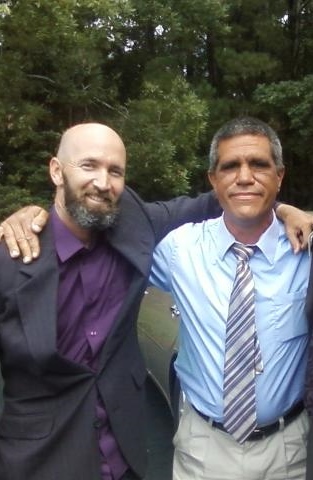
Jason Mitchell and Mike Dickey are both pastors who work with homeless people downtown. Both of them knew Barton well and both said they were saddened by the way his death appeared in the news.
“Transient. Homeless man. That was it. They just labeled him,” said Mitchell. “Did Steve sleep on the streets? Yes. But he was a friend. He was at my wedding. My family loved him.”
Mitchell is a pastor who directs projects aimed at fighting homelessness with Vigilant Hope (a Christian outreach group dedicated to helping those dealing with poverty and/or homelessness). He also works with the Tri-County Homeless Interagency Council (the continuum of care group approved by the Department of Housing and Urban Development for the homeless populations of Brunswick, New Hanover and Pender counties).
A changed man who still had demons
About 5 and half years ago, Mitchell began his urban ministry. Barton was one of the first people he met in the streets.
“When I first met him, he was angry – belligerent – he was an angry man. Did his addiction have something to do with that? Yes,” Mitchell said. “But then something changed. It was a pretty radical change. He was a different man, night and day. After that, he was pure joy to be around.”
According to his friend, Barton became a fixture at church, and – whether it was a religious conversion or simply having a support system – his anger fell away and he became an active member of the local community. But while his personality had blossomed, he was still living on the streets and he still had his demons.
“Steve spent a lot of time with friends and loved ones,” Mitchell said. “But he also spent a lot of time alone.”
The isolation, and the physical and mental hardships of sleeping on concrete, may have contributed to Barton’s struggle with alcohol, Mitchell said. Still, Barton made progress in his battle with addiction. In 2014, with Mitchell’s help, Barton successfully completed rehab at the Walter B. Jones facility in Greenville.
Dickey met Barton a little over a year ago when he opened the CityLife Church near Greenfield Lake. Barton was an early member of the congregation and the first member of the church’s outreach team. Dickey saw Barton’s struggle firsthand.
“There were times where he would cry, he would literally weep,” Dickey said. “He cried on my shoulder because of his addiction.”
Barton wasn’t born on the streets of Wilmington. He once had a job and a home. What happened to him?
“That’s a question we never really got answered,” Mitchell said. “We got bits and pieces. We know he was from Jersey, he went to Parsippany High School, I think (the school does have a record of a Steven Barton graduating in 1987, but no further info). He was an EMT. How did it all fall apart? I don’t know. I guarantee you it was a lack of a support system, though.”
The gaps in Barton’s story are troubling, but not uncommon. Mitchell said it’s a symptom of the lack of a support system that was the common theme for the vast majority of homeless people he works with.
Without friends and family to help tell their story, many homeless suffer from a kind of generic anonymity. It can be frustrating, and sad, but outreach workers like Mitchell deal with it by looking forward.
“It’s almost a question I avoid. What happened, well, that’s tragic, but ultimately less important to me than where we are now, what comes next,” said Mitchell.
What came next, Dickey and Mitchell agree, was that Barton became something of an unofficial leader in the homeless community.
An ‘unofficial leader’ in the streets
“He was a servant, he was there to help,” Dickey said. “What was cool about Steve was that he was kind of an unofficial leader in the streets. You could tell that the part of him that was an EMT, was still there. He was intelligent, very smart, but he focused it on helping people and helping to organize others.”
Dickey recalled Barton’s efforts to help in any way that he could: working as a handyman, helping to distribute supplies or lending support to those in need – even those he’d never met.
“We as a church were sending a care package to a kid in New York who had been in a terrible accident,” Dickey said. “Our church came together and gathered things, from magazines to gift cards to lotions and essentials for hospital stays. Steve, who had nothing, came to the church with a care package that he had been blessed with and gave it all to this kid so he could bless him and his family. That’s who Steve was.”
Barton had become an important member of Dickey’s church and was a fixture there. Dickey recalled Barton, losing himself in music and prayer:
“If there’s one image of Steve, it’s him in church,” Dickey said. “He loved to worship – he was a worshipper. He would cry, one hand in the air, a tear on his cheek, the other beating on the back of a metal chair, beating along with the drums.”
Barton continued to struggle with addiction. He relapsed and then, several months ago, repeated his successful rehab at Walter B. Jones. Mitchell credits Barton’s positive attitude.
“Even stripped of everything, stripped of his dignity, he was the most optimistic person I knew,” Mitchell said.
Remembering the man, considering the legacy
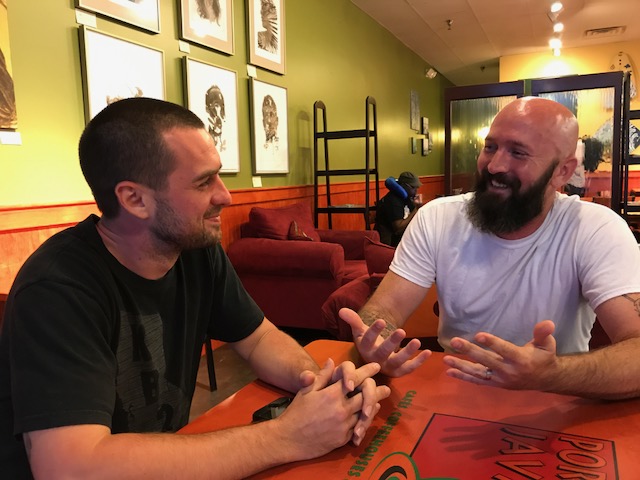
In the end, after all he had struggled against, Barton didn’t lose his life to addiction or to the elements. He was murdered, the victim of an apparently senseless killing. It is unquestionably a tragedy, but one Mitchell and Dickey hope will leave a positive legacy.
“It’s beyond sad,” Mitchell said. “But we’re sitting here remembering Steve, laughing, because he was pure joy. I remember him, arms out stretched, shouting to me, ready to make me laugh.”
Most off all, Dickey recalled Barton’s big personality.
“He was loud, he was boisterous,” Dickey said. “And it was exciting, to be around him. Because he brought joy, because it was Steve.”
Dickey said he hopes the memory of Barton will help open people’s eyes to the humanity of the homeless in Wilmington.
“People look at the homeless as the abusers of the system, like they’re trying to get something,” Dickey said. “People avert their eyes, they cross the street. If you could get to know Steve, if you could see the way he would pop into my church, to see what he could do for me, you’d understand.”
Services for Steven Robert Barton will be held at the Epworth United Methodist Church on Monday, May 1, at 9 a.m. All are welcome.
