


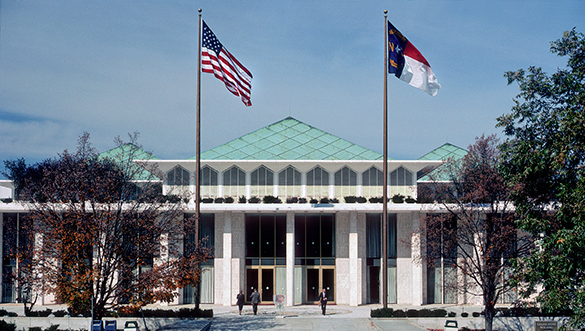
Lawmakers will return to Raleigh on Wednesday for a short and tight-packed session of the General Assembly, with game plans eyeing teacher pay, coal ash regulations and the expiring film tax credit.
That’s in addition to the primary reason for the even-yeared session: to address the state’s budget, a challenge in itself with its projected $445 million revenue shortfall, a number cited in a recent General Assembly staff analysis.
Leaders hope to adjourn well within two months, before Independence Day, and that being the case, lawmakers don’t expect much wiggle room.
“I don’t know that there’s going to be a whole lot of action in terms of filing new bills or trying to create new law,” said Rep. Susi Hamilton (D-New Hanover).
While the film credit’s extension will stand as a must-have discussion, “We’ve been told by our leadership that we’re going to primarily focus on the budget,” said Sen. Thom Goolsby (R-New Hanover), “getting everybody in and out, doing what we need to do with the budget, and then moving on.”
But, despite their chances, there is a slew of potential laws being drafted or already eligible for consideration. They address such areas as homeowner insurance rates, gun permit confidentiality, Venus flytrap poaching and drinking water quality.
A few are described below.
Homeowner insurance
Proposed is a reform in how homeowner insurance rates are set or changed in North Carolina.
A bipartisan bill whose chief sponsors include Reps. Hamilton and Frank Iler (R-Brunswick) seeks to address a concern from coastal property owners that they’re treated unfairly by the system and receive disproportionately high rate increases.
That’s party because the N.C. Rate Bureau (a body of insurance companies responsible for recommending rate changes) looks at risk models rather than historical data for what areas of the state should pay more. Since the coast is seen as most at risk to seasonal storms rolling in from the ocean, it’s routinely marked for the highest of increases.
If Hamilton and Iler’s House Bill 519 became law, it would require all Rate Bureau cases to include actual hurricane loss data for each year since 1987. The state’s insurance commissioner (who has the final say on rates) would have the authority to request a statistical analysis comparing the historical data with risk-model data–methodology that officials say would even out the process across North Carolina’s regions.
“This will allow for a more transparent process, provide for a more accurate model/forecast, and ensure each homeowner across the state is paying the cost of their actual risk,” said the N.C. Business Alliance for a Sound Economy, a Wilmington-based policy group.
Rep. Paul Tine (D-Dare) is also a primary sponsor of the bill, which charged through the House on a 116-0 vote last year and currently waits in the Senate’s insurance committee.
Story: Local legislators decry proposed insurance increase; state commissioner’s office responds
Iler on Monday said this is a bill the Senate needs to pass. Hamilton was doubtful it will get such attention.
“It’ll probably get overshadowed by other issues,” she said.
“I guarantee we’ll be talking about it,” said Sen. Bill Rabon (R-Brunswick). “Just where it sits right now and where it goes, I just don’t know.”
Gun permit confidentiality
A bill to make gun owner information private in North Carolina is also eligible for the law books. It passed through the House in March 2013 on a 97-20 vote, with every tri-county-area House member in support.
House Bill 17 would provide for the confidentiality of info regarding concealed handgun permits and pistol purchase permits. Sheriffs and dealers would keep accurate sales and permit documents, but they’d depart from the purview of the state’s public records law.
The N.C. Sheriffs’ Association supported the bill, which now sits in a Senate judiciary committee.
Separately, Rep. Ted Davis (R-New Hanover) is a primary sponsor of a bill that would allow any state judge and clerk of superior court who has a valid concealed handgun permit to be exempt from the general prohibitions on carrying a concealed weapon or carrying a weapon on certain premises, like a state office building or a private property where a notice hangs forbidding concealed weapons.
That item, House Bill 405, passed on a 110-8 vote in May 2013 and sits in the Senate’s rules and operations committee.
Venus flytrap thefts
Davis also said he’ll file a bill to make the theft of Venus flytraps and their seeds a felony–a step up from the crime’s current misdemeanor status. But the local bill would only affect New Hanover County, meaning if it passed that way, flytrap theft would still be a misdemeanor in habitat-heavy Brunswick County.
Davis said other counties in the area could join the bill if interested.
In order for Davis to file the local bill, he had to have unanimous support from the local delegation, which he said he’s secured. If Brunswick and Pender counties’ delegates support it all the same, they could add themselves.
The North Carolina State Constitution doesn’t seem to preclude laws that elevate a crime as such in one county and not others, said Jeff Welty, associate professor of public law and government at the UNC School of Government.
He didn’t immediately have examples to cite of local acts establishing geographically specific felonies, but “It’s really common to have local acts that have misdemeanors applicable only in certain counties,” he said. “We have those all the time.”
Water, coal ash, film
Another bill whose primary sponsors include Hamilton and Rep. Rick Catlin (R-New Hanover) would authorize a city or county to calculate its stormwater infrastructure capacity and allocate any excess capacity to urban redevelopment projects. The House passed it in April 2013 on a 118-0 vote and it’s awaiting attention in the Senate’s commerce committee.
Catlin on Tuesday said he planned to file two statewide bills addressing drinking water and sewer spills. “It’s always been on my agenda to protect our water,” Catlin said, adding that he’s one of four House members on the Environmental Review Commission working on legislation to deal with how coal ash is stored.
That’s a priority for the legislature following the Duke Energy spill of as much as 39,000 tons of coal ash into the Dan River at Eden earlier this year.
Story: Environmental groups urge action from the state on coal ash
The film tax credit, another priority item, will be at center stage. Due to expire at the end of this year, it gives big-spending movie and television productions a 25 percent refund on qualifying expenses. A recently released report from the N.C. Department of Revenue tallied a potential payout of $61.1 million from the state to these companies for tax year 2013.
Story: Report details film expenses, incentive payouts
The business employed 13,649 workers in that time, according to the report. That’s partly why it’s worth so much to North Carolina, say proponents of the incentive.
Opponents–who locally have included Catlin and Rep. Chris Millis (R-Pender)–want to let it expire, seeing it as unfairly favoring one kind of industry over others. At the same time, last year’s overhaul of the state’s tax system intended to let all such tax credits expire as scheduled.
“I will be working hard with my colleagues to see that they are extended, hopefully to 2020, to give the production companies certainty as they plan new productions in our state,” Iler wrote in a bulletin Monday.
Past story: Local legislative wishes: Some granted, some not
Teacher pay is another central focus following a bitter 2013 and a budget that didn’t keep pace with educators’ demands. Last week, Gov. Pat McCrory announced a plan for a 2 percent salary increase for all teachers and a “Career Pathways for Teachers Framework” to address how educators are paid in the long term.
McCrory also planned to reintroduce one-time salary adjustments for teachers earning advanced degrees in their core subject areas.
Story: Gov. McCrory proposes teacher raises, long-term pay changes
Not ranking among priorities, but closely watched by local governments, is House Bill 150, which could restrict ordinances pertaining to design and aesthetic controls.
Click here for a full list of bills eligible for consideration in the short session.
As for what makes it to the floor in the legislative building, time will tell.
“We will caucus and we will talk about it and if there are any burning issues, we’ll discuss them and decide, within time constraints and money constraints of course, what we’re going to do in the short session,” said Rabon.
Ben Brown is a news reporter at Port City Daily. Reach him at [email protected] or (910) 772-6335. On Twitter: @benbrownmedia
