


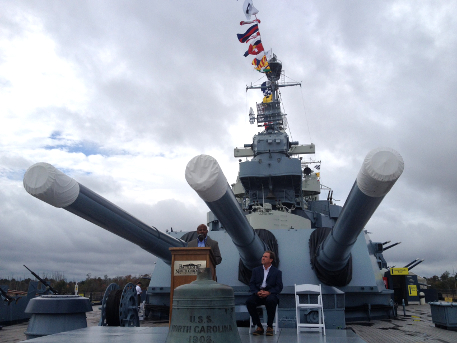
A $17 million fundraising campaign at the U.S.S. North Carolina got a jolt Thursday with the announcement of a large contribution from Duke Energy Progress.
The Charlotte-based power company’s charitable foundation selected the World War II battleship for a $1 million donation that will go toward the restoration of its thinning hull.
Some spots on the hull these days are no thicker than a dime, said Capt. Terry Bragg, the tourism ship’s executive director, and Duke Energy’s contribution will enable the repair project to move forward.

Bragg, during a press event Thursday morning on the historic vessel’s fantail, accepted a check from the nonprofit Duke Energy Foundation “on behalf of the 11 million visitors who have come to the ship since 1961, and the millions of visitors expected to come in the future….”
Lloyd Yates, executive vice president of regulated utilities at Duke Energy, told reporters the donation–which the ship won through a competitive application process–was in respect to veterans past and present and to the battleship’s local importance.
“The battleship is a unique memorial to 10,000 North Carolinians who gave the ultimate sacrifice during World War II,” said Yates, who termed the donation an “investment, because it is.”
The vessel–overseen by an 18-member, state-established commission–hasn’t been drydocked since the 1940s, and putting it up again would cost in the neighborhood of $35 million, Bragg said Thursday. But even if that kind of money was on hand, getting the ship to the yard in Norfolk, Va., would be an entirely different challenge, given the bridges and power lines and other obstacles that appeared after the ship found its home in the Cape Fear in 1961.
So, the $17 million plan includes improvement of the hull exactly where it is–just with less surrounding water. A coffer dam would go into place around the ship to allow the work, which will depend on successful fundraising from private and public sources.
(For its main operations, the ship is supposed to be self-supporting–relying on admissions fees, gift-shop sales, donations and investments, primarily–and is not a recipient of tax dollars.)
Related story: Battleship N.C. specialty license plates available; revenue to help operation
Duke Energy’s $1 million donation makes $5 million raised to date, while ship officials are hopeful for $10 million from the state. Bragg said a formal request has already gone to the state, and he said he saw a brief this week ranking the project as a top priority with the N.C. Department of Cultural Resources.
“We think we have momentum,” Bragg said.
If fundraising and planning processes go as desired, construction could begin in mid to late 2014. Once the coffer dam is in place, the work could take about six months.
“The sooner the better, because we’re down to a point where there are areas of the hull that are only one-tenth of an inch thick,” he said.
It would also satisfy the Department of the Navy, which has been eyeing the battleship and even hinted at the ship’s final days.
In July 2009, the ship’s management received the following word from Naval Sea Command: “If the U.S.S. North Carolina Battleship Commission does not have a viable plan for the future dry-docking of this vessel, you [the battleship] should either develop a dry-docking plan or prepare and provide the Navy with a plan for the eventual disposal of the ex-North Carolina.”
Bragg, who quickly emphasized the ship isn’t going anywhere, said the Navy sees the coffer dam plan as adequate–thankfully, he added, because the ship is worth too much to Wilmington and to World War II remembrance.
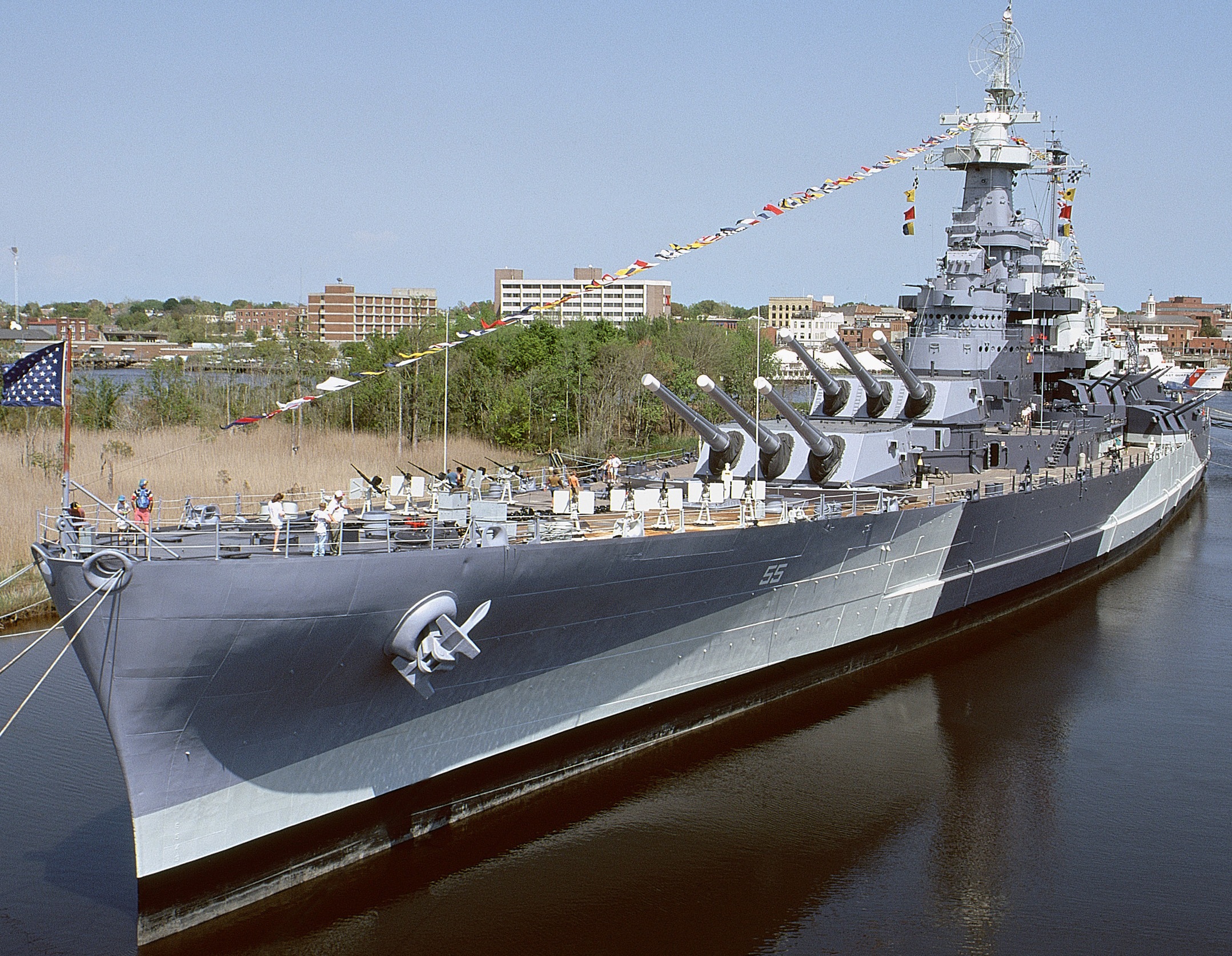
Once a fast-moving WWII vessel that participated in every major Pacific naval onset, the U.S.S. North Carolina was commissioned in April 1941 and earned 15 battle stars before its June 1947 decommissioning.
Recent story: U.S. House passes bill to recognize Wilmington as ‘American World War II City’
For the 14 years to follow, it sat in the Inactive Reserve Fleet in Bayonne, N.J.
When North Carolinians learned in 1958 of the plan to scrap the battleship–known in its action days as “Showboat”–they launched a campaign to save it. The movement ultimately, in 1961, parked the ship at its current spot on the Cape Fear River across from downtown Wilmington.
In May, the UNC Chapel Hill Center for Competitive Economies released an analysis claiming the battleship–through tourism, jobs, property value boosts and other layers–grew New Hanover County’s economy by $23.4 million in 2010 and by as much as $245 million over the previous decade.
In October 2012, the boat announced its best year of visitorship in a decade, with more than 216,000 visitors between Oct. 1, 2011 and Sept. 30, 2012.
It was also “one of the best financial operating years since coming to Wilmington,” it added.
Story: WWII’s Battleship North Carolina thinking green
Yates on Thursday said the ship’s environmental, educational, community and economic qualities were a winning combination in Duke Energy’s competitive grant process, which delivers $16 million to causes each year in North Carolina.
“We want the battleship to be here,” Yates said. “We think it’s important. We think that it’s important to this area. It’s important to the state of North Carolina.”
Ben Brown is a news reporter at Port City Daily. Reach him at [email protected] or (910) 772-6335. On Twitter: @benbrownmedia
