


Responding to reported contamination of groundwater near Duke Energy Progress’ Sutton Steam Plant, the utility and the Cape Fear Public Utility Authority have entered into an agreement to share the cost of monitoring wells in the area and extending water lines to the nearby Flemington community.
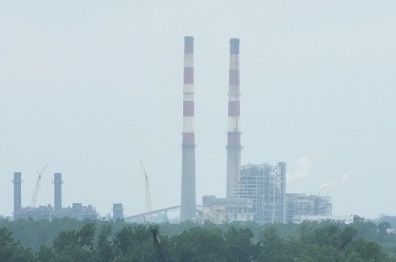
That neighborhood, along U.S. 421 near its interchange with Interstate 140, is currently served by wells that are in close proximity to the coal-fired plant’s ash disposal ponds, where elevated levels of pollutant constituents have been identified, according to the agreement approved at Wednesday’s meeting of the CFPUA board.
While staff emphasized those wells are not contaminated, Jim Flechtner, the authority’s interim director, acknowledged their proximity poses a risk.
“Our groundwater wells are not contaminated at this point. We don’t have monitoring sites between the ponds and our wells, so we don’t know exactly where those constituents are and how fast they’re moving,” Flechtner said. “This allows us to move forward before those contaminants get there.”
The agreement calls for Duke and the authority to share in the cost of constructing monitoring wells in the area and extending and upgrading water lines to connect Flemington to the water system, served in that area by the CFPUA’s Sweeney Water Treatment Plant.
According to the agreement, Duke and the authority would split the cost of constructing the monitoring wells, as well as the overall cost of the project, which is estimated to cost between $1.5 million and $2.25 million. Duke would cover the first $1.5 million, projected for the water line’s design and construction, bringing the estimated breakdown in cost to $1.887 million for Duke and $472,000 for the authority.
Board members expressed general support for the agreement, which they noted would allow the CFPUA to provide more water to an area—the industry-heavy U.S. 421 corridor—that is slated for considerable growth while also protecting the health of residents in Flemington. While the CFPUA has identified a connection to Flemington as a needed project, it is not included in the authority’s 10-year capital improvement plan.
“I know we need water on that 421 corridor. This is a way to get it there,” Charlie Rivenbark said. “We’ve probably got the best deal we’re going to see. I’m ready to move on.”
Added attorney Linda Miles, the board’s legal counsel: “We get to move faster and we get to accomplish a lot of things that we might not have been able to accomplish without the agreement.”
Woody White questioned whether the authority and its customers should have to contribute toward a project that is prompted by activity at the power plant, adding that he shares concerns expressed by speakers who addressed the board Wednesday, including Kemp Burdette of Cape Fear River Watch and Frank Holleman, an attorney with the Southern Environmental Law Center.
“I’m just unconvinced why we have to pay,” White said, “because we have no liability. Nothing’s contaminated yet, so it may never be contaminated. We aren’t talking about this but for ash being dumped on that site.”
White and others lauded, however, what they called Duke’s “proactive approach” to the issue, noting it could otherwise involve a lengthy legal battle.
The board approved the agreement conditionally, directing Flechtner to negotiate with Duke on a provision that topped the concerns expressed by Burdette and Holleman: that the area—which Holleman said comprises 11,000 acres, or 17 square miles—would be restricted from the CFPUA in terms of drawing additional groundwater via additional wells. Language in the contract said that provision would remain in effect “forever”—a word taken issue with by White.
“I don’t like the word ‘forever’ in any contract,” White said. “It is a no-no. I don’t know what’s going to happen 30 years from now.”
Burdette and Holleman maintained the provision would eliminate a resource available to the public, though Flechtner, the interim director, said the CFPUA has no plans to dig more wells in that area, noting the availability of water at Sweeney and other treatment plants.
Nonetheless, Holleman argued: “This might be the largest loss of a public resource due to illegal contamination in the history of North Carolina.
“It is stunning that Duke is telling you all [that] this needs to put off-limits 17 square miles of this community’s groundwater resources,” he said.
Added Burdette: “Duke is at fault here. I don’t understand why the ratepayers should pay anything to help clean this up.”
Responding to that, Flechtner and White said the agreement would allow the authority to add larger pipes to an area slated for growth and in need of water—on top of addressing the primary concern of protecting the health of residents in the community.
“This will make our investment in Sweeney worth it, and most importantly protect the health of people out there,” Flechtner said.
Outside the meeting, Holleman lauded the CFPUA for its handling of the issue, maintaining, however, his criticism of Duke.
“What is a shame is that Duke, the county’s largest and richest utility, is polluting and trying to muscle the CFPUA and its customers in this community to pay $400,000 to deal with this,” he said. “It should own up to its responsibility, pay the full cost. Instead, they want the average person to help pay to clean up their pollution.”
Erin Culbert, a spokeswoman for Duke Energy, responded to Holleman’s comment, which she said inaccurately makes it appear that CFPUA’s customers will be paying for part of the project. In an email received later in the day, Culbert said:
To be clear, cost-sharing for some portions of the project was the approach both parties thought was fair. CFPUA’s portion includes paying to up-size the 8-inch line needed to serve the Flemington community to a 12-inch line that will foster economic development in that area, as well as splitting the costs with Duke to install the additional monitoring wells and any contingency needed above the $1.5 million. Their dollars are coming from existing funds and will not represent any additional burden for their rate-payers.”
In a press release, CFPUA spokesman Mike McGill added: “All of the costs will be contributed by Duke Energy or allocated from existing CFPUA funds in its water emergency repair and water developer agreement projects.”
Note: This story was updated from a previous version that published at 2:09 p.m. Wednesday. The comments from Culbert and McGill were added to the original report, which otherwise remains unchanged.
Jonathan Spiers is a reporter for Port City Daily. He can be reached at (910) 772-6313 or [email protected]. On Twitter: @jrspiers
