


Buses will continue to roll in northern and southern New Hanover County, at least through the rest of the current fiscal year.
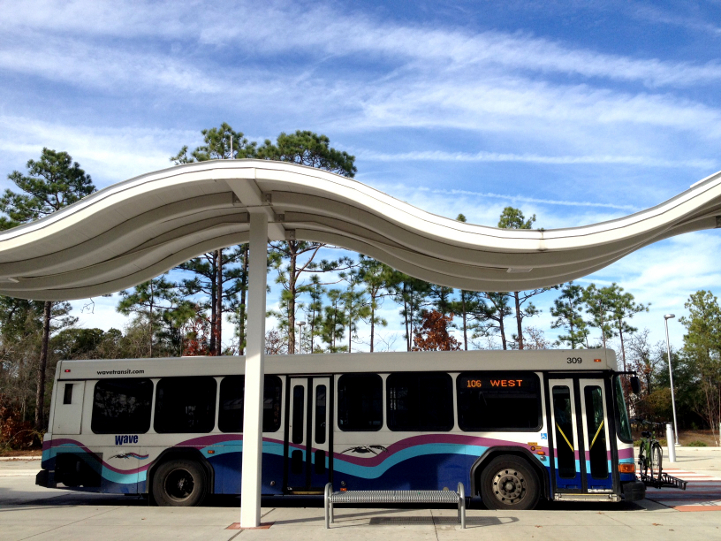
As they indicated they would in a meeting last week, New Hanover County commissioners agreed Monday to forgive repayment of a loan that Wave Transit officials have said would allow them to continue its current level of service—including two routes that were slated to be cut, due in part to an unexpected decrease in funding from the county.
Those routes serve the county’s northern area, including the airport, the Veterans Affairs clinic and Cape Fear Community College’s North Campus, and points as far south as Monkey Junction and Pleasure Island. With the decrease in the county’s annual contribution, from $250,000 to $140,000, Wave officials said those routes would need to be cut, prompting outcries from riders who said they rely on the routes to get to classes and jobs.
Related story: Bus riders plead for routes to remain as elimination deadline nears
With the loan amount approved by commissioners this spring, Wave has about $133,000 to work with to offset the decrease and secure additional funding from state and federal sources.
Said Albert Eby, Wave’s executive director: “It gives enough local money to leverage federal and state money that’s available to continue the routes for the rest of the fiscal year.”
At last week’s meeting with Wave’s governing board and Wilmington City Council, which also provides local funding for Wave—nearly $1.3 million this fiscal year, an increase from last year of about $36,000—county chairman Woody White stated his intention to support the loan forgiveness deal in exchange for further discussion on long-term funding expectations for Wave, which he said has expanded service despite its year-to-year funding challenges.
Related story: County amenable to loan forgiveness deal to continue Wave bus routes
Commissioner Jonathan Barfield, who represents the county on Wave’s board, remained critical of Wave’s financial approach, reiterating comments he said he has told that board for years. At Monday’s regular meeting, however, Barfield made the motion for the loan forgiveness deal, allowing for a unanimous vote in support of the short-term funding solution.
“My convictions and my thought process is that the county should not forgive that loan,” Barfield said in making the motion. “But at the same time, I understand the need for us as the ones who look out for the greater good of those who need services that those bus routes provide.
“In looking at the greater good—and I’ve wrestled this issue over and over again,” he said, “…the best route taken is what’s good for everybody. At the end of the day, my position is that we should forgive the loan and allow those routes to continue.”
White said he agreed with Barfield’s comments, though he reiterated his own criticisms of Wave, which he said has wasted millions of dollars since its inception a decade ago, through oversized buses and expansions in service for what he described as minimal ridership.
“I challenge anyone to send me a picture or show me where there are people on the buses taking up every seat,” he said. “We bought giant buses for routes that were needed and necessary that two or three or four people ride on in any given time.
“What I don’t understand is, over time, why haven’t we downsized the cost of the fleet?” White said. “Why haven’t we bought vans or small buses? Why did we go with the same size buses, right from the outset, for regular ridership that they use in Boston or New York?
“We don’t need that,” he said. “Maybe we do on some routes; we don’t on all the routes. So when I say waste over the course of a decade, millions of dollars have been wasted, in my opinion.”
Related story: Waiver could be coming to Wave; county to decide loan forgiveness deal
White said the county does need to be in the “public transit business,” noting, however, that it only is required to provide paratransit—or destination-specific—service, according to the interlocal agreement that formed Wave in 2003.
“We have to have a cost and revenue stream in place that doesn’t leave us as a county, as a city, every budget cycle deciding what their contribution’s going to be. We only have to do paratransit,” he said. “And because of the work of our staff, we have seen that we are paying our full share…
“Is it our job as county taxpayers to pay for students at Cape Fear to have rides to the North Campus? Some would say yes; some would say no. We’ve never had that discussion. We’ve just been told we’ve got to do that,” White said. “And you’ve got to do it on a giant bus with four people riding on the bus.
“People might think these are controversial statements. They’re just my opinions,” White said. “I’m a citizen here; I make the same observations that many other people do. And we are generations away from changing patterns or people [riding] on a bus to their place of business.
“We are going to always have public transit here. As we have more people move here over the course of time, we are going to continue to grow that system. But the growth has outpaced the funding that we have. We can’t be all things to all people,” he said. “We have to make tough choices, and that’s what this board is confronting.”
White said the board looks forward to amending the interlocal agreement as part of the long-term funding discussion, which the three boards intend to have in another joint meeting to be held by mid-January.
Eby, Wave’s director, said Tuesday he looks forward to that discussion as well, describing Monday’s loan forgiveness as a step in that direction.
“It’s a good opportunity for all the parties involved to get together and decide how we’re going to move forward,” Eby said.
“We look forward to the opportunity to work with both the city and county and all our funding partners—UNCW, Brunswick County, Leland—to talk to them about some of the challenges that we face when it comes to providing the service,” he said. “There’s a lot of requirements from the federal government—everything from the Americans with Disabilities Act to emissions and all kinds of issues that we have to deal with when we not only purchase vehicles but when we try to figure out the capacities and we look at the maintenance of the vehicles and how they’re built.
“It’ll be an interesting opportunity for us to kind of get everybody, hopefully, to understand the challenges we face,” Eby said.
Jonathan Spiers is a reporter for Port City Daily. He can be reached at (910) 772-6313 or [email protected]. On Twitter: @jrspiers
