


Not quite ready to put a lid on talking trash, New Hanover County commissioners are taking more time before deciding how to go forward with a comprehensive plan of the county’s solid waste disposal needs.
The board voted Monday to delay its decision on whether to proceed with the plan’s second phase, tabling the issue until its next regular meeting Oct. 7. Commissioners plan to decide at that time whether to fund further development of the comprehensive plan, and what disposal options to include in that effort.
Commissioners had asked at their meeting Sept. 2 for more information on options recommended, including projected costs of different disposal methods. Numbers provided Monday showed the 20-year cost of refurbishing and running the county’s Wastec incinerator, which has since been shuttered, at $345 million, whereas privatizing the landfill would cost $141 million, a turn-key transfer station would cost $183 million, and transfer and disposal outside of the county would cost $165 million.
Related story: Commissioners’ discussion on solid waste plan turns up some trash talk
Jonathan Barfield reiterated his argument for Wastec, contending that the cost for refurbishing the facility had gotten so high because previous boards failed to maintain it sufficiently. Barfield also noted a timeline presented of solid waste efforts since 2008, when he was elected to his first term on the board.
Joe Suleyman, the county’s environmental management director, had told the board the county has “been down this road before,” describing this plan as the fourth iteration for “trying to address some of the very same issues we’re trying to address today.”
“I’m looking forward to seeing what you bring back to us in phase two,” Barfield said in response, “but for me, this county has spent an awful lot of money on consultants and reports, and we’re coming back to the same answers.
“There’s nothing new in what I’ve seen since I got on this board back in 2008 until now. There’s really not much new technology when it comes to how you handle your solid waste,” he said. “I would assume that by the time we pay [consulting firm CDM Smith], we’ll have probably spent upwards of $600,000 or better, in total, since I’ve been on this board in trying to find a solution for solid waste that apparently we haven’t found yet.
“I would love for us to stop wasting taxpayers’ dollars and put resources where they should be and handle the business for those that live here in New Hanover County long-term, not short-term,” he said.
Commissioners Beth Dawson and Tom Wolfe suggested the board go ahead and dismantle the rest of the Wastec facility, with Dawson asking staff the process for requesting proposals from prospective companies. Wolfe has said the county continues to pay upwards of $500,000 a year on insurance for the facility, the smokestack for which was taken down in May.
Related story: Wastec comes down, makes room for household hazardous waste facility
Wolfe said he wanted more time to review the report, which CDM Smith first presented to the board at its previous meeting. Dawson said the board could take action that day, contending that it didn’t need to go forward with phase two of the planning effort because the initial report listed plenty of options.
Dawson said the county could try a combination of a transfer station, using its landfill and other efforts such as recycling to help prolong the life of the landfill.
Woody White, the board chairman, said he supported going forward with phase two of the plan, contending that five people sitting on a board are not the most qualified to make a decision without additional guidance from professionals.
“While I agree that perhaps we do need another two weeks or so for some commissioners to get up to speed or to fully grasp and understand this—this is complicated stuff with a lot of decimal points with high dollar amounts; I get that, and I agree with that—I do not feel comfortable adopting long-term policies without continued guidance.
“I see extreme value in the final phase of the professionals guiding us. We’ve come a long way. We have a much clearer picture of where we want to go, I think, right now than we did just a year or so ago when the debate was solely about Covanta,” he said, referring to the company the county was negotiating a contract with for refurbishing Wastec.
White also took issue with Barfield’s comments on saving taxpayers’ dollars, noting that Barfield voted for that contract, which White said “would’ve put a $330-million price tag on burning trash for the next 20 years.”
“I see tremendous benefit in phase two,” White continued. “I am not an engineer; I’m not a solid waste expert. I’m a private citizen like everyone else up here that’s trying to make good decisions. And I need information to do that.”
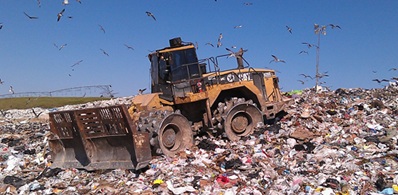
At the board’s previous meeting this month, commissioners were presented with results of the plan’s first phase, which compiled options available now as well as potential challenges that would be weighed in the second phase. Those options center on extending the life of the landfill, either by expanding the landfill’s capacity or by diverting waste put into the facility, through measures such as recycling programs or paying to dispose of waste outside the county.
CDM Smith has said a countywide recycling program is advisable based on the county’s small size and dense development. Other options the county could explore include building a stabilized wall around the landfill that could increase capacity without increasing its footprint, yard waste and composting facilities, and increasing efforts to divert disposal of construction and demolition debris at the landfill.
Commissioners called for a comprehensive plan of long-term solid waste disposal strategies earlier this year, when they allowed for expanding the usable space of the landfill located off U.S. 421.
Related story: Landfill decided, but trash disposal debate remains
Jonathan Spiers is a reporter for Port City Daily. He can be reached at (910) 772-6313 or [email protected]. On Twitter: @jrspiers
