


After nine months of work and big-picture discussions, the Cape Fear Public Utility Authority has adopted a formal growth policy that Chairman Jim Quinn has called the last “big decision” the authority needed to make in its five-year history.
The document, which details how the authority would pay for expansions to its water and sewer systems—through system development charges, funding agreements with developers or city or county government, and other approaches for different situations—makes clear and more consistent the authority’s expectations and policies for growth, given different types of development scenarios.
At the authority’s board meeting this month, Quinn acknowledged the work of board members and staff in drawing up the policy since the process started in January, noting as well the different approaches the City of Wilmington and New Hanover County took before merging their utility departments to form the CFPUA in 2008.

“As a former politician, I recognize that between the city and the county there was not a unified policy, much less a stated policy, within the two governments,” Quinn said. “And it caused a lot of friction between the two governments in some cases.”
A former city councilman, Quinn noted the city’s approach was incremental income from taxes that would result from annexing the area where service was being expanded. The county’s approach, Quinn said, was to expand its system so long as developers paid for it and capacity was available.
“And we went willy-nilly for many years,” Quinn said, “through a very intense growth period, with those fairly not-well-defined policies.”
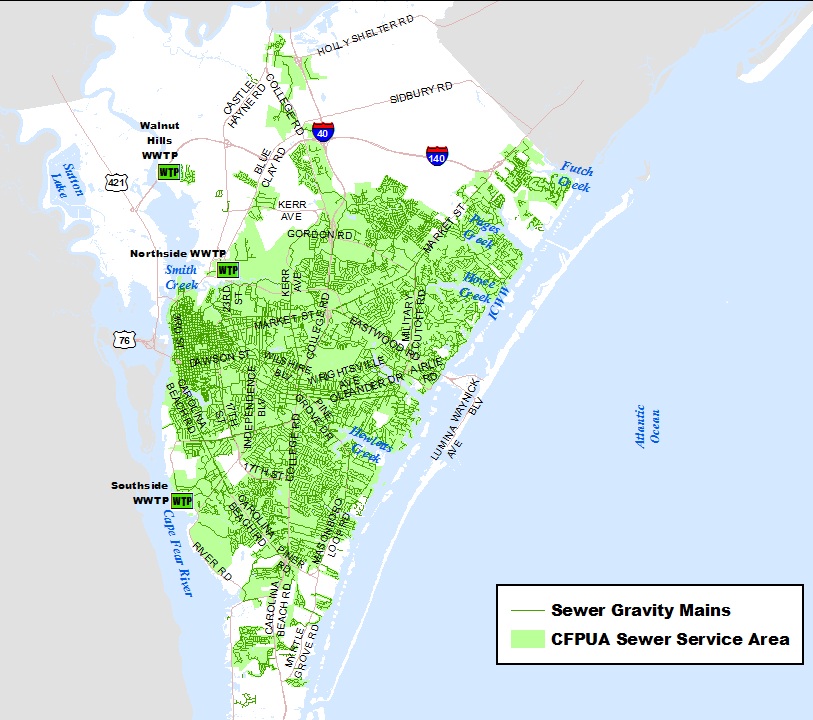
With annexation no longer an option for the city, and development in the county slowed in recent years, Quinn said a policy was needed to spell out whether the authority would rely on development-driven expansion, fund expansions on its own or through governmental partnerships—particularly for health-related projects like septic-to-sewer improvements—or take some other approach, depending on the type of growth occurring.
Related story: CFPUA drafts policy for growth; septic-to-sewer projects addressed
“When the authority was formed and the politics, for large measure, were taken out of it, and the economy began to change and the dynamics that were there weren’t there anymore—the city, for example, can’t annex anymore; the state legislature’s taken that away. The builders aren’t building as much as they were,” Quinn said. “So what do we do? How do we decide to go about expanding our system?
“In simplest terms, what our guiding principle was: don’t raise rates to expand,” Quinn said. “And all of you, in the process of looking at this, embraced that mantra. And this is a result of really kicking it around and pushing and pulling it and massaging it, and we’ve come up with a policy that we all have pretty much signed off on.”
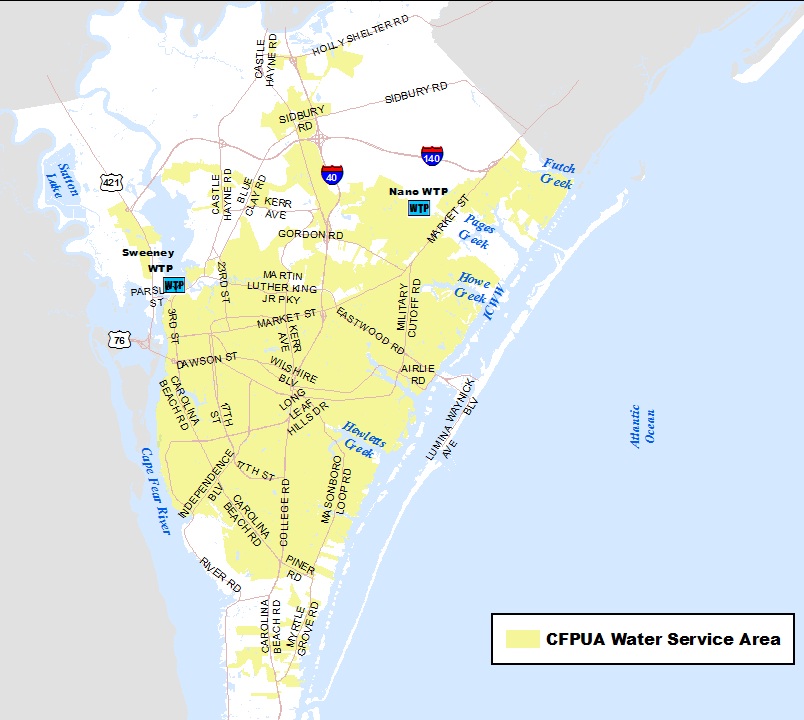
Staff and board members mulled the issue at a retreat held in February, and discussions continued at a workshop in April, when board members tackled how health-related projects—at that time, septic-to-sewer improvements for Marquis Hills and Heritage Park—would be funded.
Board members made clear—and the policy reflects—that they wanted expansions to be funded by developers, and if a government authority called for expansion to address health concerns, that government would essentially serve in the role of a developer, in terms of bearing the brunt of paying for the expansion.
Related story: CFPUA: Paying for county health projects ‘not our problem’
With Marquis Hills and Heritage Park, after debating the issue for several months, New Hanover County commissioners ultimately agreed to share in the cost of those projects with the authority, which in turn agreed to contribute its standard service development charge and cover costs of design.
Such arrangements are what the policy is intended to help guide, and Quinn thanked all involved for helping to create it.
“It’s a good start,” he said. “It’s a living document, if you will. It can be changed. But it’s a start.
“We’ve got a stated policy that, if anyone’s interested, they can read and know what we’re thinking and how we’re going to approach this,” Quinn told the board. “So I applaud and congratulate all of you and your input and work on putting it together, and I’m really pleased to see that we’ve got this. It’s a good beginning.”
The policy can be viewed in full here.
Previous stories:
- CFPUA considering policy for growth, future expansion
- Ahead of future growth, CFPUA eyes formal expansion policy
- CFPUA joins county in committing funds for septic-to-sewer projects
Jonathan Spiers is a reporter for Port City Daily. He can be reached at (910) 772-6313 or [email protected]. On Twitter: @jrspiers
