


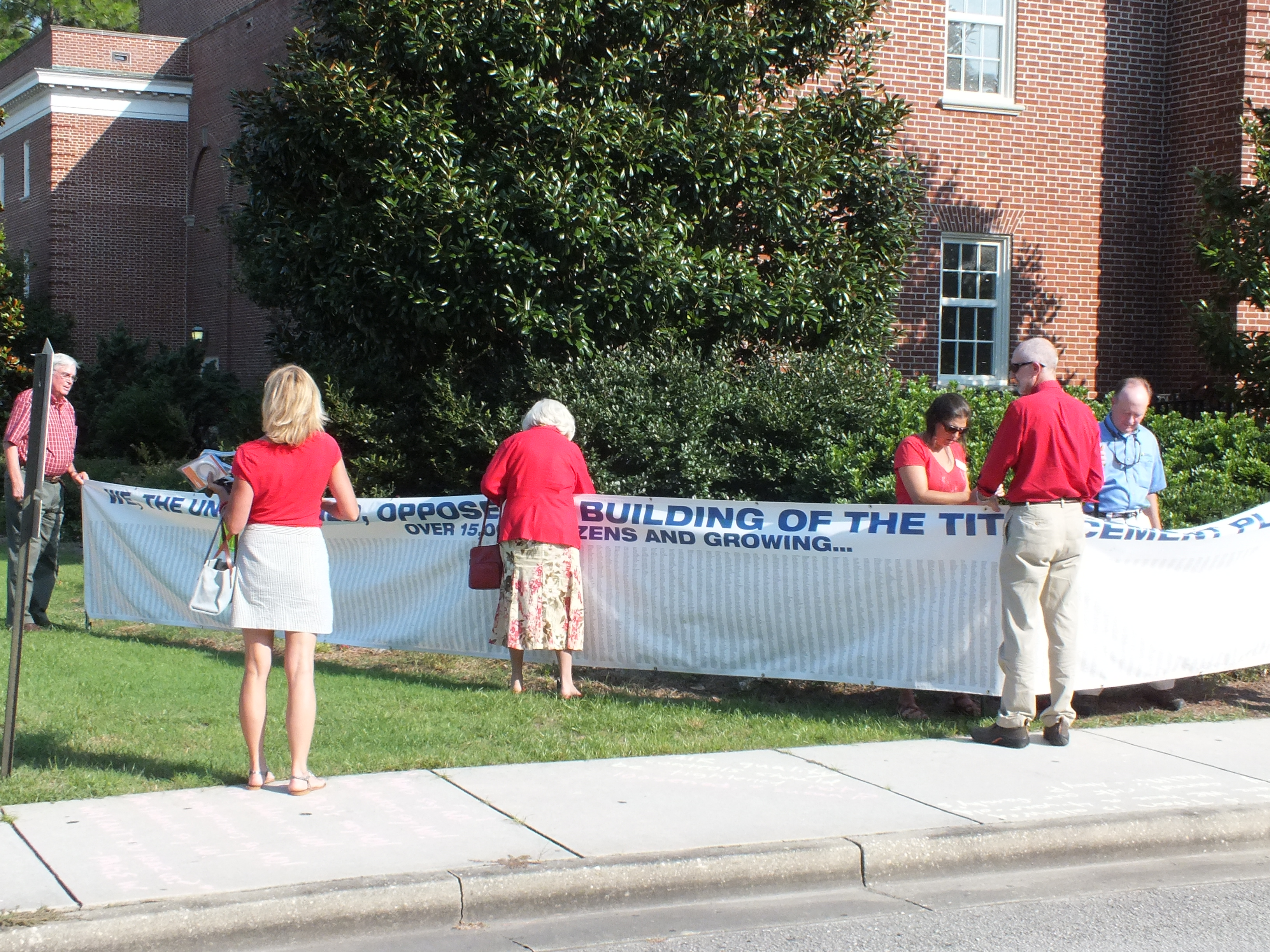
Several hundred people packed UNCW’s Kenan Auditorium on Monday night for the N.C. Division of Air Quality (DAQ) public hearing on a revised air permit submitted by Carolinas Cement Co. for a proposed cement plant in Castle Hayne.
About 70 people spoke on the permit request, which increases the plant’s annual emissions of fine particles by 22 tons per year and coarse particles by 10 tons per year.
Titan America, parent company for Carolinas Cement Co., had 18 months from receiving the initial permit, which was awarded in February 2012, to move forward with the project, but the revised standards—as well as a lawsuit filed by the Southern Environmental Law Center to contest the permit—prevented the company from proceeding within that time frame, Carolinas Cement Co. Manager Bob Odom said.
Related story: Proposed Titan cement plant hangs in the balance of Monday’s hearing
Those in favor of granting the application focused on the need to bring long-term jobs to New Hanover County. Those opposed spoke to the pollution and associated health risks if the plant were approved.
Dr. Jessica Cannon, a physician opposed to the cement plant, spoke to Port City Daily before the hearing.
“I’m involved as a concerned citizen and someone who knows the health effects of pollution,” Cannon said. “As a mom and as a parent, I’m opposed to this project for health reasons. We know that pollution is associated with a lot of medical problems. The list is long and there are some very scary things on that list, including autism and birth defects and cancer and heart and lung disease.”
Cannon was at the hearing with several environmental groups–including Stop Titan and the Sierra Club–to rally against allowing Titan to build its plant.
“There are many years of research out of the University of Southern California on pollution and its effects on children. What they have found is that kids who are exposed to high levels of pollution have lung disfunction at the same level of chronic smokers.
“We know that the cement industry was able to affect EPA (Environmental Protection Agency) regulations in the past year to effectively increase the levels that we know should be enacted for safety. I don’t think there’s any dispute that, even if the industry follows the letter of the law, the pollution in our area will go way up.
“And the question is, are we going to allow this to go forward? I think the only safe answer is to not build,” Cannon said.
Ed Scott, who lives in Rocky Point in Pender County, said the proposed increase in particulate matter emissions could be traced back to “political pressure financed by Titan” on the EPA, adding the proposed 492-foot smoke stack would be “clearly visible to all tourists using I-40.”
“Like it or not, it will be in your backyard,” Scott said.
Martin Beach served as interim town manager of Burgaw when Titan first started the process of building a plant in New Hanover County. He said he spoke with local officials in towns where Titan operates cement plants, including Roanoke, Va.
“Their reputation was they were good corporate citizens. I support the environmental process. I consider myself an environmentalist. But I also believe if they can meet the regulations by the state and federal government, we’re talking jobs,” Beach said.
Bob Warwick, a New Hanover County native, said he hunted and fished on the northeast Cape Fear River for most of his life, and supports Titan and its amended air quality permit.
“And they have committed to meet all of the federal and state laws. The reason they need an extension is because the state of North Carolina was sued for issuing the air permit earlier. It’s not because of Titan’s or Carolinas Cement Co.’s problems. The state of North Carolina was sued.
“If a company comes to southeastern North Carolina and they meet all the federal and state environmental laws, then we need to support them. We need jobs,” Warwick said.
Wilmington resident Gabrielle Steele spoke on behalf of the American Lung Association and the estimated 3,000 children and 14,000 adults in New Hanover County who suffer from asthma. Steele said the emissions of particulate matter from the Titan plant would “only further exacerbate our problems.”
Cassie Gavin, director of government relations for the Sierra Club, said Titan was planning to go against the national trend of retiring coal-fire plants, saying they were the “second-largest source of particulate matter air pollution.”
Before the start of the 6 p.m. hearing, local elected officials were invited to stand, but no one did, which was disappointing to Neil Taft, who said political and civic leaders should have attended the hearing.
Mike Giles, a representative of the N.C. Coastal Federation in Wilmington, asked DAQ officials to consider a previously conducted health-risk assessment survey.
“In 2011, groups got together and went to leading authorities. We went to the state for a health-risk assessment,” Giles said. The state wouldn’t fund the study, Giles said, so private entities and nonprofits raised $60,000 for the study.
“What we request is for DAQ to accept this report. It was submitted to the Division of Air Quality a day late. It is now in state hands. We ask that you take this report and expand it for a full year, and, in fact, for the life of the process and fund this request. Fund a full health-risk analysis of Titan’s health risk from air pollution,” Giles said.
To view the draft permit request, visit the N.C. Department of Environmental and Natural Resources Wilmington office, 127 Cardinal Drive Extension, or visit www.ncair.org.
Tom Mather, DAQ spokesman, said an decision could be announced as early as 30 days from the hearing.
Port City Daily reporter Jonathan Spiers contributed to this report.
Caroline Curran is the managing editor of Port City Daily. Reach her at (910) 772-6336 or [email protected]. On Twitter at @cgcurran.
