


Dr. Michael Goins remembers when smoking was allowed in—of all places—hospitals.
He also remembers when second-hand smoke was not yet considered a public health risk.
He was one of those smoking back then, after all. But times have changed, as have social acceptance of smoking in public and attitudes about tobacco use in general.
As laws have been passed to prohibit the use of tobacco indoors and in public outdoor spaces, electronic cigarettes—or e-cigarettes—have emerged as an alternative to tobacco-based products, producing a liquid-based vapor that provides the sensation of smoking—as well as the “fix” of nicotine—without the smell and exposure to tobacco that results from traditional cigarettes.
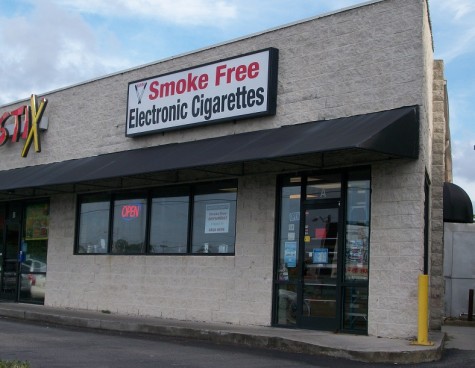
As such, e-cigarettes have been viewed as a healthier alternative to smoking, even a cessation tool to help people quit. Stores selling the devices specifically have popped up in high number, and e-cigs have become a part of the social landscape as more advertisements and use in public—even indoors—have become commonplace.
That worries Goins, who serves as vice chairman of the New Hanover County Board of Health. An optometrist who has served on the board, off and on, for two decades, Goins says little is known about the product, just as less was known in the past about the health effects—direct and indirect—of tobacco products.
Little is also being done, Goins said, to prohibit the sale of e-cigarettes to minors. A bill entered by state Sen. Thom Goolsby, of New Hanover, that takes effect in August will ban the sale of e-cigarettes to persons under 18 and require sellers to post signage requiring proof of age before the purchase of any cigarette, electronic or tobacco. (Related story)
But the fact that such a law is not already in effect is troubling to Goins, who last month asked the board of health to consider a resolution requesting stricter regulations on the sale and use of e-cigarettes from the federal Food and Drug Administration.
The board was scheduled to vote on the resolution at its meeting this morning.
“There are, as I understand it,” Goins said, “no regulations about selling e-cigarettes to minors, which I think is a glaring loophole. We’re just saying that we’d like for the Food and Drug Administration to enact more strict regulations on overseeing the sale and use of e-cigarettes, and (that) somebody needs to conduct research about” them.
“Everybody keeps saying: ‘But it’s not smoke,’” he said. “Well, you’re still emitting vapor. And for years we said second-hand smoke wasn’t a problem. Well, we found out as time went by smoking and second-hand smoke were a problem.”
At its meeting in June, the board added e-cigarettes to its board of health policy while also directing staff to draft the resolution. That resolution identifies the board as responsible for protecting and promoting public health in New Hanover County, and notes several actions relating to e-cigarettes, including the FDA’s announcement in 2011 that it intends to develop regulations for the devices.
The resolution also notes the National Association of County and City Health Officials has adopted a policy urging the FDA “to enact strict regulations overseeing the sale and use of e-cigarettes and to conduct research on their health impact,” and that the number of American smokers who have used e-cigarettes doubled from 10 percent in 2010 to 21 percent in 2011, according to a survey by the Centers for Disease Control and Prevention.
The resolution urges the FDA “to enact strict regulations overseeing the sale and use of e-cigarettes and to conduct research on the health impact to persons using e-cigarettes and those who come into contact with vapors emitted by such devices.”
Goins said the resolution is directed at the FDA as the agency that has jurisdiction over the matter. Acknowledging the state could also have jurisdiction, Goins said he was not familiar enough with the law that takes effect in August to speak on it in detail.
“I would certainly support that, but I would like to read the full bill,” he said, “because a lot of times these bills on the surface say one thing and on the bottom line it says another.
“We’re just trying to throw a salvo across the bow saying, ‘Is anybody doing anything here? Is anybody paying attention?’ We’re just trying to call attention to it—(that) there are still health hazards that impact all of us in one way or the other, whether it’s our cost of health insurance or our own health.
“And I do see the benefits of e-cigarettes,” he said. “I’ve talked to my physician about it; he thinks that e-cigarettes may offer one of the best chances for a lot of people to get off cigarettes, because chewing gum doesn’t appeal to some people, the patches generally end up causing a rash with a lot of people, or contact dermatitis.
“But I don’t think all the little stores with e-cigarettes that you see—I don’t think they’re trying to prevent people from smoking,” he said.
“It may turn out to be the best way of treating or trying to get people to stop smoking. But on the flip side, I don’t think all these retail outlets that are being started as you ride across town, that that’s their mission,” he said.
“So you’re in this catch-22 world of, yes, it may help some people, but where are the clinical studies? And having been an ex-smoker, I remember many a time: ‘Well, I’m just going to buy one more pack of cigarettes.’ And that went on for years.’
“Is this just a way people can inhale their nicotine and still eat in the restaurants and not be kicked out? I think there’s a lot of questions to be asked,” Goins said, “and I think the health department’s the folks that need to stir the pot and try to get people to think about that.”
Jonathan Spiers is a reporter for Port City Daily. He can be reached at (910) 772-6313 or [email protected]. On Twitter: @jrspiers
