


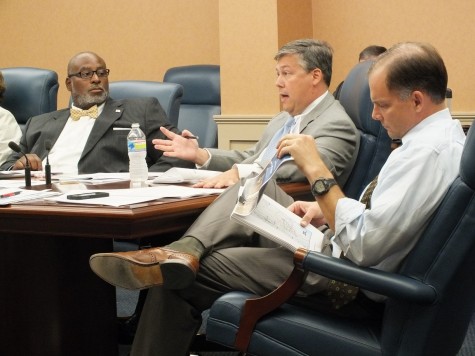
New Hanover County commissioners appear willing to give a little more funding to Wave Transit—in the form of forgiveness on a loan repayment—but remain unmoved in their stance on a recommended subsidy for daycare in the proposed budget.
In a workshop today—the second of two on the recommended spending plan for fiscal year 2013-14—most members of the currently four-member board said they remain opposed to offsetting reductions in state and federal funding for daycare assistance with an increase in funding from county taxpayers.
Commissioners Beth Dawson, Woody White and Tom Wolfe maintained that the county should avoid passing “unfunded mandates” from state and federal government onto local taxpayers, contending that the subsidy in the budget—a recommended increase of $635,000—should be returned to the county’s reserves, or fund balance.
“I can’t see it,” Wolfe said, when asked his position by White, the board chairman. “Not at that level of expense per recipient.”
White has previously said the amount would equate to a taxpayer burden of $488 per child in the program, which currently serves about 130.
Commissioner Jonathan Barfield reiterated his support for the increase in funding, challenging his colleagues on their motivations.
Questioning whether the board was setting a policy of not picking up funding for programs that see reductions in state and federal support, Barfield asked: “Are we doing the will of the people or the will of ourselves in this process?”
Earlier in the workshop, Dawson proposed adding to the recommended level of funding for Wave Transit—$140,000; a decrease of 36 percent from the $250,000 provided last year—by forgiving the repayment of a $133,000 loan that commissioners granted Wave two months ago. Dawson described the proposal as a compromise in light of Wave’s original request for $500,000—an amount director Albert Eby said would maximize state and federal funding potential.
Barfield, who represents the county on the Cape Fear Public Transportation Authority—Wave’s governing board—said he was not comfortable agreeing to that proposal. White agreed with Barfield, while Wolfe sided with Dawson.
“If I had the choice of spending money,” Barfield told Dawson, “I would give the money to DSS instead of this increase you’re talking about.”
Noting recent additions to Wave’s bus routes, Barfield maintained, “From a business standpoint, you can’t spend or expand services when you don’t have the money to cover your current responsibilities already. You can’t continue to add if you don’t have enough resources to cover what you have.
“We can’t be everything to all people,” he said.
White maintained the authority was formed 10 years ago due primarily to the City of Wilmington’s desire to provide mass transit in city limits. The county’s responsibility, he said, was funding paratransit, “and nothing else.”
“That’s a policy decision the county’s never made,” White said. “We’ve never shifted from paratransit funding to paratransit and public transportation funding.”
Related story: Wave Transit looking at cutting two routes in light of reduced county funding
County Manager Chris Coudriet said the $140,000 amount proposed for Wave is in addition to funding provided for that service—transportation primarily for health and human services purposes—and covers the cost of bus service provided in the county, specifically the northern route that serves the Castle Hayne campus of Cape Fear Community College.
Contending there is no empirical data to show that ridership has increased enough over the past 10 years to warrant expansions in service, White said: “I hear it almost daily, that we need to stop spending money on public transportation.” The emphasis, he said, should be on changing rider habits, among other approaches.
White said he could support Dawson’s proposal in the short-term, but he later agreed with Barfield that he didn’t feel ready to support it altogether. White said he would think about it more over the weekend.
The board is set to vote on the budget at its regular meeting Monday. A required public hearing was held at the board’s June 3 meeting.
Also during the workshop, commissioners agreed to maintain funding for DWI court and drug court programs, and to decline—at Dawson’s suggestion—a recommended market adjustment in board members’ salaries.
Wolfe proposed increasing the level of funding for Wilmington Downtown Inc. from $25,000 to $37,500—a change Coudriet said would be taken out of funds allocated for economic development.
The board also agreed, with Barfield expressing opposition, to eliminate the general assistance fund as recommended.
Jonathan Spiers is a reporter for Port City Daily. He can be reached at (910) 772-6313 or [email protected]. On Twitter: @jrspiers
