


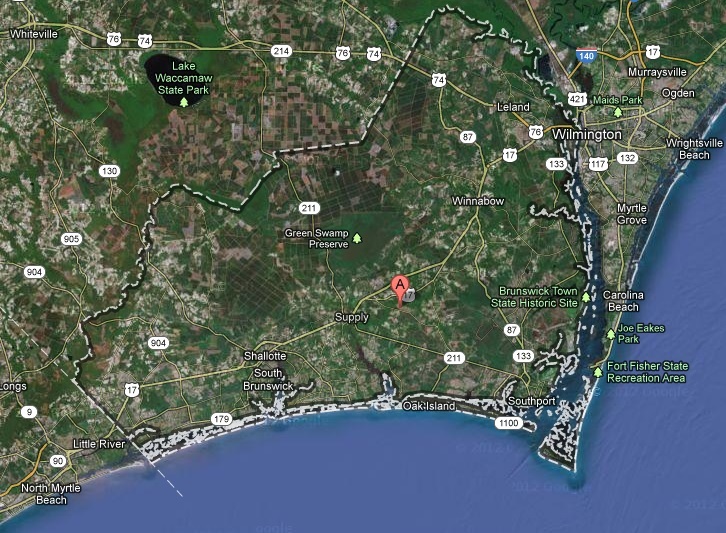
A recent change in census designation that lumps Brunswick County in with metro Myrtle Beach, as opposed to the Wilmington metro area, has attracted the attention of U.S. Rep. Mike McIntyre, who says he is working to have the decision reversed.
“It makes no practical, economic, or common sense for Brunswick County to be pulled out of the Wilmington Metropolitan Statistical Area (MSA) and placed in the Myrtle Beach MSA,” the statement said.
“Our office is working with local officials and leaders to gather information so that we can appropriately respond to this unfortunate decision,” McIntyre added. “We will do all that we can to reverse this decision.”
McIntyre’s statement comes in response to the U.S. Census Bureau releasing the latest delineations of MSAs across the country. The adjusted lines are meant to reflect population growth since the 2010 Census, and Brunswick County’s numbers showed more growth closer to Myrtle Beach than Wilmington.
The change has local and state officials concerned, as it means the Wilmington MSA is now without Brunswick County—one of the largest counties in the state in terms of land area, and the one that is visible across the river from Wilmington.
It also means the Myrtle Beach metro area, centered in South Carolina, now includes the entirety of a North Carolina county.
MSAs are used in “collecting, tabulating, and publishing Federal statistics,” according to the census bureau’s website, meaning that Brunswick County’s statistics—its population, especially—would add to the metropolitan area of Myrtle Beach, not Wilmington.
Not to be confused with similar sounding terms such as the transportation-specific “metropolitan planning organization” (MPO) or “transportation management area” (TMA), MSAs do relate to those in that they group population statistics that are used to determine federal funding amounts for regional transportation projects.
But Brunswick County’s re-designation as part of the Myrtle Beach MSA would not impact funding for the Wilmington MPO, said executive director Mike Kozlosky.
The MPO has an established urbanized area boundary that reaches into northeastern Brunswick County, encompassing Leland, Belville and Navassa, specifically. That area, which is used to determine funding allocations from the federal government, would not change as a result of the MSA issue, Kozlosky said Tuesday.
“The redrawing of the MSA boundary should not impact the Wilmington MPO and our operations and our boundaries,” Kozlosky said. “The MPO boundary is based on the urbanized area boundary, and our funding for planning purposes is also based on that urbanized area boundary.
“Much like Myrtle Beach’s urbanized area boundary expanded up into North Carolina—which required the inclusion of Sunset Beach, Calabash, some of those towns—our boundary extends into Brunswick County,” he said. “And therefore it should not have any impact on the metropolitan planning organization, our structure or our funding.”
The MSA issue recalls a recent situation that Kozlosky also refers to: the Myrtle Beach MPO’s expansion into southwestern Brunswick County, encompassing urbanized areas as far east as Shallotte.
An offer was made for other coastal communities, as far east as Southport, to be included in the boundary expansion, prompting discussion by local officials about geography and logistics—as well as criticism from state Rep. Frank Iler, of Oak Island, who argued against the MPO’s boundary crossing state lines.
Officials from Southport and other—but not all—communities in southeastern Brunswick County reached out to the Wilmington MPO, requesting inclusion in its urban area boundary. But members of the MPO’s Transportation Advisory Committee declined to extend the boundary southward, citing geographical distance and a lack of requests, per resolutions, from all affected communities. (Previous story)
As a result, southeastern Brunswick County remains part of the Cape Fear Council of Governments’ Rural Planning Organization, as far as transportation planning is concerned. And now, like the rest of Brunswick County, it is considered part of the Myrtle Beach MSA.
Kozlosky said he has yet to examine any potential impacts, beyond funding for planning, that the MSA change could have on the Wilmington region’s transportation efforts. If the MPO’s advisory committee requests such information at its meeting this Wednesday, Kozlosky said he would ask for a month to compile information for a formal presentation.
“At this point, we have not had an opportunity to review any other impacts that it may have,” he said. “I’ve been focused solely on the impact that it would have on us as an MPO.
“We have not looked at any of the secondary or cumulative impacts it may have on the MPO as far as statistical information and things like that at this time,” he said. “If it’s an agenda item for discussion, it would come up by the board, and if the board were to take action, I would recommend that that action be taken in April so we have some additional time to review any secondary cumulative impacts based on this re-designation.”
Jonathan Spiers is a reporter for Port City Daily. He can be reached at (910) 772-6313 or [email protected]. On Twitter: @jrspiers
