


NORTH CAROLINA — “Beach nourishment” is both a legislative and local-budget priority at Carolina Beach.
But on the legislative end, it may be an issue of semantics.
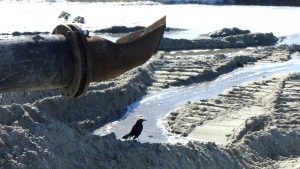
The term isn’t the most beloved for political marketing these days and may not adequately address the purpose of conducting beach nourishment projects, Carolina Beach Town Council members noted this week.
Said Mayor Bob Lewis at a board meeting Tuesday, “The federal government, and the [U.S. Army Corps of Engineers], no longer use the term ‘beach nourishment.'”
Instead, he pointed out, agencies are going with “coastal storm damage reduction project”–the official terminology for the sand replenishment the Corps is currently organizing for Carolina and Kure beaches.
When setting its legislative agenda on Tuesday, council members agreed they should involve the updated phrasing.
Councilman Steve Shuttleworth, citing conversations he’s had with persons knowledgeable on the topic, explained why: “Inland legislators in North Carolina are more inclined to do something for protection than they are for ‘beach nourishment.’ It’s semantics.
“And that’s to benefit them legislatively,” Shuttleworth added. “When [coastal representatives] are trying to get legislators from the Piedmont to the mountains to support something, they were shying away from the words ‘beach nourishment.'”
Coastal officials, during various recent discussions of beach funding challenges, have said the term can be defective under a view from inland dwellers that beach-focused projects only truly benefit people who own expensive homes with views of the ocean.
Layton Bedsole, shoreline protection coordinator for New Hanover County’s government, said on Thursday that “storm damage reduction project” more adequately describes the point of performing beach nourishments–to help spare people, property, infrastructure and places of work from harm.
In November, federal lobbyist for the coast Howard Marlowe told a gathering of North Carolina beach town leaders that October 2012’s Superstorm Sandy created a valuable message to Congress with regard to damage reduction. Areas of New York and northern New Jersey that had conducted beach nourishment projects experienced generally less devastation than those with thinner beach strands.
Said Marlowe, “…you’ve got to realize if you take a look at where these projects are, they worked.”
That message follows the sticker shock that appropriators may feel with beach nourishment. The scientific work involved–sand-source mapping, environmental-impact research–and the effort to stage a dredge vessel to pipe sand ashore can be costly.
Between the upcoming placements planned for the Carolina and Kure beach strands, costs are around $9.3 million, an adjustment from a previous $14-million estimate. The county, state and federal governments are sharing the costs–the federal government covering about 65 percent.
With focuses on spending reductions so often discussed in Congress, local beach leaders and coastal state legislators have explored for funding alternatives to keep North Carolina’s inhabited beaches wide and healthy.
A 2012 state study on ways to raise new money for inlet dredging (sand from which could nourish associated beaches) examined possibly increasing the fees on coastal fishing licenses and boat registrations, but the report determined that might actually worsen the situation by influencing a reduction in the number of people buying those licenses or paying those fees. Instead, the report said, the state might want to consider dividing the coast into project districts and charging them for the maintenance dredging.
State lawmakers including Sens. Bill Rabon (R-Brunswick), Thom Goolsby (R-New Hanover) and Harry Brown (R-Onslow) and Reps. Rick Catlin (R-New Hanover), Ted Davis (R-New Hanover), Frank Iler (R-Brunswick) and Pat McElraft (R-Carteret) are among those who have said they’ll place a focus on beach funding solutions in the current General Assembly.
The legislative agenda at Carolina Beach, among other area beach towns, asks for new, long-term funding mechanisms for the pricey projects as they generally have to be repeated.
While town staffers during the Carolina Beach discussion this week supported the wording of “storm damage reduction” on the agenda, they encouraged “beach nourishment” to run along with it, just in case the term still has some application for lawmakers and legislation.
Contact Ben Brown at [email protected] or (910) 772-6335. On Twitter: @benbrownmedia
