


NEW HANOVER COUNTY — The site of an old fuel burn-pit in New Hanover County that contaminated groundwater and made the federal government’s priority clean-up list has been returned to form.
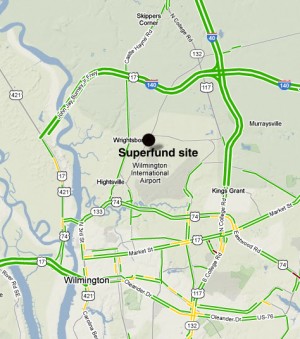
The “New Hanover County Airport Burn Pit Superfund Site,” after pricey remedial work dating back to 1990, received a final ruling from the Environmental Protection Agency (EPA) on Thursday deeming it clean, developable, and ready to be crossed off the priority roll.
“That’s certainly good news,” New Hanover County Environmental Management Director Joe Suleyman said when contacted Friday morning. He said that essentially historic case was one of the first at his attention from a “mountain of files” he inherited when he came to the job in June.
Off Gardner Drive, on county-owned land 500 feet west of Wilmington International Airport, was the site of the 1,500-square-foot earthen burn-pit, which fire squads decades ago drenched with fuels that soaked into the soil.
According to various EPA documents, the pit’s original construction date is anyone’s guess, but a second pit was built in 1968 and put to use over the following 11 years by Cape Fear Technical Institute for firefighter training. The Wilmington Fire Department and other squads in the county had used the site until 1974. The U.S. Air Force used it as well, during the Vietnam War, when that military branch controlled the local airport.
Materials burned in the pit included jet fuel, gasoline, petroleum storage tank bottoms, fuel oil, kerosene and more. “It is estimated that between 100 to 500 gallons of ignitable fuel were used during each firefighter training exercise,” an EPA case summary said. “Water was the primary fire extinguishing agent; however, carbon dioxide and dry chemicals were also used.”
New Hanover County officials sampled the pit sludge in 1985 and indeed found contamination, which the state verified the following year. Its inspection in May 1986 found the lustrous metal barium in the pit, and in the soil around it were arsenic, cadmium, chromium, lead and mercury, as well as barium.
Tests of the groundwater detected contamination that well exceeded maximum federal standards, and officials concluded the metals had impacted as much as 9.7 million gallons of groundwater.
At the time, around 6,300 people drew their drinking water from public and private wells within three miles of the site. Fortunately, the plume of pollution traveled no farther than 350 feet from the source, an official narrative said.
By 1989 the burn pit had made it to the National Priorities List, which compiles instances of pollution or threats of pollution that may warrant federal intervention. The EPA had also identified four potentially responsible parties: New Hanover County, the City of Wilmington, Cape Fear Community College, and the U.S. Air Force.
(Later, energy company Axel Johnson Inc. and subsidiary Sprague Energy Corporation were added to the list. A settlement in October 2002 stated those companies “sent petroleum waste materials from their local petroleum facilities to the site. These waste materials contained lead and volatile organic compounds, which are hazardous substances and which have contaminated the site.” The companies agreed to pay $460,000 into the EPA’s Hazardous Substance Superfund, which addresses abandoned hazardous waste facilities.)
The county, city and community college began and completed the pollution removal effort at the burn pit in 1990. According to a review of the process, they removed 12,500 gallons of water from the pit area and 6,000 gallons from on-site tanks. They dug away 3,220 tons of tainted soil and dismantled nearby structures used for the firefighter training, including the fuel supply tank and automobile bodies.
That effort cost the parties $452,500, according to a 2008 report.
Though follow-up treatments had to address deposits of benzene in the ground, subsequent sampling in recent years has consistently found contaminants at safe levels and the site this past June was advertised for deletion from the EPA’s priorities list. After a public input period, in which regulators received no comments, the deletion became official on Thursday, according to the Federal Register.
EPA Remedial Project Manager Beverly Stepter, who said she had worked roughly 10 years on the airport burn-pit case, called the site’s new status an “exciting” milestone.
“It’s done,” she said Friday. “It’s finally all taken care of.”
The site’s updated profile notes that it now could be developed for commercial or light industrial use.
