


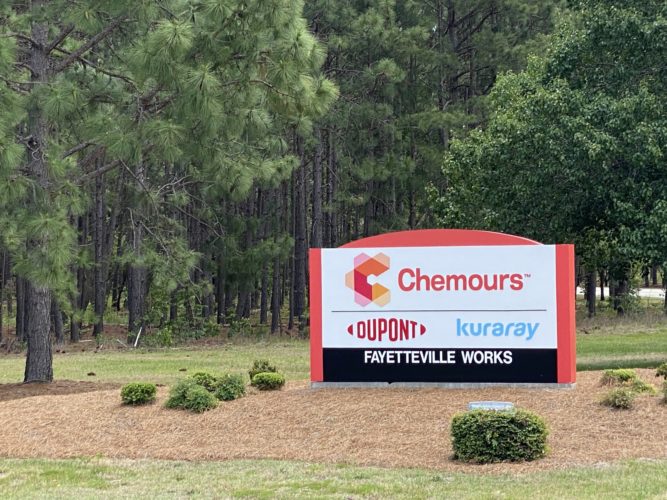
SOUTHEASTERN N.C. — Chemours has been issued a formal notice by the North Carolina Department of Environmental Quality and the Division of Air Quality for not mitigating and remedying PFAS contamination to the extent required in a 2019 consent order the company signed with the state. The company held accountable for dumping PFAS into the Cape Fear River has 60 days to respond to the claims or litigation could ensue.
The move follows another letter sent by the Southern Environmental Law Center on behalf of environmentalist group Cape Fear River Watch in September alleging violations of the consent order. The river watch and NCDEQ are part of a court-enforceable order, signed after Chemours faced a series of lawsuits because of its decades-long pollution in the river. The consent order mandated the company investigate and clean up PFAS contamination associated with its Fayetteville Works facility and provide replacement drinking water to qualifying private-well users.
Riverkeeper Kemp Burdette said of the state’s notice this week: “We knew [NCDEQ’s] letter was coming. We didn’t know what the content of the letter was gonna be, but our letter had legal requirements that the state respond.”
READ MORE: CF River Watch says Chemours broke consent order; company disputes claim
ALSO: Chemours, DuPont, Corteva settle multi-million PFAS lawsuit with NC localities
The river watch letter called upon NCDEQ to issue a warning to Chemours as the regulatory agency in the consent order. The notice did not specify a deadline for NCDEQ to respond, but Burdette explained the agency reached out in the last month to confirm it intended to.
On Monday, NCDEQ submitted the letter, noting it found several problems with Chemours’ adherence to the consent order, declaring the company’s corrective action plan for remediating contaminated groundwater too narrow in scope and insufficient. Its message mandates Chemours fully assess all contaminated groundwater and soil in the Lower Cape Fear, revise and expand its corrective action plan, analyze all chemicals associated with its Fayetteville Works plant — not just GenX or PFOA — and develop a strategy to address the impact of its discharge.
“Today’s direction to the company makes clear that DEQ expects Chemours to clean up all the areas they have polluted,” NCDEQ Secretary Reid Wilson said in a press release. “DEQ will hold Chemours accountable no matter how long it takes.”
The agency also explained the letter was sent in part as a follow-up to the settlement reached among Attorney General Jeff Jackson and Chemours, DuPont and Corteva for more than $455 million in September. The settlement explicitly states the company must adhere to the rules laid out in the consent order, and cites paragraphs 16 and 18 from the 2019 document.
Chemours did not say whether it agreed with NCDEQ’s deficiency findings, but the company told Port City Daily it would be taking the state environmental agency’s comments into consideration when assessing its current action plans and how to update them. This is a deviation from Chemours’ former denial of Cape Fear River Watch’s violation allegations; the company informed Port City Daily in September it has “taken significant actions in implementing the order” and disagreed with Cape Fear River Watch’s claims it broke the consent order.
Chemours built a mile-long barrier wall underground at its facility in 2023 and samples groundwater monitoring wells at its Fayetteville Works plant, nearby private drinking-water wells and wells in New Hanover, Brunswick, Pender and Columbus counties.
The corrective action plan
Chemours first submitted its corrective action plan in December 2019 and nearly seven years later, it has yet to be approved by NCDEQ. The plan was rejected in early 2020 due to failure to adequately outline plans to treat and reduce groundwater and soil contamination to state groundwater standards (called 2L Rules).
Since its denial, Chemours has not formally submitted a new corrective action plan proposal, saying the scope of the work to address groundwater contamination wasn’t feasible because the company didn’t have the funds or technology to do so.
November’s review letter marks the state’s second formal denial of the original corrective action plan and also calls for a new one to be submitted.
“With NCDEQ’s formal feedback to our 2019 Corrective Action Plan, On and Offsite Evaluation, and Risk Assessment now in hand, we can move forward,” Chemours spokesperson Jess Loizeaux said. “We are reviewing NCDEQ’s comments in detail and will respond through the established process.”
According to NCDEQ, the corrective action plan was supposed to show how Chemours would remediate groundwater contamination caused by the plant per North Carolina’s 2L rules, or those that deal with groundwater contamination standards.
However, NCDEQ said Chemours has investigated and tested contaminated soil and groundwater in only four counties (New Hanover, Brunswick, Pender and Columbus), and not as a part of a corrective plan. Over the years, the company has submitted multi-part assessments mapping PFAS in soil and groundwater, which included human health and ecological risk evaluations claiming that off-site PFAS levels posed low risk.
NCDEQ cited 10 counties the company needed to include in its testing — including Hoke, Harnett, Cumberland, Sampson, Robeson, Bladen, Pender, Brunswick, Columbus and New Hanover. Chemours did not have a plan to treat the total amount of groundwater contamination, so NCDEQ is requesting an expanded and more comprehensive plan targeting all counties, particularly in those that have yet to be assessed by the company.
Also, NCDEQ wants Chemours to provide a more robust report on chemicals found in the plant’s discharge. This would mean testing for and monitoring tetrachloroethylene (PCE), fluoride, chromium, iron, manganese, cobalt, 1,4-dioxane and PFAS chemicals other than GenX (capped at 10 parts per trillion), PFOA and PFOS (both capped at 4 ppt). According to the letter, all of the chemicals listed were either found in groundwater or are associated with the production types in their respective areas.
Chemours must begin gathering data and monitoring the amount of each chemical listed, with the intention of mitigating further pollution, according to the letter. This information will then be submitted for review and made publicly available.
Additionally, NCDEQ said Chemours misinterpreted the requirement to reduce contamination levels by 75% in its corrective action plan. Chemours suggested that because the Cape Fear River receives discharge from Old Outfall 002, Willis Creek and Georgia Branch, reducing contaminant levels by 75% at the river, or the recipient, would fulfill the consent order requirement. This is opposed to reducing levels at the source.
“This is not an accurate statement of the Consent Order requirements,” according to the NCDEQ letter. “It does not pertain solely to the Cape Fear River.”
Chemours must reduce emission levels by 75% rule for Old Outfall 002, Willis Creek and Georgia Branch, too.
The letter then stipulates different ways Chemours can further remedy its corrective action plan. The company will need to provide supporting costs, technical evidence and expected cleanup timelines in its documents to NCDEQ. Chemours must conduct repeat sampling and provide updated flow models explaining how pollution moves from the plant to people and the environment.
Chemours also will have to redo its risk assessments, which determine the kind of threat its discharge poses to human health and the environment. NCDEQ is pushing for use of current GenX toxicity information and better sampling, since the agency said the company’s initial reports downplayed the hazard GenX. In Chermous’ 2019 assessment, consulting firm Geosyntec determined GenX wouldn’t pose a hazard to human health even in the absence of groundwater remediation; however, NCDEQ pointed out the assessment used outdated numbers and thus weren’t reliable.
NCDEQ requires more investigation of contaminated biosolids and the contribution of ongoing air emissions to groundwater pollution. This would be completed by testing sewer sludge originating from the plant that may have made its way to agricultural use or otherwise shipped off-site.
“Whatever you send up into the air, it’s just going down onto the ground,” Burdette said. “Then it’s just going to soak into the ground, and it’s never going to break down.”
Moreover, NCDEQ instructs Chemours to implement a public engagement plan so community members can provide feedback and guide the company’s assessments, research, mitigation efforts and corrective action plan.
All updates to the corrective action plan need to be approved by NCDEQ; failure to do so could have Chemours face judicial action.
“And I don’t think Chemours wants to be back in court, or they wouldn’t have signed this consent order in the first place,” Cape Fear River Watch’s Burdette said.
Division of Air Quality’s letter
Also on Nov. 9, NCDEQ’s Division of Air Quality sent a separate letter to Chemours to address inadequacies in quality control and emissions reporting of PFAS chemicals at its Fayetteville facility. This includes changing its testing procedures, and sending samples and reports to the division for independent review.
Chemours emits PFAS into the air through its manufacturing, since the chemicals are typically vaporized during the production process. These emissions are routed through a thermal oxidizer, which doesn’t completely incinerate the chemicals. The PFAS-filled air is then pushed out through a pipe from the plant. This air pollution can seep into groundwater and further pollute surface waters.
Air emissions are measured by pounds per year. According to NCDEQ, Chemours’ GenX emissions have drastically reduced from nearly 700 pounds per year in 2017 to 2.44 pounds per year in 2022. However, other chemical emissions remain high, including TFE at nearly 1,000 pounds per year and other fluoropolymers ranging from 2,000 to 2,500 pounds per year.
According to the letter, Chemours’ lab tests of the air emissions coming and going from the thermal oxidizers have not been consistently reliable due to problems with quality-control measures for samples collected from the plant’s exhaust pipe. The Division of Air Quality said the results were then reported to the state even though the tests were conducted with samples that were contaminated by outside factors.
The DAQ requires Chemours collect uncontaminated and controlled samples instead of using failed ones. Further, Chemours will need to set aside an extra portion of any sample so DAQ can run its own tests and analyses of emission control efforts and contaminant levels. The agency currently does this, but concerns over the quality of the samples has been an issue, according to the agency.
The state said reports submitted by Chemours didn’t show their testing and analysis methodologies, nor how the calculations were performed. The state is requiring the company to be more transparent and consistent with its reports.
Beginning in spring 2027, Chemours will need to start an intensive carbon filter testing program, which would monitor emissions entering and leaving the filter at the beginning, middle and end of the filter’s service life. These tests will help determine or change ongoing testing and carbon-replacement schedules, the state said.
Burdette stressed the importance of the DAQ letter also coming out now; Chemours is currently seeking permission to expand production at its existing Fayetteville Works plant through a change to its air-quality permit. The proposal would build upon the plant’s existing Vinyl Ethers North and Vinyl Ethers South production units; the application is still under review according to NCDEQ’s website.
“The state’s basically saying, ‘Look, there’s no way we consider an expansion until you can, at the very least, explain to us what’s going on with your air emissions and clean up,’” Burdette explained.
Chemours will also need to submit two documents to the state by Feb. 26, 2027: a quality assurance project plan to establish a framework for air emission sampling and analysis and a document to set a scheduled plan for testing the carbon filters for its service life and how it fares under different production conditions.
Have tips or suggestions for Emily Sawaked? Email [email protected]
At Port City Daily, we aim to keep locals informed on top-of-mind news facing the tri-county region. To support our work and help us reach more people in 2026, please, consider helping one of two ways: Subscribe here or make a one-time contribution here.
We appreciate your ongoing support.
