


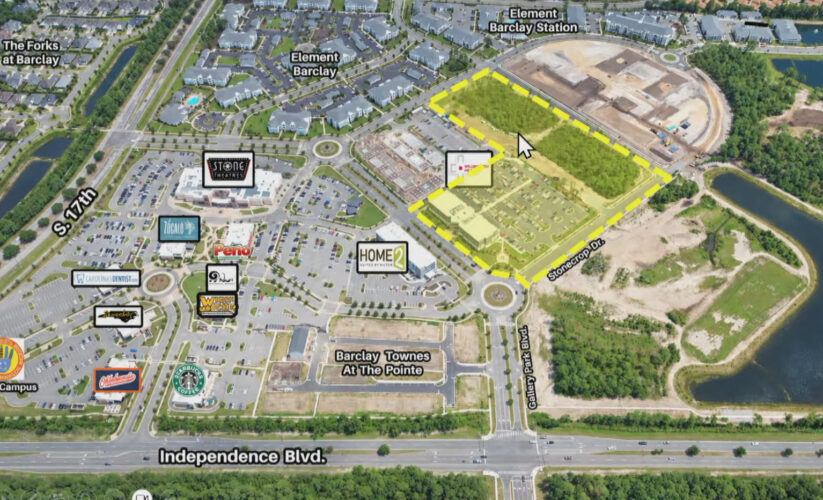
WILMINGTON — A request to remove a density cap on a major midtown mixed-use campus has been postponed to November after Wilmington City Council members requested the developer commit to workforce housing first.
The Wilmington City Council voted unanimously Tuesday to continue a rezoning of 12.26 acres of Barclay West, submitted by Cameron Properties Land Company, until Nov. 17.
The postponement will allow the property owners to decide whether they want to comply with council’s desire for workforce housing to be part of the project. Workforce housing is typically defined as units set aside for tenants making 60% to 120% of the area median income; 60% of Wilmington’s AMI is $45,531.
READ MORE: Barclay West developer seeking to lift density cap on remaining land
Plans for the Cameron Properties’ entire host of Barclay properties — including commercial hub surrounding The Pointe movie theater and several residential complexes near it and across Independence Boulevard — was approved in 2013.
Because of population growth and housing needs that have emerged over the past decade, the developer argues the last remaining Barclay West land should maximize residential offerings. If the cap is removed, it would allow Cameron Properties to build 208 units on the property as opposed to 44.
Council agreed more density in the area made sense, but wanted to ensure the housing constructed could be affordable across incomes.
“Because that master plan existed and so much time has passed, we’re now in a position where, unless we have something extremely appetizing to us on a workforce housing and affordable housing plan, we’re in a position where we don’t have to give you approval to do that,” council member David Joyner said. “I think there’s a bit of leverage and negotiation here that we’re wanting to engage with.”
Barclay West’s rezoning request raises several questions around development approvals in the city: whether council should vote for proposals offering additional housing, even if that housing is not specifically dedicated to working class or low-income tenants. It also raises questions about the effectiveness of multi-phased master plans that take years, and in this case a decade, to build out when a high-growth city can change so much over time.
“Sometimes we approve something, and I drive by for years, and the property just sits there, and I’m like, ‘Well, is it now in a condition that made sense for what we gave them approval to do?’” council member David Joyner asked rhetorically.
Matt Nichols, an attorney representing the property owners, told council the developers were open to considering the addition of workforce housing once plans finalized.
However, these plans won’t come back before council for approval if allowed by-right. This means the density cap removal is the last remaining way for council to have a say on the property unless another rezoning is filed.
Because they did not yet have a formal site plan in place for the vacant acres, Nichols said his client could not commit right then to a number of workforce housing. Workforce housing doesn’t offer the financial recuperation to developers like market rate units do, so developers
“It would be very difficult to commit to a specific number or the parameters of that without having a plan and not knowing at this point exactly what’s going there,” Nichols said.
Nichols tried to redirect council to the main purpose of the request: a density cap was placed on the property in 2013, and based on that, the remaining acreage could only host an additional 44 units. However, without the cap, the city code would allow for 208 units.
Notably, Cameron Properties could do away with the density cap by dedicating 10% of its planned residential development to workforce housing.
Nichols told the Wilmington Planning Commission last month the same thing he told council: Developers have not committed to plans for the remaining acreage — whether the land will be entirely dedicated to residential use, for example, or whether they will pursue the full build out of 208 acres. So, they wanted to pursue lifting the cap instead of constraining itself to building workforce housing on the property.
Thus, the developer chose the complicated rezoning route to remove the cap, though the property will remain in the office and institutional zoning.
“We’re not asking for any extra density, we’re not asking for any density variances or exceptions,” Nichols said. “We’re simply saying, can we develop this just as you would today any other O&I property?”
Planning staff and the planning commission recommended it favorably. Council, though a vote wasn’t tallied, seemed hesitant.
Mayor Pro Tem Kevin Spears said it would be “foolish” to remove the cap without having in hand detailed plans for the property.
“Could a car wash go there? Could some storage facilities go there? Probably,” Spears said.
Nichols countered, saying the office and institutional zoning allows for many uses of the property by-right, but his client has a financial incentive for responsible stewardship of the property. Also, the original conditions placed on the 2013 Barclay master plan confined Barclay West to architectural consistency with the overall development and prohibited uses like retail strip malls.
The 12.26-acre site also already contains a Wilmington Health facility and parking lot; the vacant acreage is around half. Theoretically, the developer could redevelop the entire 12-acre parcel, but Nichols has said the intention is to keep the medical building onsite.
“Why rezone what you’ve already — and I know the answer – rezone what you’ve already built out?” council member JC Lyle said.
She answered herself: including the Wilmington Health facility land in the total acreage for the parcel would allow for higher density on the remaining vacant acreage. Nichols confirmed.
Nichols tried to nudge the council away from lumping his client’s case in with other rezonings where the intent is for more density.
“This is not an instance where someone is perhaps trying to increase density or place new density next to an established residential lower density neighborhood, which can be an issue at times,” Nichols said. “This is in the middle of the mixed-use community that they have created, so it was contemplated the whole time, and the property around them is what they have developed through their control.”
He asked the council to consider the big picture.
Nichols also pointed to the tax base generated for the city. He said the entire 320-acre Barclay property had a property tax bill of $1,714 in 2012; in 2026, the bill for just the 6.6 acres at the heart of Tuesday’s discussion is more than $130,000.
Nichols lauded the mixed-use appeal of the property, an example being traffic reduction on city roads because people “don’t have to drive to Mayfaire to see a movie” or elsewhere to go to the doctor.
While Lyle appreciated the goal of building communities where someone can live, work and play, she doubted anyone working at the businesses in Barclay’s commercial hub — including a Starbucks, Bagels on Pointe, and several fitness studios — could afford to live in its residential offerings. A one-bedroom with 747 square feet in the adjacent Element Barclay apartments is listed for $1,467.
Council member Salette Andrews renewed the call for 10% of whatever number of residential units to be built on the Barclay West subject property to be dedicated to workforce housing.
“Our biggest needs are really in the area where I understand that commercial developers are not going to build, and we need to subsidize…but at this level, what we really need is workforce housing,” Andrews said.
Mayor Bill Saffo suggested Nichols step outside of council chambers to discuss a workforce housing condition with one of the property owners in attendance. Nichols returned with the request to table the request until the Nov. 17 meeting, granted without further conversation.
At Port City Daily, we aim to keep locals informed on top-of-mind news facing the tri-county region. To support our work and help us reach more people in 2026, please, consider helping one of two ways: Subscribe here or make a one-time contribution here.
We appreciate your ongoing support.
