


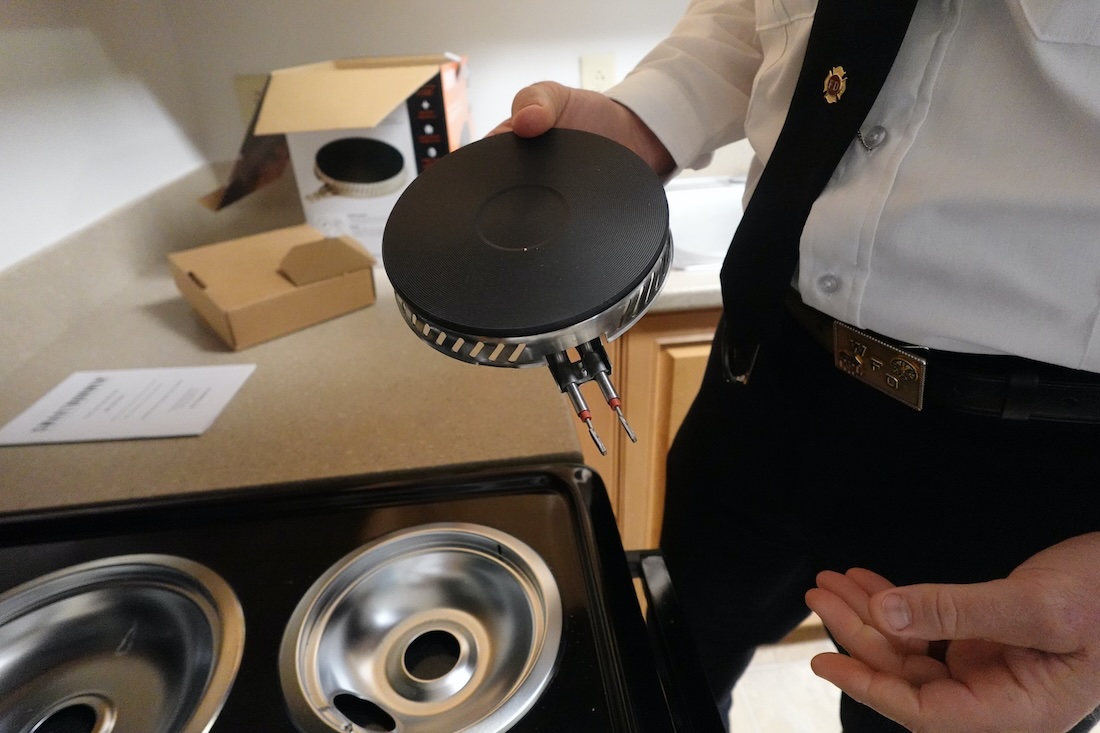
WILMINGTON — A new fire prevention technology designed to stop cooking fires before they start is now being tested at UNCW, where the Wilmington Fire Department installed 100 SmartBurners in a residence hall Wednesday as part of a federally funded pilot program.
Cooking is one of the nation’s leading causes of residential fires. WFD Community Risk Specialist Wendy Giannini-King said SmartBurners are an example of “engineering in the name of prevention.” Wilmington was selected as one of three pilot sites, with others including Michigan and Ohio. The SmartBurners were installed in Seahawk Crossing #4 on UNCW’s campus.
The burners function like a traditional electric coil under normal cooking temperatures but limits the extreme heat that can ignite cooking oil. The burner is installed by removing the old coils and snapping the smart burner into the receptacle. The internal control unit turns off two of the three coils automatically when the plate hits roughly 662°F.
READ MORE: UNCW to exceed housing capacity fourth year in a row
“The majority of cooking-related fires start on electric coil stoves and the predominant problem is unattended cooking fires,” Will Boak, vice president of business development for Pioneer Technologies, said.
The pilot program is a partnership with Pioneer Technologies, the group behind the SmartBurner technology, and the nonprofit organization Vision 20/20 — the latter is a national initiative of the Institution of Fire Engineers USA Branch.
Funded through FEMA’s Fire Prevention and Safety Grant Program, the pilot has come at no cost to the City of Wilmington or UNCW. Vision 20/20 was the recipient of the grant but didn’t respond to Port City Daily by press on how much was received and appropriated to Wilmington’s pilot site.
According to the letter received from Vision 20/20 to WFD announcing its selection, the participation with UNCW will “contribute to the creation of a replicable, evidence-based Cooking Fire Prevention Toolkit that Vision 20/20 will distribute to fire departments nationwide. Wilmington Fire will be recognized as a model program and valued contributing partner in all published materials and grant reports.”
Although students are not exclusively vulnerable to cooking fires, they face unique risks. For many, college is the first time they regularly use a stovetop and since students also live in close proximity to one another, it increases the potential impact of cooking fires.
According to the U.S. Fire Administration, cooking caused 51% of residential building fires between 2017 and 2019.
Giannini-King said Seahawk Crossing generates a high volume of calls for the Wilmington Fire Department. According to WFD spokesperson Rebekah Thurston, the WFD responded to 120 cooking-related fires in 2025. Though how many were student-related is unknown.
Gianni-King said officials hope the SmartBurners reduce emergency responses, allowing campus police and firefighters to remain available for other calls.
“There is a trickle effect of risk involved with an emergency response,” she said. “Campus police are involved, environmental health and safety staff are involved, the Wilmington Fire Department and sometimes the Wilmington Police Department. If the call doesn’t happen because the SmartBurner prevents a cooking fire or too much smoke from activating an alarm, all those people get to keep doing what they were doing before.”
Although the pilot is grant-funded, SmartBurners are also available to consumers, which retail for about $270.
“We hope the data will prove they are valuable tools and that everybody should invest,” Giannini-King said.
If the pilot proves successful, officials hope similar installations could expand to other housing communities.
In 2024, the City of Wilmington applied for a $92,000 FEMA grant, with a $4,500 match for the SmartBurners to be installed in 450 Wilmington Housing Authority units; however, the grant was not awarded.
At Port City Daily, we aim to keep locals informed on top-of-mind news facing the tri-county region. To support our work and help us reach more people in 2026, please, consider helping one of two ways: Subscribe here or make a one-time contribution here.
