


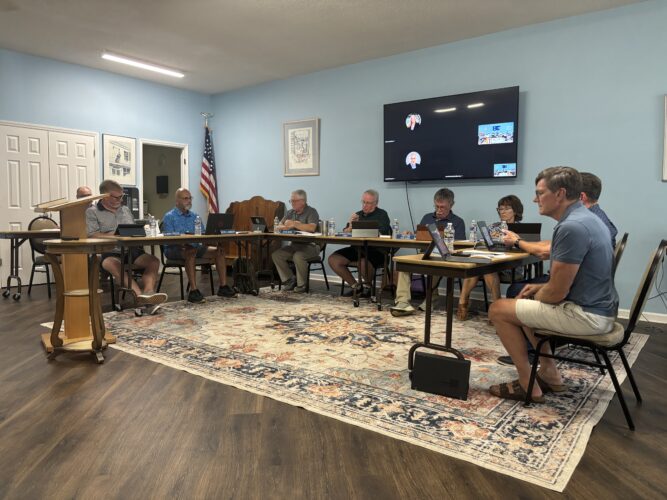
SOUTHPORT — A city-proposed zoning amendment to regulate data centers in Southport drew backlash as residents questioned why a ban wasn’t on the table. However, no amendment was recommended by the Southport Planning Board this week, which instead voted unanimously to suggest a 15-month moratorium to aldermen.
On July 16, the board met for an hour to discuss regulating data centers should one ever be proposed for the city. The amendment would only allow data centers under conditional zoning in the highway-commercial district, and regulates how close the center may be to other uses in the city, what utilities it can use and how, and the planning and oversight it must adhere to.
The amendment requires data centers be 1,000 feet away from homes, schools, places of worship, public spaces like libraries and parks, daycares, playgrounds and farmland or other agricultural spaces. The 1,000 foot setback was put into place “to protect established neighborhoods and preserve the reasonable use of nearby properties,” according to planning director Maureen Meehan.
READ MORE: Southport announces parks director’s ‘voluntary retirement,’ source claims otherwise
ALSO: Southport PD investigates property damage on parade route
CATCH UP: Code enforcement violations stall Southport Board of Adjustment appointment
There are 10 additional conditions required, also focusing on environmental impact and operational standards. Included are requisites to mitigate impacts on water utilities and quality, electrical power grids, 60 decibel maximum limits and noise abatement plans, and lighting pollution mitigation.
Southport Planning Board Chair Larry Ashley explained he proposed addressing the amendment after discussions the board had about the rapidly expanding data center market occurred at the end of 2025.
“I absolutely own this,” Ashley said. “So if anybody wants to throw slings and arrows — whatever they want to do — throw them at me.”
Local municipalities like Leland and Shallotte have already implemented similar amendments into their unified development ordinances. Brunswick County and Boiling Spring Lakes are both in the process of updating their UDOs to do the same. Local municipalities are attempting to not fall behind the curve as data centers open in rural communities across the country.
The industry is rapidly expanding with 20 data centers planned for development in the state since the start of 2025. According to the Data Center Map, there are already 95 centers in North Carolina overall, including one in Fayetteville, one in Rockingham and another in Goldsboro. There are more than 4,500 data centers across the country, with Virginia known as “Data Center Alley,” as it hosts the highest number of facilities at over 600.
Many residents have requested the city ban them altogether due to pollution they cause, particularly to drinking water. According to the University of Georgia, 57% of all data centers use potable water to cool down their systems — 449 million gallons of water per day (1.7 billion liters) in 2021, to be specific. The water used, though, can carry chemicals that often discharge into local groundwater and impact drinking water.
In order to mitigate both water pollution and overwhelming the city’s water utilities, a water usage plan is required in the zoning text amendment.
Further, potable water would need to be provided by the applicant rather than the city, and the condition specifically requires the discharge be reused, recycled, recovered, or sent to an approved sanitary sewer system or authorized facility.
However, both board member Maria Horton and alternate board member Clark Freise worried about further exasperating PFAS discharges — forever chemicals linked to cancer. Freise was the assistant commissioner for the New Hampshire Department of Environmental Services and has several degrees in oceanography.
“PFAS doesn’t break down in that process; instead it gets distributed,” he said, comparing it to the Chemours pollution.
Data centers do not create PFAS, but they are in the coolants used for the servers. They are also in the insulation and heat protectants for microchips, central processing units and cables, and PFAS are in the facilities’ fire suppression systems. Essentially, the PFAS used by data centers can pollute the air or drinking water by discharging into the water or evaporating in the air.
Several organizations have linked data centers to the increase of PFAS in drinking water. The University of Georgia released a report noting the discharge, or “blowdown water,” contained PFAS. Locally, the Sierra Club, an environmental advocacy group, also noted the connection, as well as others, such as: the Environmental and Energy Study Institute, Utah Physicians for a Healthy Environment and Clean Water Action.
Having a data center locally could lead to higher utility bills, board members also worried.
A study from researchers at the Federal Reserve Bank of Dallas showed data centers in the U.S. have already increased utilities prices by 3% to 5% on average. If trends continue at a rapid pace, it reports the cost of bills could rise by 50% or 20% with “moderate” buildout.
The amendment also includes an applicant to present an energy usage plan and annual reports on energy usage and infrastructure improvements. According to a report by Lawrence Berkeley National Laboratory, in 2023, data centers in the U.S. consumed 176 terawatt-hours of power, which made up roughly 4.4% of all electricity consumption in the country.
The city suggested mandating the data center use on-site renewable energy resources to the maximum extent possible, and to then use off-site renewable resources if needed. The amendment aims to limit inundating the local power grid in Southport. Southport’s electric system is at capacity, which is why the city budgeted for a transformer project on Howe Street behind Dosher Hospital.
Horton also brought up “dirty electricity,” or electrical pollution, stemming from servers overloading power grid systems. This can lead to potential outages.
She worried the rules as proposed were not as informed as they could be, nor as comprehensive. A certified information system security professional and an information system security management professional, she explained having been in multiple data centers and thought the amendment needed to regulate milligauss. These are electrical units used to measure electromagnetic fields, and output by data centers.
“Cancers, potential dementia. We already have an older population. If we look at that, this particular conditional zoning may require monitoring that they never exceed 10 milligauss, or 20 milligauss, but we need to look at the standards,” she said. “Even if they’re not absolutely conclusive, we want to lean to the protection of the citizens.”
According to the National Cancer Institute, there are little to no experimental human study evidence to back up the conclusions of electromagnetic fields and milligauss causing cancer. However, the International Agency for Research on Cancer and the European Commission Scientific Committee on Emerging and Newly Identified Health Risks have concluded both claims are true or possible in 2002 and 2015 respectively.
No one was present on Thursday for public comment; however, two people submitted comments to be read aloud. One email was sent by Wendy Long, who believed more focus should be spent on improving infrastructure rather than regulating data centers.
“As a citizen of Southport for 30 years, I feel even considering a data center within city limits is ludicrous,” Long wrote, noting she wanted a ban altogether.
But, contrary to what residents and critics suggested, the city explained a ban could still present issues.
There is no statute barring the city from prohibiting data centers, but a ban can be disputed by property owners if it can be construed as ambiguous. The city added disputes of this nature often favor landowners. In Schooldev East, LLC v. Town of Wake Forest from 2024, the North Carolina Supreme Court of Appeals ruled any ambiguity in land use ordinances would result in an interpretation that least limits the owner’s property rights.
To solidify the moratorium, however, there must be a public hearing, according to General Statute 160D-107.
Freise worried a 15-month moratorium would make the board complacent, asking his coleaguesto not let “perfect get in the way of good,” though Ashley assuaged his concerns.
“I think we can be careful of that, and having you on the board, I think you’ll be a very vocal reminder of if we’re trying to make it so enforceable, it’s unenforceable,” he said.
However, before a moratorium can be put in place, the board of aldermen will need to take a vote on it. The aldermen will also need to pass the zoning text amendment when it is completed by the planning board and staff.
The board explained the amendments are needed to prepare the city for any potential data center applications — with the goal to be proactive instead of reactive.
Planning board member Doug Luehe thought Southport may already be behind, given how many already are in the state. He also wanted to look ahead to the future.
“What are they gonna look like five years from now?” he asked. ”The equipment that was put into a data center five years ago was obsolete twice over, right? So the equipment’s getting smaller. This type of packed data centers are getting smaller.”
The city would monitor ongoing compliance and if the data center is abandoned, the owner would be required to properly decommission the center by removing materials and restoring the site and surrounding environment. Because the hardware or equipment in these facilities contains PFAS and the cleanup could be left to the city or an unqualified person should the facility be abandoned.
“We want to make sure we’re protecting the city and the citizens,” Meehan said.
Have tips or suggestions for Emily Sawaked? Email [email protected]
At Port City Daily, we aim to keep locals informed on top-of-mind news facing the tri-county region. To support our work and help us reach more people in 2026, please, consider helping one of two ways: Subscribe here or make a one-time contribution here.
We appreciate your ongoing support.
