


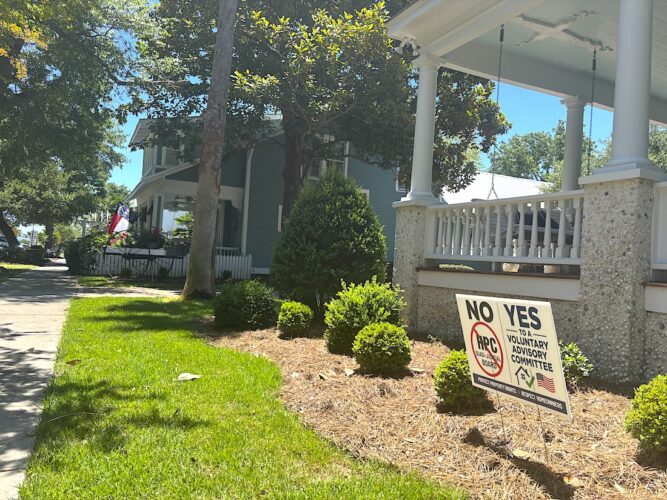
SOUTHPORT — After months of public pushback over the city’s attempt at enacting an historic overlay district, as defined by its Historic Preservation Commission, the North Carolina General Assembly passed a bill preventing the city from having and creating an HPC and district. However, Southport found a workable solution: a Historic Preservation Appearance Committee.
Senate Bill 876 was first filed on April 28 and ratified July 2 and lists 16 various municipal provisions. Included is the Southport historic overlay and commission portion, recommended by the city’s representatives.
Alderman Robert Carroll worried about the state’s pattern of getting involved with and overriding Southport’s decisions, citing government overreach concerns.
READ MORE: Future of Southport’s Historic Preservation Commission to be addressed next month
CATCH UP: ‘Not trying to regulate you to death’: Southport Historic District Overlay receives mixed support
“Southport deserves the right to make its own decisions,” Carroll said.
This is the third piece of legislation in two years involving Southport and pushed forth by state lawmakers.
In 2024, the state eliminated Southport’s extra-territorial jurisdiction, which gave over roughly 2,000 acres to the county. Then in 2025, the state allowed 11 properties in the Heron Circle and Oakwood Glen neighborhoods to deannex from Southport, shrinking the city’s tax base.
Carroll told Port City Daily the topic of the HPC was a point of discussion with Rep. Charles Miller (R-Brunswick, New Hanover) when de-annexations were at the height of concern in 2025. Carroll said after the bill was filed he sent a letter to Miller in May 2026, reminding him of a conversation he said they had previously.
“During that discussion, you assured me that if Southport moved forward with a Historic Preservation Commission district and guidelines through the proper public process, you would not pursue similar legislative action to undermine or undo those local decisions,” Carroll wrote. “I appreciated that commitment at the time, and I took you at your word.”
Port City Daily reached out to Miller and Sen. Bill Rabon (R-Brunswick, Columbus, New Hanover) to understand the necessity of the bill, why this provision was introduced and about the pattern of state oversight in Southport but did not receive a response by press. Both voted in favor, as did Rep. Frank Iler (R-Brunswick), Rep. Carson Smith (R-Onslow, Pender), Rep. Ted Davis (R-New Hanover), Sen. Michael Lee (R-New Hanover) and Sen. Brent Jackson (R-Pender).
The Historic Preservation Commission, established by city ordinance in 2022, has been a topic of debate for a few years now, due to rules the commission put forth in a 100-page regulatory document, outlining construction or renovation requirements for historic homeowners to follow in an attempt to maintain the integrity of Southport’s historic district. There has been severe pushback by historic homeowners, calling the regulations more government overreach and akin to an HOA. One group even threatened litigation against the city if it passed the district, their attorney citing it runs afoul of the state’s downzoning laws.
After a town hall and public hearing in the spring, Mayor Joe Pat Hatem announced last month the HPC would discontinue as is and be re-established as a “voluntary advisory committee.”
“They took credit for something we already decided,” Alderman Carroll said of legislators codifying the HPC abolishment into law.
Carroll noted that while the HPC has drawn criticism from residents, the process of conducting public hearings, open meetings and the like has been done in accordance with city ordinances.
“What concerns me, however, is the possibility of state-level interference overriding local public processes before that process has even had the opportunity to fully play out,” Carroll wrote. “I believe our residents deserve the chance to participate in these discussions and have their locally elected officials make decisions without the threat of legislative retaliation hanging over the conversation.”
Though the new bill prevents the aldermen from re-establishing the commission, the city will be introducing a Historic Preservation Appearance Commission at this Thursday’s meeting instead. It essentially will be the same as an advisory committee and will also oversee the current historic district. The main difference is it will make recommendations and not require any measures for homeowners to follow when making changes to their properties.
The new committee is allowed under North Carolina General Statutes 160D-304 and 160D-960, which directly authorizes the institution of appearance commissions. Both the current HPC ordinance has to be repealed and the appearance commission will require an aldermen vote.
The appearance commission would advise homeowners on how to go about renovation projects, while still maintaining the historic feel of the 386 parcels in what would have been the historic overlay district. Within 15 days of filing a permit with the city to renovate their properties, residents and homeowners will be encouraged to meet with the appearance commission. However, failure to do so will not delay permitting, and the planning director may provide the advisory role in the commission’s stead.
Comments and requests made by the commission will be non-binding, though, according to city documents. The appearance commission will not require a Certificate of Appropriateness, such as the HPC required. The official document was to be issued before allowing a homeowner to alter, demolish, or construct exterior features on historic properties; it also does not have enforcement authority.
Contrary to a historic district overlay, the approval of the commission would also constitute a historic study area for preservation study, public education, planning and advisory consultation. Other responsibilities for the commission include:
- Conducting and assisting inventories of historic, architectural, cultural, landscape, streetscape, and community resources.
- Public education on preservation, compatible infill, adaptive reuse, maintenance, disaster preparedness, and community character.
- Advising the board of aldermen and city staff on historic preservation guidelines, policies and plans.
The bill brought forth public support though, including from Alderman Paul Gross, who has notably been against the historic overlay district.
“The final document was the gold standard for over-regulation and an infringement on the rights of property owners at its worst,” Gross told Port City Daily.
As he previously pointed out in aldermen meetings, the public hearing garnered 62 comments from residents, with 80% of the speakers in opposition to the regulations. Gross also mentioned criticisms from residents about the sitting members of the HPC, adding five of the seven members did not live in the historic district. Thus the unelected officials creating the new rules — the HPC was a quasi-judicial board but appointed by aldermen — did not have to live under them. Gross found it problematic, a sentiment echoed by many during the June 2 public hearing.
Gross added he was thankful for the bill and for Miller and Rabon for representing the people who live in the district and “have cherished and maintained our special city since 1792 without government overreach.”
Whereas Carroll viewed the bill as legislators overstepping local authority, Gross believed it necessary to really accomplish dissolving the current HPC.
“It was necessary for the State Legislature to step in because several Southport Elected Officials would not allow a vote to terminate the HPC and the Overlay District,” Gross said.
Last month the aldermen discussed taking up a vote to dissolve the HPC as it currently stands, a vote to recommend staff do further research and more. However, the aldermen decided June 17 to push off all discussion of the HPC until July.
Port City Daily also reached out to aldermen Marc Spencer, Lowe Davis, Karen Mosteller and Rebecca Kelley but did not hear back.
The Historic Preservation Appearance Commission will be taken up for a vote on July 9.
Have tips or suggestions for Emily Sawaked? Email [email protected]
At Port City Daily, we aim to keep locals informed on top-of-mind news facing the tri-county region. To support our work and help us reach more people in 2026, please, consider helping one of two ways: Subscribe here or make a one-time contribution here.
We appreciate your ongoing support.
