


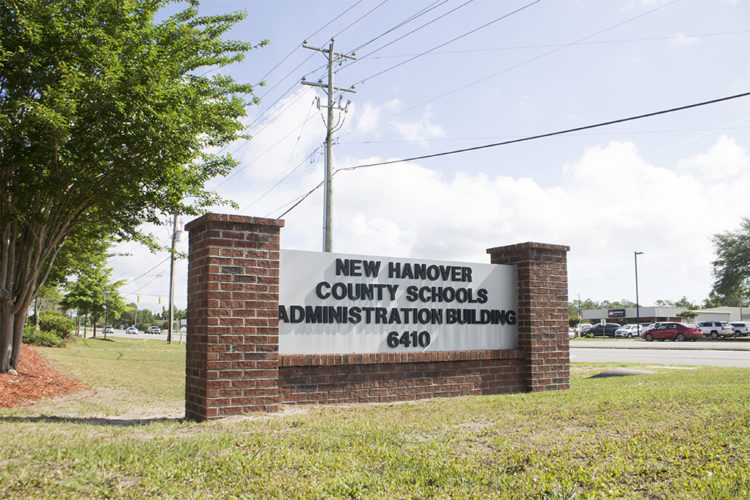
NEW HANOVER COUNTY — The New Hanover County Board of Education is pruning its budgetary needs as the deadline nears it to deliver a a balanced, recommended budget to the county.
At the board’s April 1 meeting, Superintendent Chris Barnes gave an update on the district’s budget for fiscal year 2026-2027. It is inclusive of 3% raises for school employees, costing about $2 million. Though that’s about the only enhancement the district — its leaders having repeatedly said they are operating at “subsistence level” — can afford in next year’s budget.
As of the March budget session, the district is currently grappling with a $2.5-million shortfall if it were to accommodate all the additions prioritized by district leadership, including more EC teacher assistants and an assistant principal for every school.
By reducing many of the requested budget additions and shoring up revenue in other places, the superintendent has shaved $1.12 million from the $2.5-million budget deficit reported last month. Barnes reported also making cuts to the central office, including his budget, supplies, and one position in the finance department.
Even with the reductions, the district would face more than a million-dollar deficit — and thus would need to ask the county to provide more money.
If the county acquiesced, it would contribute another $700,000 for its cost-of-living adjustment to NHCS’ employees. The county is currently budgeting 2.33% for COLA — the amount stipulated by the Consumer Price Index — but NHCS is asking for 3% to match the expected raise made by the state.
Barnes said he has talked to County Manager Chris Coudriet, commissioners’ Chair LeAnn Pierce, and Vice Chair Dane Scalise on the increase. As reported by Port City Daily, the county will likely need to pull the money from its nearly $300-million Revenue Stabilization Fund, which it is already projecting to use for next fiscal year due to revenue limitations of its own.
With the reductions in budget additions and more funding from the county, Barnes said the district’s deficit is about $485,000. He reported he’s already implemented a spending freeze for the current fiscal year and expects the savings will cover the deficit.
However, some of the budget additions he noted were “mission critical” to the board.
Ultimately, the superintendent received $16 million in additional budget requests, which was whittled down to $1.2 million. They include the addition of three assistant principals to ensure no elementary school had to share one at a cost of $265,000. Leadership also wanted to up its EC teacher assistant allotment from 57 to 59 at a cost of $135,000. Additionally, the district wanted to hire an occupational and physical therapist, a cost of $85,000.
Barnes said he would continue to find ways to fund the needs before bringing a recommended budget to the board of education on April 28.
In addition, the district could shore up more revenue through estimating contract increases only at 2.33% rather than 3%, a $373,000 difference. Also, moving some pre-K classrooms to buildings already certified to meet state requirements — rather than upfitting classrooms — will save the district $178,000.
The district is contemplating a student technology fee to help offset the cost of school laptops, projected to bring in $356,000 if implemented.
Though the county has indicated its amenable to increasing its contribution to the schools, Barnes has cautioned the board against continuing to demand more money from the commissioners.
“I think it’s totally appropriate to say to the county commissioners: ‘Hey, this is our gap. This is where we are,’” Barnes said at the last budget session. “But I also want to make sure that we can do everything we can to address that prior to asking for any additional funding. I do think it’s fair to say that they have increased our allotment every single year, while the state and the feds have not.”
North Carolina has repeatedly been ranked among the lowest funders of public schools nationwide when comparing the state’s ability to pay versus what it expends. When costs increase without state adjustments, it leaves counties left picking up the slack.
“The argument over who is supposed to pay for the water to put the fire out at my house doesn’t put the fire out at my house,” Barnes said at the April 1 meeting. “I don’t have the time to argue between the local government and state over who should be funding what. Public school is essential for this community, it’s essential for this nation moving forward. So we are going to continue to advocate for that.”
Barnes continued, saying he “doesn’t want the narrative to be that the county commissioners are not supporting public schools.”
At the April 1 meeting, Barnes pointed out the county has continued to increase its funding line to NHCS despite declining enrollment. New Hanover County Schools has lost 839 students over the last few years; that’s the population equivalent of a middle school. The data indicates the students aren’t leaving for charter or private school, but is due to a nationwide birth rate decline and also a migration of families with students out of the increasingly expensive New Hanover County.
Declining enrollment is a state and nationwide problem; Barnes noted 100 of the state’s 115 school districts are losing students. One of the only ones with a positive trajectory is Brunswick County, the fastest growing county in the state and fifth in the nation. Barnes indicated it was safe to assume some New Hanover County families were moving across the river seeking lower costs.
To grapple with its declining enrollment, the district has decided to undergo an in-house analysis of its school buildings. The goal is to highlight which could potentially be closed to reduce the district’s overhead costs — utilities and infrastructure expenses, but also one less building means there’s less need for staff, which are the district’s highest cost.
However, that study won’t yield results in time to affect budget decisions for fiscal year 2026-2027. Barnes said families and the county community will be involved in any discussions about closing facilities before the study is presented to board of education members for any action.
Reach journalist Brenna Flanagan at [email protected].
At Port City Daily, we aim to keep locals informed on top-of-mind news facing the tri-county region. To support our work and help us reach more people in 2026, please, consider helping one of two ways: Subscribe here or make a one-time contribution here.
We appreciate your ongoing support.
