


NEW HANOVER — County officials have signed off on the next step for a controversial development in Castle Hayne, but not without placing firm restrictions on how the project can proceed.
The New Hanover County Technical Review Committee, made up of county staff, granted conditional approval to the Hilton Bluffs subdivision on March 10. This means, once state and federal environmental permits and other stipulations are met, Charlotte-based Copper Builders may begin constructing the first 581 homes on about 581 acres of upland areas in Castle Hayne, known as Sledge Forest.
READ MORE: Sledge Forest developer removes unauthorized BBB seal from website following state complaint
ALSO: Sledge Forest conservation plan falls through after grant application denied
It’s unclear when Copper Builders will break ground as the developer didn’t respond to Port City Daily’s inquiry. County planning staff said the timeline for construction depends on when permits are obtained and final plats are recorded; however, the TRC has a two-year timeline on conditions or the builder has to resubmit a new application.
Conditional approvals include permitting from the U.S. Army Corps of Engineers for construction of a connection bridge to the adjacent Wooden Shoe neighborhood, a conservation easement potentially in place, roadway upgrades, Coastal Area Management Act permits, tree removal permits, land disturbance and stormwater permits, and water and sewer approvals from Cape Fear Public Utility Authority.
Copper Builders is planning an 1,800-home development on roughly 1,809 acres, which was pared down from 4,000 homes on 4,000 acres originally brought to the public’s attention in 2024. The project will be completed in six phases.
Allowed by-right, Hilton Bluffs is zoned Rural Agricultural, which permits one residential unit per acre under the county’s UDO — that would be 1,800 homes without needing approval from county commissioners. But the builder still has to follow all county regulations and ensure conditions executed by the TRC are met.
1,200 of 1,800 acres are considered a combination of wetlands and class IV soils, which are water-saturated, organic “muck.” Common in coastal forests, they act as a natural sponge for the ecosystem and supports long-standing tree growth.
Copper Builders submitted their first application in 2024 and suggested preserving 3,000 acres in a conservation easement. A conservation easement is a permanent legal agreement between a property owner and a qualified conservation organization removing development rights from environmentally sensitive areas. Once in place, the easement ensures those areas remain protected in perpetuity, even if the land changes ownership.
The project was later scaled back to 1,800 units, which developer Wade Miller previously told the StarNews allows for “flexibility” for conserving portions of the property while moving forward with construction on upland areas.
Under the county UDO, a developer can use land placed under a conservation easement to count towards the project’s total allowed homes, even though it can’t be built on.
Copper Builders previously wanted to partner with the nonprofit Unique Places to Save in an attempt to secure a $10.2-million grant from the North Carolina Land and Water Fund to purchase and protect roughly 1,160 acres of the tract. However, the state denied the application in October 2025; officials did not disclose a specific reason for the decision.
If the builder can find another conservation partner, the now-1,200 acres conserved toward the total density would permit the full 1,800 homes to be clustered on nearly 600 acres of upland. If Copper Builders cannot secure a third-party conservation partner, the county allows an alternative: the land could be placed under a homeowners association, making future residents legally responsible for maintaining protected areas under a county-approved management plan.
Per the TRC, conditions place a hard limit on early construction. Under the requirements, Copper Builders are not allowed to break ground on more than 581 homes on upland areas initially, which could make up some of phase 1 and phase 2.
Once the easement is in effect, they can build the rest of the 1,800 homes; the total phasing breakdown for construction is as follows:
- Phase 1: 383 units
- Phase 2: 222 units
- Phase 3: 265 units
- Phase 4: 367 units
- Phase 5: 213 units
- Phase 6: 350 units
Traffic and infrastructure
Beyond conservation, the county’s conditional approval ties future construction to traffic and infrastructure improvements. According to the December 2025 Traffic Impact Analysis, at full build-out of 1,800 units, the neighborhood will bring 14,795 daily trips.
Roughly 95% of neighborhood traffic will funnel onto Castle Hayne Road, a corridor already over capacity. North Carolina Department of Transportation traffic data shows the road carries roughly 17,000 vehicles per day, just above the roadway’s capacity of about 16,800 vehicles. Castle Hayne Road is approaching or exceeding capacity even without additional traffic from the Hilton Bluffs development, according to the Wilmington Metropolitan Planning Organization, which reviewed the TIA.
Castle Hayne Road has an “E” level of service scale, as graded by the NCDOT from “A” (free-flowing) to “F” (heavily congested). Growth in the area is projected to push the intersection of Castle Hayne Road and Holly Shelter Road to “E” by 2034, with some lanes projected to fail at “F” — representing long delays during peak travel times. With Hilton Bluffs, the main entry is planned at Sledge Road — currently private — and Castle Hayne Road, which is projected to potentially reach an “F” by 2029.
To address added congestion, the county’s conditional approval requires developer-funded, phased infrastructure tied to the number of constructed homes and projected traffic volumes:
- Phase 1 (98 units / 990 daily trips) — Construct a 100-foot northbound left-turn lane on Castle Hayne Road, plus a full-length left-turn lane and an exclusive right-turn lane for cars exiting the site.
- Phase 2 (700 units / 5,467 daily trips) — Open a second entrance at Marathon Avenue and restripe the westbound lane at Riverside Drive and N. Kerr Avenue into a 450-foot queue line to improve vehicle storage and flow during peak hours.
- Phase 3 (1,800 units / 14,795 daily trips) — Install new traffic signals at Sledge Road, Marathon Avenue, and McDougald Drive. Redesign the N. College Road roundabout, adding a northbound slip lane and a second circulating lane to accommodate the full neighborhood traffic.
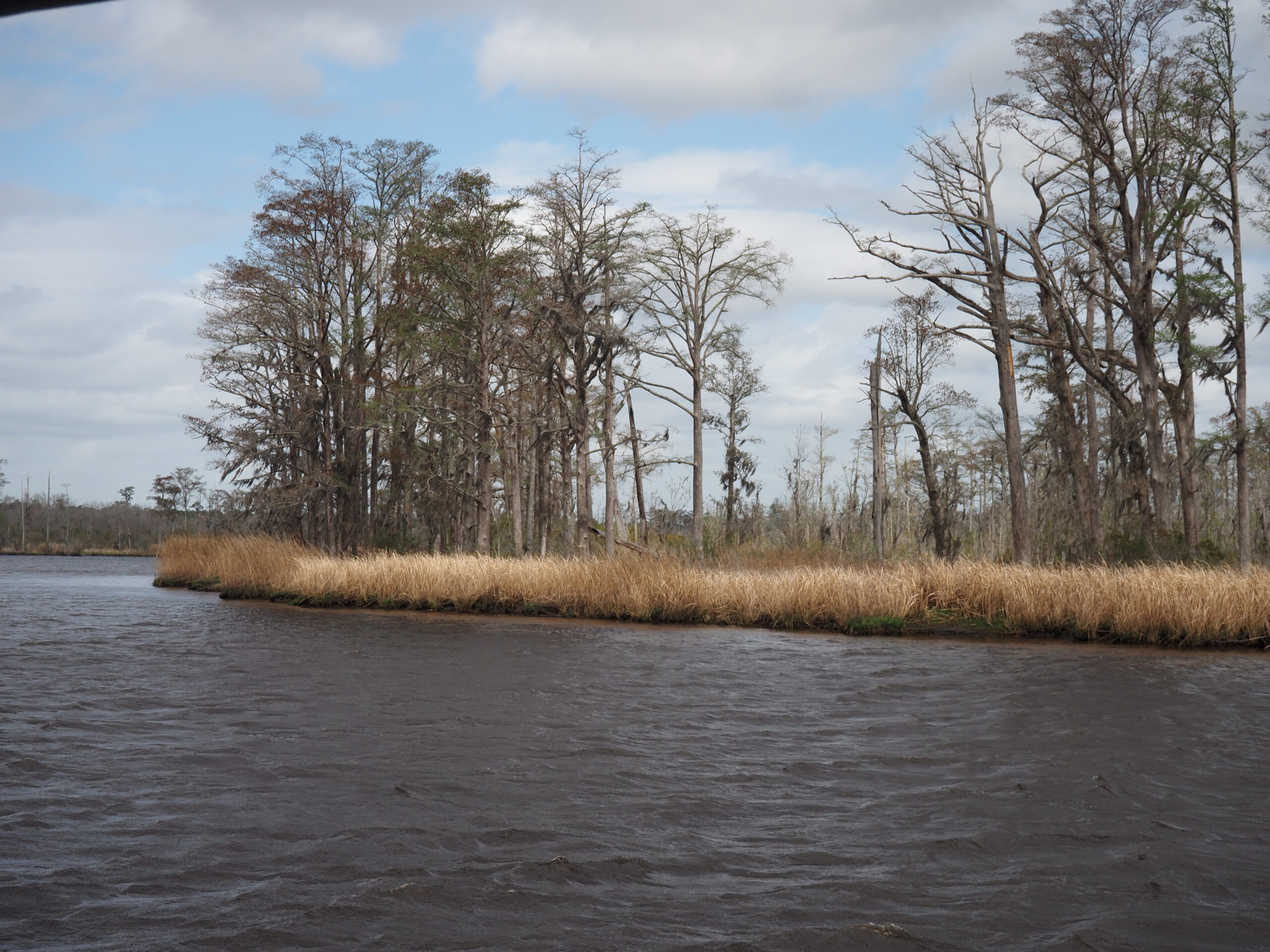
Residents and advocacy groups have been closely monitoring the project since it was first proposed two years ago. This includes Save Sledge Forest 501(c)3 nonprofit. Bob Parr, a Castle Hayne resident and environmental advocate, has spoken against it, including during a fundraising boat trip for the nonprofit, held along the Northeast Cape Fear River last weekend. The trip gave supporters a chance to see the forest from the water and witness firsthand the land that could be affected by the development.
Parr pointed out to boat trip participants that while the TIA assumes most neighborhood traffic will funnel onto Castle Hayne Road, it does not fully account for how cars would travel once they reach surrounding streets. As Hilton Bluffs grows beyond its first phase, traffic would be forced onto rural roads like Marathon Avenue and Indian Corn Trail, which runs through the Wooden Shoe neighborhood.
“These are rural roads, not designed for this volume,” Parr said. “They have narrow lanes, sharp turns, poor sightlines, and conflicts with pedestrians, bicyclists, and service vehicles. It’s not safe for local residents.”
Sledge Road would be the primary entrance to the development, connecting to Castle Hayne Road, though as the neighborhood expands into phase 2, the development would be required to add additional access through Marathon Avenue, a two-lane road, to help handle traffic from higher phases. Marathon is classified by NCDOT as a local road, meaning it is intended to serve individual homes rather than handle high volumes of through traffic.
Indian Corn Trail, another local connector, could also see additional cut-through traffic, with sharp turns, limited shoulders, and minimal sightlines.
Parr is specifically worried about an increase in speeding on Marathon Avenue, referring to the roughly 1.4 miles of road as the future “Castle Hayne Motor Speedway.”
“You know what’s gonna happen if there are thousands of cars going down this road? Almost within the first couple years, you’re gonna get traffic bumps,” Parr said. “That’s not what you want. Once again, this is not an access point. This is a local road where people live.”
For comparison, Parr pointed to Landfall, a 2,600-home development in New Hanover County with roughly 2,200 acres of land. Unlike Hilton Bluffs, Landfall has three security-guarded access points connecting directly to major roads, Military Cutoff and Eastwood roads, both designed to handle high traffic volumes. Parr noted the multiple entry points and arterial connections in Landfall help distribute traffic efficiently, whereas Hilton Bluffs relies primarily on two-lane local roads not created to handle such capacity.
“We are not giving up,” Kayne Darrell, the Save Sledge Forest founder, said during the boat ride. “People power works. It’s going to require all of your help, but we are nowhere close to seeing an end to this. We intend to save this for us and protect our community from this development.”
Save Sledge Forest has retained legal counsel to provide guidance as the group works to oppose the development, with fundraising going toward covering attorney fees. During the boat trip, Darrell encouraged supporters to stay engaged, contact county officials, and continue advocating for the forest and Castle Hayne community.
Have tips or suggestions for Charlie Fossen? Email charlie@localdailymedia.com
At Port City Daily, we aim to keep locals informed on top-of-mind news facing the tri-county region. To support our work and help us reach more people in 2026, please, consider helping one of two ways: Subscribe here or make a one-time contribution here.
We appreciate your ongoing support.
