


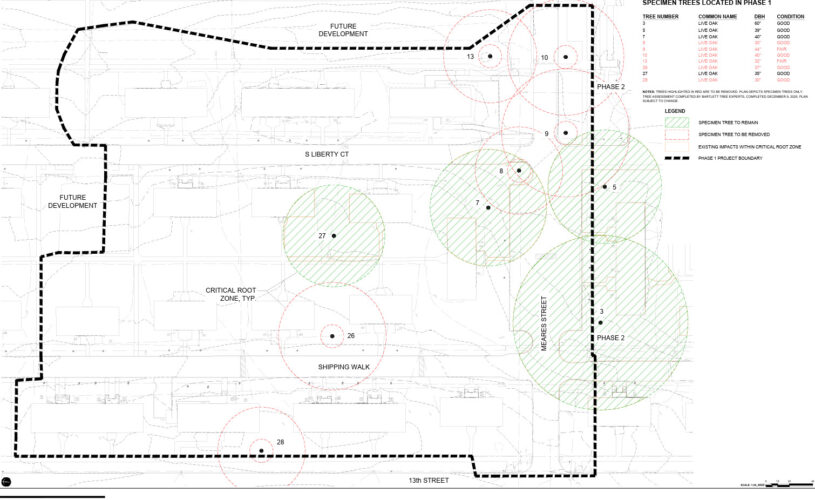
WILMINGTON — The Wilmington Board of Adjustment approved a variance last week allowing the team behind the redevelopment of Hillcrest, an 80-year-old public housing complex, to remove six live oaks from the property and impact the critical root zone of four other trees to remain.
The decision was unanimous, though Chair Jeff Hovis recused himself from the discussion and vote; he was replaced by BOA alternate Greg Thompson. Hovis is chair of the Wilmington Housing Authority, owner and operator of Hillcrest.
READ MORE: After mold crisis and cash crunch, WHA plans a transformational decade
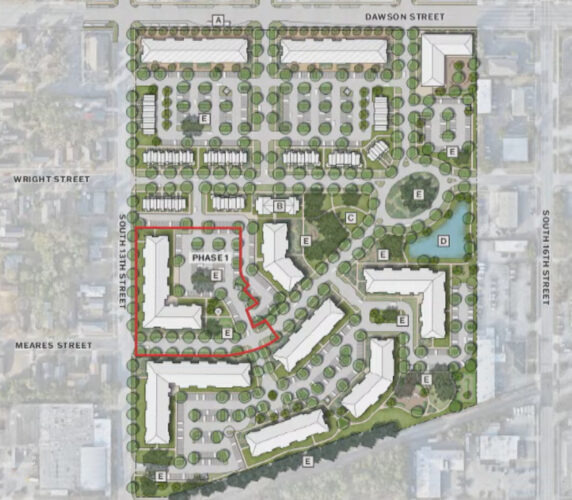
Situated along Dawson Street between 13th and 16th streets, Hillcrest was originally built as temporary housing during World War II, so the concrete, one-story houses date back to the 1940s. The complex has undergone few updates since, leaving its aging infrastructure susceptible to moisture and mold issues.
“The infrastructure, the pipes in the ground, all of it, are over 80 years old, and so it is not realistic to either continue the operation of the site in its current condition or to simply replace things in exactly the place where they’re located,” attorney Sam Franck, representing WHA’s variance request, said at the meeting on Feb. 19.
The Wilmington Housing Authority announced last March it would rebuild the 251-unit Hillcrest complex in four phases, ultimately upping the unit count to 550. The redevelopment’s first phase, consisting of 84 rental units for seniors, received $5.7 million in funding from The Endowment in October, to go toward the $20-to-$25-million project.
There are nine live oaks located within the first phase’s development footprint. The original application included 10 specimen trees, though one was later identified as a laurel oak, which is not a specimen tree.
The development team has marked six of the trees to come down — ranging in size from 30 inches to 40 inches in diameter — as they stand in the way of the new construction, particularly the updates planned for the utility lines on the property.
Live oaks with a minimum diameter breast height of 24 inches are considered specimen trees, considered important community assets. The City of Wilmington’s land code mandates developers get approval from the board of adjustment before removing these trees.
The housing authority’s plans will also encroach further into the critical root zone of the four other trees. The land code requires a variance approval when impact to specimen trees is expected to go past the 20% impact allowed.
The critical root zone of each of the three specimen trees will see a 50% impact and, thus, are not expected to survive the disruption. If those trees reach a certain level of deterioration in coming years, they would need to come down as well.
Franck claimed the development team did everything it could to preserve as many trees as possible.
“The easiest thing to do here would just be to ask your permission to remove all of these trees — we don’t want to do that,” he said.
However, due to the uniqueness of the site, the attorney argued, the variance is necessary to move the project forward. He also pointed out the applicant didn’t bring upon the development hardships caused by the site and locations of the trees, as it did not construct the property nor was it involved in conversations about its utility work.
Per the board’s approval, the attorney’s argument satisfied the four findings of fact required to be met for board of adjustment variance requests. The findings are:
- Unnecessary hardship would result from the strict application of the ordinance
- The hardship results from conditions that are peculiar to the property, such as location, size, or topography
- The hardship did not result from actions taken by the applicant or the property owner
- The requested variance is consistent with the spirit, purpose, and intent of the ordinance, such that public safety is secured, and substantial justice is achieved
“I think what’s being proposed is certainly a necessary thing,” BOA member Patrick Moore said at the meeting. “I always think it’s a shame to lose trees but I do feel like the applicant has put forth a significant amount of effort in preserving the trees that can be saved.”
The BOA’s approval does come with the requirement that impacted trees be bonded for at least three years. This process essentially connects the root systems of two trees to promote nutrient sharing and mutual survival.
As for the trees that do come down, the city requires mitigation of specimen trees at a rate of 200 percent. For every one inch of trees removed, measured in diameter breast height, two inches of mitigation trees, measured in caliper inches shall be planted.
The development team will also need to mitigate any non-specimen trees that are cut down, though these were not part of the applicant’s variance request. These trees must be replaced at a rate of either 100% or 75% based on whether they are native to the area.
Franck said the team was planning on mitigating as many trees as possible and paying the fees for remaining inches it deems can’t be planted. Fees in lieu of mitigation are subject to city manager approval; the money is then put into the city’s tree improvement fund and reserved solely for planting trees on public lands and rights-of-way.
Reach journalist Brenna Flanagan at brenna@localdailymedia.com.
At Port City Daily, we aim to keep locals informed on top-of-mind news facing the tri-county region. To support our work and help us reach more people in 2026, please, consider helping one of two ways: Subscribe here or make a one-time contribution here.
We appreciate your ongoing support.
