


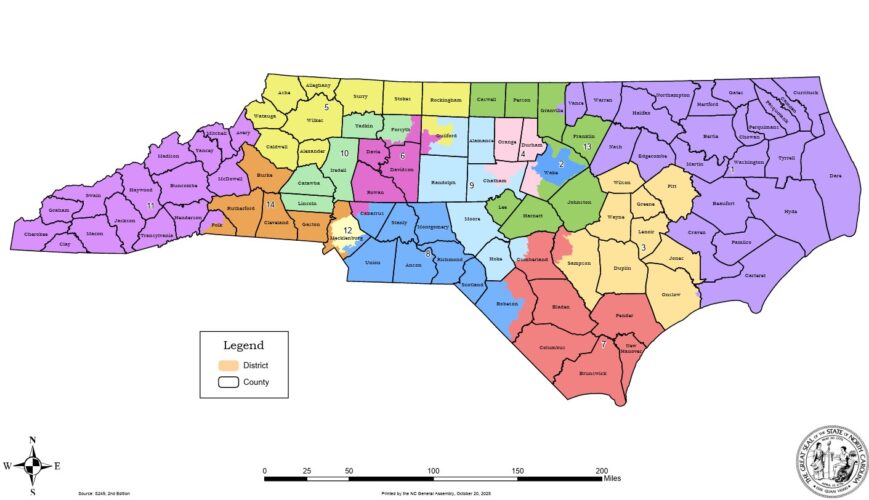
[Ed Note: The new map passed the House of Representatives, and thus is law, on Oct. 22 in a 66-48 vote down party lines. Rep. Deb Butler (D-New Hanover) opposed it, while Reps. Charlie Miller (R-New Hanover, Brunswick), Ted Davis (R-New Hanover), Carson Smith (R-Pender) and Frank Iler (R-Brunswick) voted for the new map.]
SOUTHEASTERN NC — Republicans in the North Carolina Senate passed a new Congressional map Monday, inflaming debates over partisanship, the Voting Rights Act and allegiance to President Donald Trump’s power grabs.
READ MORE: Election association warns SB 382’s ballot-counting timeframe is ‘logistically impossible’
The Senate vote was 25-20, split down party lines; the vote occurred after the Assembly’s gallery was cleared of protestors chanting “cheater” at the legislators.
Of the tri-county Senate representation, Brent Jackson (R-Pender) was the only one present to approve the new map on Monday, which affects several districts in northeastern North Carolina. Sen. Bill Rabon (R-Brunswick) and Sen. Michael Lee (R-New Hanover) were both given excused absences, and thus didn’t vote. [Ed. Note: Lee did vote in favor of the map on a third vote in the Senate on Tuesday].
None of the senators returned Port City Daily’s request for comment.
As is the stated goal of the GOP, the move will give Republicans the likely chance of turning the district 1 seat in the U.S. House of Representatives, currently held by Democrat Rep. Don Davis.
“We are doing everything we can to protect President Trump’s agenda, which means safeguarding Republican control of Congress,” Senate President Pro Tempore Phil Berger said in a statement on the map.
In conversation with Rep. Deb Butler (D-New Hanover) last week, the representative described the move as Berger’s “attempt to elicit an endorsement from the president because he knows he’s floundering in his primary.”
The bill authorizing the new map could head to the House of Representatives Tuesday.
“I look forward to being in Raleigh on Tuesday to discuss this with my fellow Republicans before any vote is taken,” Rep. Ted Davis (R-New Hanover) told Port City Daily.
However, Rep. Deb Butler was clear she opposed the redrawn map: “It is just a gross abuse of a power of power and people should be furious about it.”
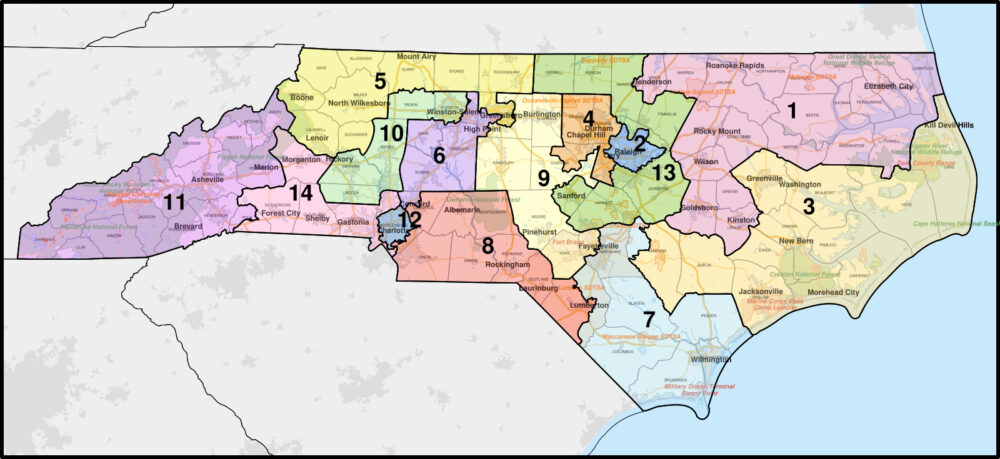
As the Republican majority has resisted attempts to redraw a fairer map in the last few years, the state’s current Congressional map is widely considered one of the least competitive maps in the country. Of the state’s 14 seats, 10 are considered safe Republican wins, three considered safe Democratic wins and one competitive seat, which the Democrats picked up in 2024.
Because North Carolina’s redistricting process is controlled by the political party in power, the redrawing of electoral lines to benefit said party is not notable. Both Democrats and Republicans have done it historically and created infamous gerrymandered districts from time to time.
However, the newly proposed map is unique because it is being created outside of a Census population recount — the reason redistricting occurs in the first place — or a court order, in what appears to be the first time in modern North Carolina history. The General Assembly is barred from recreating a map outside those two circumstances for the state legislature, but no such rule exists for the Congressional map.
In his response to Port City Daily, Rep. Frank Iler (R-Brunswick) claimed the Democrats “gerrymandered the entire state for 200 years and created these race-based districts, one of which looked like a snake from Charlotte to Greensboro.”
The Southern Democratic Party didn’t become socially liberal, particularly on segregation, until the 1960s and 1970s, when many defected to the Republican Party.
However, Iler is correct in his reference to the “snake” district, North Carolina’s 12th Congressional district redrawn in 1991. Winding along 1-85, the district was intended to be majority Black voters. At the time, Republican President George Bush was pushing for majority minority districts to satisfy the Voting Rights Act, which calls for minorities to have an equal chance of electing someone of their choose.
Democrats on Monday invoked the Voting Rights Act as well, claiming the newly proposed district diluting the Black vote in northeastern North Carolina could violate it.
“For more than a decade, our neighbors in the east have been pushed to the margins, forced to live under maps drawn to dilute their voices and divide their strength,” Sen. Mujtaba Mohammed (D-Mecklenburg) said. “You dared them to vote against you before, when you created a 10-4 four map [10 Republican, 4 Democrat], and now and now, you’ve effectively silenced their vote altogether with this new shape. This Assembly has become a machine, not of representation, but of control, a regime of suppression disguised as governance.”
The move takes counties referred to as the “Black belt” that have elected a Black representative for 30 years straight and add whiter counties to them in order to dilute their vote. Almost half of district 1’s voters are racial or ethnic minorities, 40% of whom are Black. The new plan is projected to shift this demographic to 60% white and 40% minority.
In gerrymandering terms, it’s called “cracking”; the opposite is “packing,” where a certain group would be concentrated into one district to ensure other districts around it are not affected by their votes.
Section 2 of the 1965 Voting Rights Act — which is currently being challenged before the Supreme Court — doesn’t allow for electoral districts that dilute the voting power of racial or language‐minority groups. Minority voters must have an equal opportunity to participate in the political process and to elect representatives of their choice.
During the civil rights movement of the ‘60s, the Voting Rights Act also contained a provision requiring certain North Carolina jurisdictions to get federal “preclearance” before changes to voting laws or practices because of the history of discrimination in the state. The Supreme Court invalidated the preclearance formula in 2013.
Sen. Ralph Hise, deputy president pro tempore representing nine counties in northwestern North Carolina, told both the elections committee and the Senate on Monday he did not use race as a factor in redrawing district 1. Though he didn’t shy away from the reasoning behind the newly proposed map.
“I think I’ve been clear … this map was drawn to pick up one additional Republican Congressional seat,” Hise said on the Senate floor, pointing to the court ruling that allows for partisan redistricting.
In 2019, the Supreme Court ruled partisan gerrymandering wasn’t a federal question, leaving the issue to the states; the North Carolina Supreme Court had previously ruled against it, but when the body came under Republican control in 2023, the justices overturned that ruling.
During the Senate elections committee meeting, Democratic members questioned Hise and party leadership’s influence from the federal government.
“I have had no direct communication with the White House or other staff,” Hise said, noting he couldn’t speak for anyone else. “There are obviously some tweets out there and others that are in the public domain. I think the president has endorsed.”
The senator is referring to a tweet made by Trump on Oct. 17 thanking North Carolina Republicans who introduced a “fair and improved” congressional map.
“[It] is a situation I am watching and strongly supporting, very closely,” Trump wrote.
Hise also noted the redistricting was in response to California’s recent redistricting effort.
“I think clearly that California has moved ahead in an attempt to move multiple seats towards Democrats, and it is important in that timeline that we respond on that matter,” Hise said.
Sen. Julie Mayfield moved to correct the narrative regarding other states’ recent districting move, noting California is responding to Texas’ redrawn maps.
“Let’s just do away with the fiction that California has started this process; they have not and everybody in the country knows that,” Mayfield said in the committee meeting. “It is frankly shocking to me that the intelligent and thoughtful Republicans that I work with continue to perpetuate this fiction.”
Over the summer, Texas Republicans passed a map that would likely skew five additional congressional seats in their favor. California lawmakers jumped into the fray with a map designed to counterbalance Texas’ gains, though California has decided to put the map on a voter referendum before they can be used in 2026.
Sen. Hise was asked why he didn’t propose doing the same with his redrawn map; he said that wasn’t North Carolina’s normal process.
Several citizens spoke during the committee’s public comment period Monday, noting North Carolina legislators should not base their decisions off other states. They also took issue with the General Assembly’s push to redistrict despite not being able to pass a budget this year.
“When are you going to do your job for North Carolina?” Cathy Martin asked.
UNC Charlotte sophomore Eric Willoughby said: “Republicans here are preparing to pass a new Congressional map that is designed to hand Donald Trump another MAGA Congressional district, and they are doing this while North Carolina has not had a state budget for 100 days. Rather than fully funding Medicaid, rather than raising teacher pay or doing their jobs, they’re wasting precious time betting the knee to Donald Trump and ripping away the voice of the voters.”
Martin and Willoughby were one of more than 25 North Carolinians that spoke during the committee’s public comment period. Every speaker urged the body to vote down the map. Hise confirmed the committee hearing was the sole opportunity — outside of a virtual public comment portal — for citizens to share feedback on the map.
“We’re concerned about the soul of this country, the soul of this democracy, and all things are underpinned in the please, please take a moment to consider what. public comment means — the public says they don’t want this,” constituent Todd Bell said, pointing to a poll showing 84% of North Carolinians answered that partisan redistricting is “never acceptable.”
During Monday afternoon’s Senate debate, Democratic lawmakers spoke for nearly two hours on the map.
“It’s like the winning football team says after the game that it’s going to change the rules again so it can guarantee and do everything it can, not just to win the game, but to run up the score as high as possible,” Senate Democratic whip Jay Chaudhuri (D-Wake) said.
Earlier, in the committee meeting, Hise claimed Democrats had done the same thing when they were in power. When asked if they had ever redrawn the Congressional map outside of a Census or court order, he pointed to 1967. However, as the New York Times reported at the time, this redrawing was done at the behest of the court after the state’s 1966 map was rejected.
Hise also pointed to the map that was used in 2024, though technically, it was redrawn after the expiration of a two-year court injunction.
In February 2022, the Democratically controlled North Carolina Supreme Court ruled that the Congressional and state legislative maps drawn by the GOP‑controlled legislature after the 2020 Census were unconstitutional partisan gerrymanders. The legislature then put forth remedial maps, but these two were rejected, and the court approved a specially drawn map for the 2022 election.
Then in April 2023, the court, with a new Republican majority, vacated the decision striking down the 2022 maps. That triggered several lawsuits over the decision and the maps that followed, put forth in October to be used for the 2024 election. One lawsuit is still pending: N.C. NAACP v. Berger, which alleges violation of the Voting Rights Act, went to trial over the summer. A court decision has yet to be made.
Reach journalist Brenna Flanagan at brenna@localdailymedia.com.
Want to read more from PCD? Subscribe now and then sign up for our morning newsletter, Wilmington Wire, and get the headlines delivered to your inbox every morning.
