


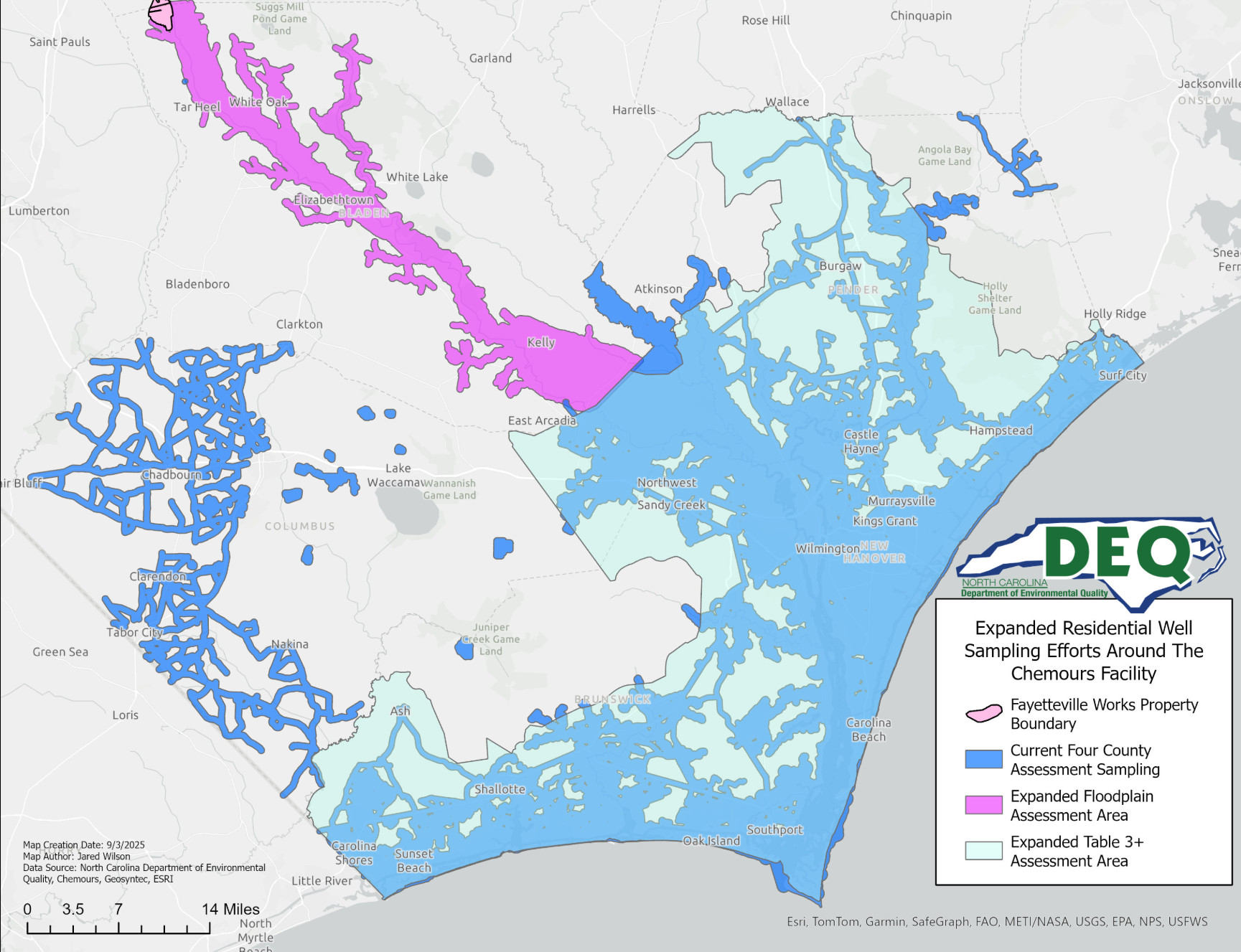
NEW HANOVER COUNTY — Many people in the southeastern corner of North Carolina could be on a faster path to clean drinking water, following an updated well-testing plan from the state’s Department of Environmental Quality.
READ MORE: EPA intends to rescind PFAS regulations as Chemours seeks to increase production
This week NCDEQ required Chemours to expand its testing under a court-enforceable 2019 consent order. 14,000 homes potentially affected by PFAS contamination from Chemours Fayetteville Works are now eligible for free well-testing.
According to the NCDEQ Office of Public Affairs, the move comes after a joint review of existing well data showed contamination was more widespread and traveled differently than previously understood. PFAS pollution was being found in areas farther away from the Chemours plant, potentially moving through surface water and floodplains.
The homes to be included in the expanded testing are located in New Hanover, Brunswick, Columbus, and Pender counties. While Chemours estimates only 2,600 have private wells, the company will send a letter to all 14,000 residences, it indicated.
Private well-testing and remediation efforts are mandated in a 2019 consent order among NCDEQ, environmental group Cape Fear River Watch, and Chemours. The legal agreement holds Chemours responsible for addressing contamination from its Fayetteville Works facility after it was found to be dumping PFAS into the Cape Fear River in 2017 for around four decades.
The consent order notes Chemours will reduce emissions, assess the extent of contamination, and provide a clean drinking water supply to residents whose private wells test above a specific action level:
- At or above 10 ppt of GenX. This qualifies residents for reverse osmosis units, a granular activated carbon system, or connection to a municipal water supply.
- At or above 70 ppt of combined PFAS compounds including PFMOAA, PFO3OA, and PFO4DA. This qualifies residents for up to three under-sink reverse osmosis systems.
- At or above 10 ppt of individual PFAS compounds. This also qualifies residents for up to three under-sink reverse osmosis system
According to Chemours’ second-quarter 2025 progress report, nearly 20,000 residences have been sampled for PFAS contamination since well-testing began in 2022. Of those tested wells, a total of 1,378 in Brunswick County, 3,771 in New Hanover County, and 3,130 in Pender County have been sampled.
Homes that tested above the action level for contamination have received a water treatment solution, with 868 solutions provided in New Hanover, 313 in Brunswick, and 513 in Pender.
Chemours has tested the wells using a “step-out” method, essentially a reactive approach. The company would only expand the testing area after contamination was confirmed in a well. It would then move out a quarter of a mile and test the next ring of homes. This process repeated until no more contamination was found.
Now, all eligible residences within the focus area can request immediate sampling, rather than waiting for PFAS to be found one well at a time.
According to a Chemours’ spokesperson, the company expects this to be the final phase of the private well-testing program and “the change will accelerate sampling.”
Residents within the refined zone, as shown on NCDEQ’s updated testing map, who are interested in having wells sampled should call Chemours at (910) 678-1100 or complete Chemours’ online form. The private well must be the primary source of drinking water for the residence to qualify. Households previously offered well testing are still eligible.
Also, NCDEQ’s Division of Waste Management will be holding a virtual public meeting to provide more information about expanded well testing and answer questions on Oct. 7 at 6 p.m. The meeting can be accessed here.
Have tips or suggestions for Charlie Fossen? Email charlie@localdailymedia.com
Want to read more from PCD? Subscribe now and then sign up for our morning newsletter, Wilmington Wire, and get the headlines delivered to your inbox every morning.
