


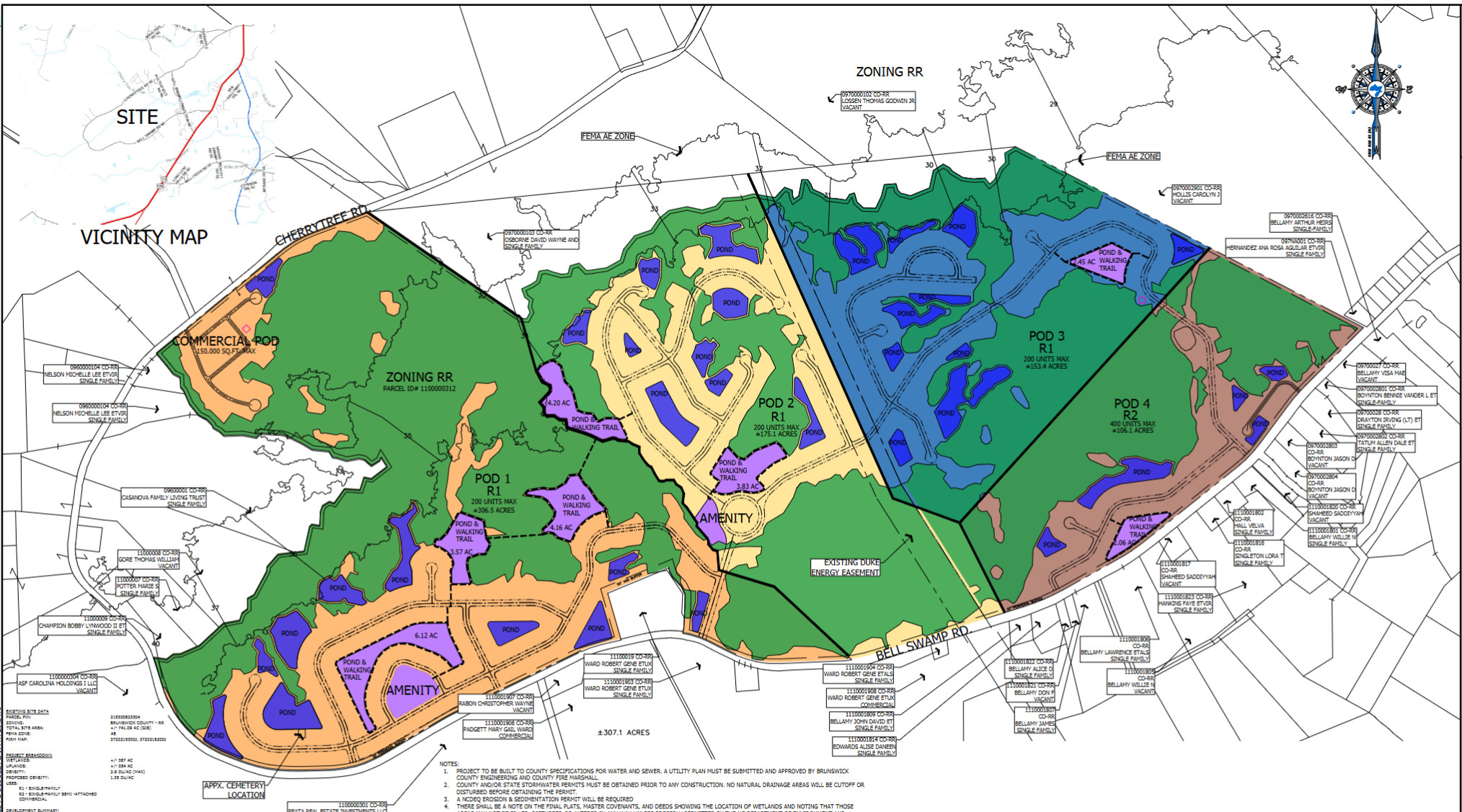
BRUNSWICK COUNTY — In two victories for residents, the Brunswick County planning board recently denied a couple of major residential projects after the public raised concerns about traffic, flooding, and safety. It approved another that was rejected in July but revised to address issues the board had.
READ MORE: Brunswick County, planning board sued by developer over Sailor’s Haven denial
ALSO: Who should have development approval power in Brunswick? Staff assessing commissioner authority
The denials for the 1,000 single-family homes Cherrytree Tract project in Winnabow and the 650 single-family homes Woodland Reserve development in Ash came at the Sept. 8 meeting after more than three hours of public hearings. Residents and board members alike voiced strong opposition to the projects.
“I think our residents in this county are very concerned about what developers are getting and not giving,” board member Cecilia Herman stated about Cherrytree Tract. Herman was concerned developers would profit from building a large community, while existing residents would be left to deal with the negative impacts, such as increased traffic and flooding.
The board’s decisions went against approval from county planning staff, prioritizing resident’s health and safety even though the projects met unified development ordinance requirements.
Though the planning board rejected the two developments from moving forward, the previously denied Oxpen Oaks major subdivision plan was approved. Board members had denied it over flooding concerns, but applicant Coastline Homes revised its site plans, removing a home and moving a septic tank out of the flood zone.
The board also learned at the end of the meeting, it was being sued by a developer, Coastal Cornerstone Development, LLC, for denying a 299 planned development near Sunset Beach in July (read PCD’s coverage here).
Cherrytree Tract; 1,000 homes
Planned development Cherrytree Tract in Winnabow was unanimously denied by the planning board over traffic increases, flooding, and impact on nearby cemeteries. To consist of 1,000 single family units on approximately 740 acres, the planned development would have had an average density of 1.35 dwelling units per acre. The land is currently zoned as rural residential allowing up to 2.9 units per acre, but the 2040 future land use plan denotes the area as open conservation and rural agricultural.
Board member Jason Gaver said he was initially supportive of the plan, but was swayed by resident’s comments and reservations.
“Prior to walking into this room, I thought that the presentation was extremely well thought out,” Gaver stated. “I think that your group has done everything they can to preserve some space but still make a return on their investment, which is what you guys do. However, there’s things I heard giving me extreme pause.”
Gaver took issue with the proposed project’s traffic count, generating approximately 8,294 daily vehicle trips on adjacent Bell Swamp Road. As a condition of approval, NCDOT requested 30 roadway improvements. including a traffic signal at US 17 and Bell Swamp Road, and ingress and egress lanes at six site access points.
Resident Haley McFarland, who lives on Cherrytree Road, said during the public hearing she and other neighbors had previously asked for a signal at the intersection of Cherrytree Road US 17 with concerns over an already dangerous intersection. McFarland explained US 17 is difficult to turn onto, pointing to elderly residents avoiding the intersection and school buses waiting for extended periods to make the turn.
But a signal at this intersection was not included in NCDOT’s list of improvements.
“Y’all do nothing to protect the safety of our current residents, but now you’re going to add over 1000 homes to that road,” McFarland stated. “This intersection is already a huge risk to our health and safety, and adding that many more cars will make it worse.”
Shannon Curcio, who lives on Quail Ridge Road near the proposed site, spoke about flooding concerns. She explained her family was stuck in their home for three days last September in the aftermath of Potential Tropical Cyclone 8. The storm dropped over 20 inches of rain in parts of the county, flooding more than 20 roads. It also left people stranded in their cars for 12 hours along U.S. Highway 17 due to pooled water preventing passage.
Curcio feared adding thousands of new daily vehicle trips to the road network would create a bad scenario during the next major weather event.
Planning Board member Jim Board addressed the gallery after public comment ended with similar comments brought up about PTC8. He called the storm an “anomaly.”
“That was an amount of water that came out of the sky that was beyond any sort of measurable event that we could possibly calculate,” Board explained of the 1,000-year storm event. “I can appreciate the comments about flooding in general, but if we only talk about PTC8, no design could accommodate the amount of water that was pounded onto Brunswick County in that short period of time, regardless of how good you are.”
At the meeting, county floodplain administrator James Paggioli noted a “significant” portion of the property is within the 100-year flood zone. 387 acres of the property are wetlands, which concerned Board, even though the wetlands are technically not in the flood zone.
Board asked developer Rob Wilfong with Development Resource Group of the Carolinas LLC, if he was aware of any flooding history on the property. Wilfong replied that he was not, but it was met with verbal disagreement from residents who were called to order by Chair Clifton Cheek.
Beyond the concerns of traffic and flooding, the property’s historical significance also came into play. The site is home to one cemetery with burials dating to the late 1800s, while a second cemetery abuts the project site. Deputy planning director Marc Pages visited the site prior to the meeting to look over the condition of the gravesites.
Although the development group planned to provide a 30-foot buffer and access points to the cemetery, resident Nicole Sullivan still worried about the project’s impact. Sullivan said her family has lived in the area since 1788 and family members are buried in the on-site cemetery. The cemetery lacks fencing, so Sullivan thought it could lead to vandalism. Additionally, she feared proposed nearby ponds would elicit flooding, disturbing the graves.
According to state law, development around gravesites only requires it to be left undisturbed and with an access point for descendents. A fence is not a requirement.
Another resident, Glenn Kye, spoke to the off-site cemetery. Worried about the development encroaching, Kye noted because it’s historic, it holds confederate soldiers; he recommended the planning board not approve Cherrytree Tract.
Port City Daily reached out to Development Resource Group of the Carolinas to see if they plan on appealing the board’s decision or revising site plans. A response was not received by press.
Woodland Reserve: 650 homes
A 650 single-family home mixed-use planned development on 232 acres in Ash also was denied by the planning board, Herman and Board dissenting.
Planning staff recommended approval, stating the project met all standards of the county’s unified development ordinance. But the board cited public health and safety issues related to traffic, removal of agricultural land, conflicting with the Brunswick 2040 future land-use plan, and overdevelopment in that section of the county.
Based on a traffic impact analysis, the development was projected to generate an estimated 6,364 vehicle trips daily along Ash Little River Road from residential use alone. With the addition of commercial use, that number was expected to more than double, reaching 14,235 daily trips.
Attorney Tonya Powell, representing developer Lennar Carolinas LLC, explained the community was designed for residents 55 and older. She noted the traffic impact analysis (TIA) was conducted for a general “market rate” community, which includes all ages and since older residents would likely have lower daily vehicle trips, the actual traffic impact would be less than what the analysis projected.
The NCDOT said in their TIA report Ash Little River Road would be able to handle the additional traffic with improvements including a new traffic signal and additional turn lanes. However, board member Jim Board expressed concern the rural road would not hold up.
“I just know this road and I just don’t see how it’s going to be able to withstand this much additional traffic,” Board said. “I know that NCDOT says it can. They don’t live here, we do and we know what the impact has been.”
Board went on to object to the removal of agricultural land. The majority of the 232 acres on the proposed site is cleared farm land. Because it was submitted as a Planned Development, the board had the discretion to deny the project to uphold the county’s long-term land-use plan.
“I’m just sick at the destruction of these rural agricultural areas of this county that
is so part of the culture here,” Board stated.
Part of the reason for the denial was the Brunswick 2040 future land use plan’s objective to preserve agricultural land, valued by the county for its role in maintaining rural character. The future land use plan serves as a blueprint for local officials when making development and rezoning decisions.
Echoing the sentiment of residents at the meeting, Board was also concerned with a pattern of overdevelopment in and near Ash.
For example, the 1,700-home Rich Square at Brunswick Plantation was approved in August of 2024 in a close 4-3 vote, Cheek weighing in to break the tie. The Rich Square project is only about 4 miles from the proposed Woodland Reserve site.
Port City Daily reached out to Lennar Carolinas to see if they plan on appealing the planning board’s decision or revising their site plans but did not hear back.
Oxpen Oaks
Major subdivision Oxpen Oaks, previously denied in July by the planning board due to flooding concerns, was approved after being resubmitted with one fewer unit and a moved septic tank. Denied applications typically have a one-year waiting period before developers can resubmit, unless significant changes are made to the application.
In contrast to the larger developments, the approved site plan will consist of 14 single-family lots on 6.6 acres, resulting in a density of 2.1 dwelling units per acre — below its R-6000 zoning designation of a maximum 7.3 units per acre.
Oxpen Oaks Developer PJ Kelly, owner of Coastline Homes, plans to provide 1.4 acres of open space, almost an acre more than what is required. About half of the open space will be dedicated to recreational needs. Kelly, who has been developing the county for over 25 years, said he is committed to keeping as many trees as possible.
“The last thing I’m going to do is propose something that is bad for the county,” Kelly stated. “I’m not going to go and clearcut six-and-a-half acres of land.”
Responding to the planning board’s denial in July, Kelly and the development team addressed flooding concerns by removing one of the units and moving a septic tank out of the 100-year flood zone. For these reasons, Gaver said his vote was changing to approval.
“I think you’ve taken the feedback you received from the planning board, which was based on public’s health and safety, you’ve reduced available land to build on, and with all of the safeguards in place, I’m in favor of this moving forward,” Gaver stated.
Have tips or suggestions for Charlie Fossen? Email charlie@localdailymedia.com
Want to read more from PCD? Subscribe now and then sign up for our morning newsletter, Wilmington Wire, and get the headlines delivered to your inbox every morning.
