


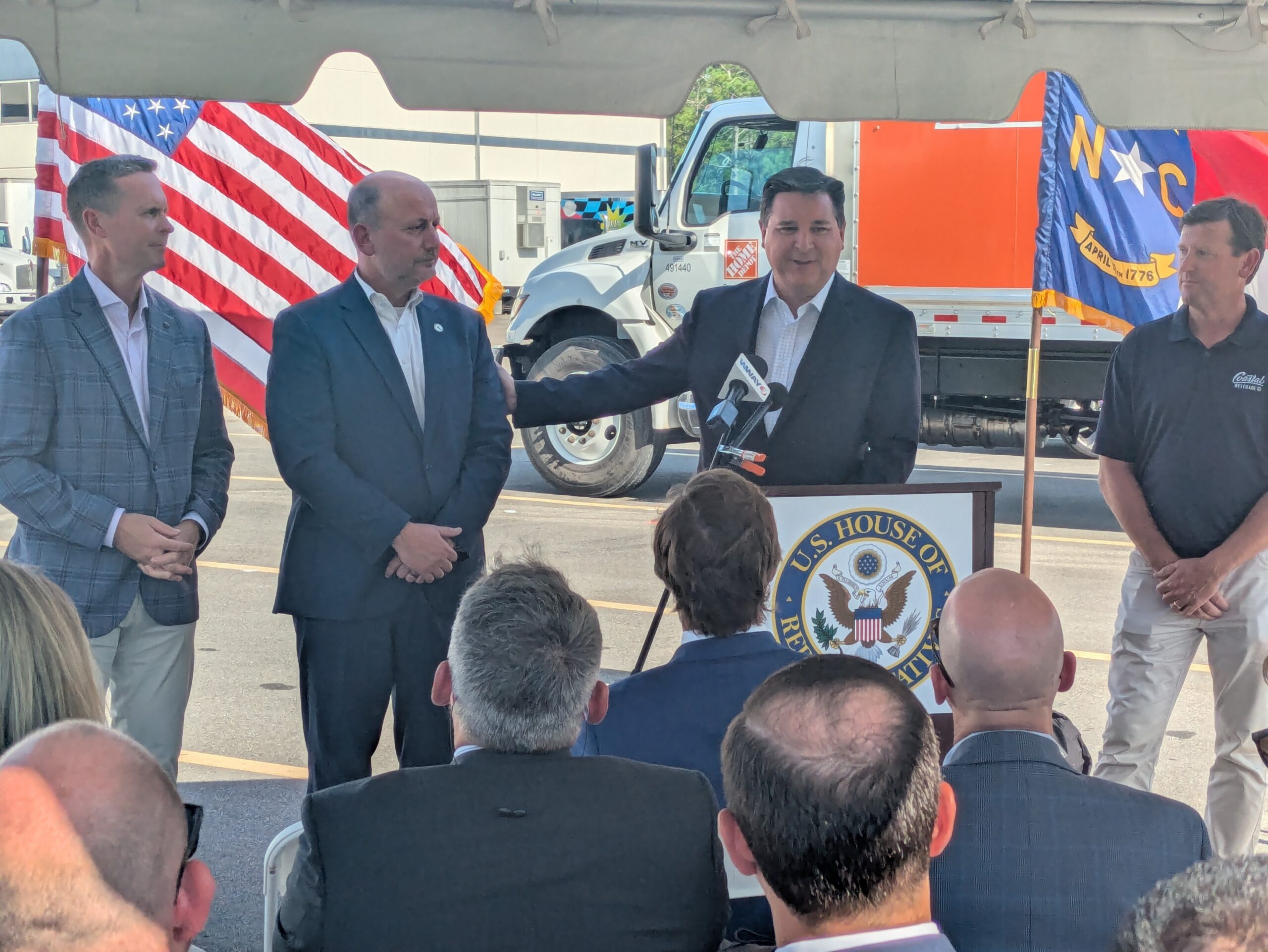
WILMINGTON — Local, state, and federal leaders met in Wilmington Wednesday to discuss the reauthorization of a key federal transportation bill impacting infrastructure, from local roads to national railways.
READ MORE: NCDOT will need hundreds of millions in additional funding each year to maintain highways
U.S. Congressman David Rouzer (R-NC-7), North Carolina Department of Transportation Secretary Joey Hopkins, Head of Government Affairs for the U.S. Chamber of Commerce Rodney Davis, and Coastal Beverage Company President Tee Nunnelee participated in a press conference at the Coastal Beverage Company in Wilmington to discuss a multi-year authorization that sets national transportation policy and funding levels, through a combination of dedicated funding and grants. The legislation impacts everything from highway construction to public transit, freight rail, and port infrastructure. The main goal is to provide states and local governments with long-term financial certainty so they can plan and execute major projects.
“Those who live around the Wilmington area or in Pender County and certainly in Brunswick County, know how much growth this area has seen, and quite honestly, our roads and bridges were behind the eight-ball,” Rouzer said.
On a local level, NCDOT Secretary Hopkins didn’t point to specific projects this bill would help fund, but referenced the Hampstead Bypass project as an example of the need for long-term federal funding. The $502 million Hampstead Bypass project broke ground in March 2022 to address significant traffic congestion along U.S. Highway 17, which sees over 40,000 vehicles a day. The project was recently awarded a $182 million federal grant for the second phase of construction.
“That project (Hampstead Bypass) will probably not be open until around 2030, we needed it probably in 2020 if not before,” Hopkins said. “We want to deliver those projects that the communities want, the communities need, and that they will use, in a more timely manner.”
Rouzer named the Cape Fear Memorial Bridge replacement as a project hindered by funding delays. He expressed apprehension over the project’s increasing cost; a 135-foot fixed span version of the project’s initial total costs were around $485 million and have since risen close to $1.1 billion.
“It’s going to require an innovative approach to address that kind of funding gap,” Rouzer explained. “But I can assure you that at the federal, state and local level, we’re all working to achieve that.”
The press conference followed a roundtable discussion on the bill featuring representatives from the NCDOT, the U.S. Department of Transportation, the Wilmington Chamber of Commerce and local businesses. Nunnelee expressed the new reauthorization bill should promote efficiency and adequate funding, particularly concerning highways and roads.
“We have about 150 CDL drivers that deliver product to every retail establishment with a small beverage license in eastern North Carolina. Not all of them are on beautiful highways and roads, we have to go everywhere and anywhere,” Nunnelee said.
Since the current reauthorization bill expires on Sept. 30, 2026, Congress needs to pass a new one within the next year to ensure continued funding for highways, transit, and other infrastructure. The previous reauthorization, signed into law in 2021, distributed over $550 billion to states and local governments for infrastructure projects.
The new bill will last five years before needing another reauthorization. Because the reauthorization is still in the draft phase, the total amount of funding for the next five years is uncertain.
The House Transportation and Infrastructure Committee has held nine hearings for its “America Builds” series to hear from stakeholders in preparation for writing the new surface transportation bill, intended to be a bipartisan effort. As chairman of the Highways and Transit Subcommittee, Rouzer has led five of the hearings on topics like truckers’ challenges and the Highway Trust Fund.
As part of the process to draft the bill, the committee has received more than 5,000 requests from local governments, industry groups, and transit authorities.
At Wednesday’s conference, Rouzer stated after hearing from stakeholders, the House T&I Committee is now focused on funding “traditional infrastructure” such as roads, highways, bridges, and railways, instead of “non-traditional” infrastructure. Rouzer used bike paths as an example for non-traditional infrastructure.
“I think if you ask most of the people around here, they’d rather have the money going toward roads and bridges and rehabilitation of roads and bridges and new roads and bridges,” Rouzer said. “We want to have a bill that addresses the most fundamental needs of the transportation infrastructure in America and the vast majority of the public agrees.”
Both Rouzer and Hopkins expressed a desire to cut red-tape and “streamlining” the permitting process for infrastructure projects in order to avoid lengthy timelines, but did not present a plan to do so. Rouzer referenced the Clayton Bypass in Wake County, which took a total of 18 years for completion as an example. One of the reasons for the project’s long timeline was a conflict concerning an endangered freshwater mussel species in the Neuse and Tar River Basins.
“When you streamline, that doesn’t mean that you’re cutting corners from an environmental standpoint or from an endangered species standpoint,” Rouzer stated. “It just means that you get the job done quicker and it’s not being held up unnecessarily.”
For example, the I-40 Pigeon River Gorge located in Western North Carolina, sustained catastrophic damage from Hurricane Helene in September 2024. NCDOT and the Federal Highway Administration worked together, receiving special authority to accelerate permitting and begin emergency and permanent repairs simultaneously. The roadway was reopened just five months after the storm.
Another goal of the transportation reauthorization bill for Rouzer and the T&I Committee is to identify new funding sources for the Highway Trust Fund.
The Highway Trust Fund finances most federal government spending for highways and mass transit — subways, buses and rail. Established in 1956 as part of the Highway Revenue Act, the HTF was designed to provide a dedicated and reliable funding source for the Interstate Highway System.
The HTF is funded through federal taxes, primarily the gas tax, and the surface transportation bill serves as the legislative vehicle to extend federal taxes. This ensures money continues to flow for infrastructure projects and helps address the fund’s significant shortfall. However, due to inflation, the gas tax has not been able to keep up with increasing project costs.
With spending consistently exceeding the revenue it takes in from the gas tax and other user fees, Congress has had to transfer more than $275 billion from the general fund since 2008 to keep it solvent. The federal gas tax — 18.4 cents per gallon — has not been updated since 1993.
In a recent April 2025 opening statement for a hearing on the HTF, Rouzer stated gas tax revenue “will continue to decline as cars become more fuel-efficient.” He specifically mentioned electric vehicles for requiring no fuel and therefore not paying into the HTF.
Trying to combat the loss of funds, the House T&I Committee approved a budget reconciliation proposal in April including new federal fees: a $250 annual registration fee for EVs and a $100 annual fee for hybrids. However, this specific provision was later removed from the final budget bill by the Senate, with concerns over the ability to implement and collect the fees.
North Carolina already has annual registration fees for fully electric and hybrid vehicles. The 2023 Appropriations Act established annual fees of $214.50 for fully electric vehicles and $107.25 for plug-in hybrids, which contribute to the state’s highway fund. According to NCDOT, the fee projected revenue for fiscal year 2024-25 is approximately $2 million.
Addressing funding issues, Hopkins said this bill is an “opportunity” to provide stable, steady funding for state infrastructure projects amidst North Carolina’s growing population.
The NCDOT has been over budget and faced significant shortfalls in the past. A 2021 state audit revealed the NCDOT exceeded its projected cash spending plan for the 2019 fiscal year by $742 million, in-part due to underbudgeting disaster spending. The department budgeted $50 million for disaster spending, only to spend $291 million as a result of the effects of storms like Hurricane Dorian.
In a financial turnaround from previous struggles, a January 2025 state audit revealed the NCDOT spent $7.68 billion from July 2023 through June 2024, about $580 million under its planned budget of $8.26 billion.
Rouzer said the goal is to finalize a draft of the reauthorization bill this fall and pass it out of the House by the end of the year to begin working with the Senate. He anticipates the bill will be signed into law next spring.
Have tips or suggestions for Charlie Fossen? Email charlie@localdailymedia.com
Want to read more from PCD? Subscribe now and then sign up for our morning newsletter, Wilmington Wire, and get the headlines delivered to your inbox every morning.
