


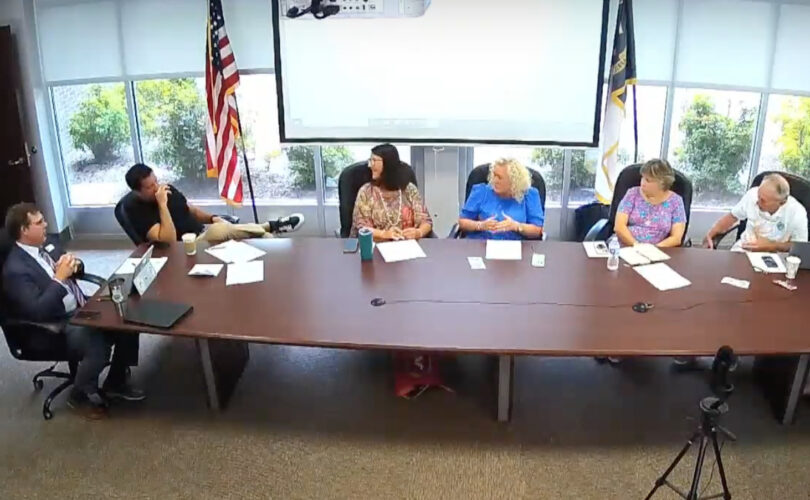
BRUNSWICK COUNTY — The Brunswick County Board of Education voted to pay for its students’ Advanced Placement exams this school year after the North Carolina Senate chose to nix its coverage in its proposed budget.
READ MORE: BCS proposes changes to failing student practices to promote learning, still combat absenteeism
The school board took up the issue at its Tuesday committee meetings. Though the North Carolina General Assembly has yet to pass a state budget, both chambers have proposed their own versions; only the House of Representatives’ is inclusive of AP funding at former levels.
The Senate has proposed cutting $14 million in funding to the exams, plus ending the state’s partnership with the College Board to expand AP offerings across the state. The money left for the program would be set aside for “economically disadvantaged students.”
The College Board requires AP exams to be paid for by Nov. 15, though submission after would incur a late fee. It is still unclear when the Senate and House will compromise on a budget, though the last approval in 2023 came on Sept. 22. With the new fiscal year starting on July 1, the state is operating under a continuation budget with line items set at last year’s level.
Presented by Assistant Superintendent Jonathan Pascal, Brunswick County Schools’ plan for the loss of funding was to notify parents they would need to pay for the exams, administered at the end of the school year, unless they wanted to be evaluated for economic hardship. Some board members had other inclinations.
“I think this board needs to step up and cover the cost for the exams that are elected to be taken,” said Chair Steven Barger, noting families have already registered for classes with the understanding the exams — mandatory per Brunswick County Schools policy — would be free.
AP classes are designed to essentially give students a head start on fulfilling some of a university’s general education requirements, where the same credit could cost hundreds of dollars; the typical class at UNCW costs $923.40 with fees.
Right now, the state funds the full cost of AP exams, $99 apiece per student. Thus, a student taking multiple AP classes in one school year could rack up hundreds of dollars to be tested on their courses.
The district administered 828 exams last school year for 576 students last year, costing $82,269. Pascal said the district is executing a slight uptick in that number this school year, but BCS did not provide by press the exact number of students enrolled or expected exams to administer this year.
The school board largely agreed with Barger’s call to action, though member Steve Gainey suggested it not be a continuing expense.
“We would just make them aware that this is a one-year program,” Gainey said.
He said then families would be able to decide on registering for classes under the new circumstances (should the Senate get its way with AP) in the next school year.
However, the board was more divided on whether to continue making exams mandatory, particularly for students failing the class. Board member Vickie Smith questioned why the board would pay for a failing student, as their grades would indicate how well they would do on the exam.
Superintendent Dale Cole pushed back, questioning why the district wouldn’t uphold the exam requirement.
“When they signed up for their AP classes, it was under the notion that the exam was going to be paid for, and they knew that they were going to be required to take the AP exam if they took that AP class, and they signed up for the class because, presumably, they wanted to earn the college credit,” Cole said.
Students need to earn a high enough score on an AP exam, the scale being 1 to 5 to gain credit; many colleges take a score of 3 or higher, though more prestigious universities may exclude 3s. According to Pascal, 72% of Brunswick County School students are passing their AP exams.
He said they could amend the policy to let failing students off the hook, but noted the data provided through test scores was valuable to the district.
“I have seen quite a few students who were passing the AP class doing well, but through my observations of maybe the teacher in the classroom. I had questions about the quality of instruction in the class,” he said, insinuating the standardized AP exam could act as a check on the class’ rigor.
Cole noted teachers that were consistently producing “not great” results on AP exams could be removed from teaching the course.
The board left the question to be decided on in the future, though still indicating they would pay for however many exams there turned out to be. Port City Daily asked where Brunswick County Schools would pull money from to set aside for exams coverage; after publication, the district said the money would be pulled from the district’s accumulated fund balance.
“This decision will eliminate, I think, a lot of mass chaos in the coming year for the counselors,” Cole said.
Port City Daily also reached out to Pender County Schools and New Hanover County Schools for their contingency plans if the funding should be lost; neither responded by press.
Reach journalist Brenna Flanagan at brenna@localdailymedia.com.
Want to read more from PCD? Subscribe now and then sign up for our morning newsletter, Wilmington Wire, and get the headlines delivered to your inbox every morning.
