


SOUTHEASTERN N.C. — Though work to repair the riding deck of the Cape Fear Memorial Bridge is starting a bit later than anticipated, the goal is still to be done before Memorial Day.
READ MORE: 5-month lane shutdown slated for costly CF bridge deck replacement
ALSO: Roughly 500 trucks will detour to S. College Road during 5-month bridge closure
The North Carolina Department of Transportation announced Wednesday full closures for inbound traffic from Brunswick County into Wilmington will begin Jan. 28. Previously, NCDOT estimated work to begin Jan. 3; however, that date was not set in stone. NCDOT was awaiting material delivery — ordered in October — and working with its contractors over the last two weeks to finalize a schedule.
On Jan. 11 Southern Road and Bridge — awarded $7.1 million on Nov. 30 to oversee the project — will start prepping its work area for the five-month project to repair stringers and replace the riding deck.
From 7 p.m. to 5 a.m., Jan. 11 to Jan. 27, set up work will begin. The two outside lanes of the bridge will be temporarily closed first to build a platform that will allow crews to work on the underside of the bridge. The contractor will then close the two interior lanes temporarily overnight to install a concrete barrier wall to protect workers from traffic while the main construction is underway.
By Jan. 28, both eastbound lanes will shut down so crews can remove the deteriorated stringers, holding up the deck, and install new ones and a new deck. If all goes as planned, all lanes of traffic will reopen after March 31 to allow for the influx of visitors to Azalea Festival, taking place April 3-7.
“While that is not a guarantee, that is our ultimate goal,” Kimes said.
On April 9, the two westbound lanes, heading from Wilmington into Brunswick County, will shut down until May 23, prior to Memorial Day, to replace the other half of the deck.
All dates are subject to change.
“Our schedule is as aggressive as it can be,” Kimes said.
If even one day of work is lost due to weather or other factors, he said it will be added to the end of the schedule.
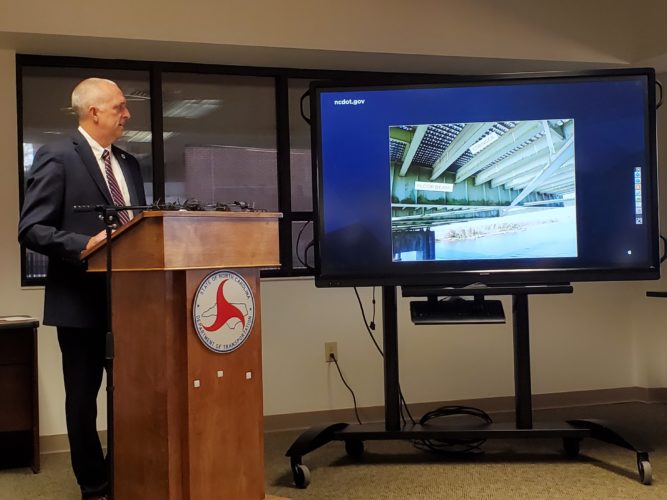
The reason two full lanes must be closed at a time is based on the design of the bridge. The stringers run parallel with the roadway above it and are designed from the edge of the bridge to the center, then from the center to the other side.
Kimes explained while NCDOT preferred to have one lane in and one lane out, it wasn’t feasible for tractor trailers to traverse an abrupt lane change without side swipes.
He also confirmed crews will be working around the clock, seven days a week, to ensure repairs are done as timely as possible. While there could be some night work done — such as material delivery and preparation, engineering and construction analyses and traffic meetings — most on-the-bridge labor will occur during the day.
“I want to make it clear: Safety is first on this project,” Kimes said. “We’re not going to risk anything dangerous. Stringers is one thing you do not want to do at night. You want all the light that you could possibly have to put stringers in; it’s dangerous work.”
NCDOT is negotiating with Southern Bridge about possibly hiring an additional crew to speed up the process. Kimes said NCDOT is willing to pay whatever it takes to get this project done in the most efficient way.
“This is a very skilled and limited trait in the nation,” Kimes said. “There’s not many folks in the nation that do this type of work.”
He added NCDOT will continue to push for as many people as needed on the project as work is ongoing.
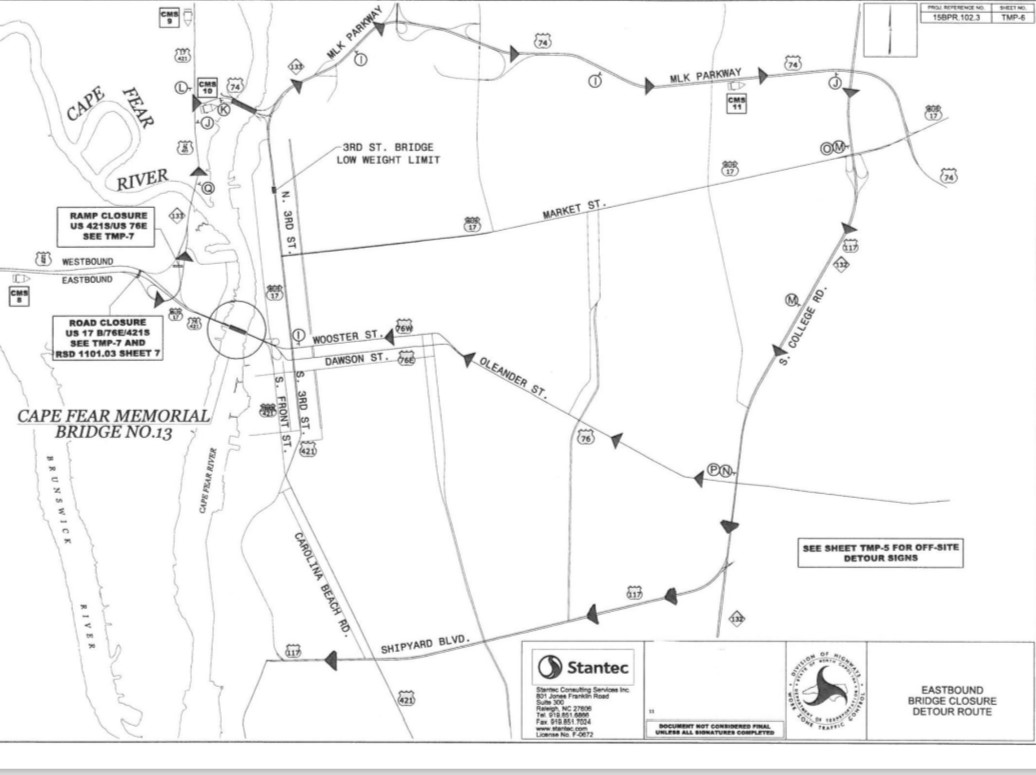
Where will traffic go?
NCDOT will place signage directing traffic to follow two different detours: Isabel Holmes Bridge to Martin Luther King Jr. Parkway to College Road and using I-140.
Container trucks headed to the Port of Wilmington will not be allowed to traverse Third Street, as determined by the City of Wilmington, due to safety, but the roadway will remain open to vehicles.
At least a dozen message boards will be installed along impacted routes to alert drivers where the congestion is and what the preferred alternate route would be.
Once NCDOT enters the lane closures into its system, DriveNC.gov, real-time information will be available to the public. Google, Apple and Waze will also sync the data to alert drivers using various mapping apps as to the best route to take at that time of the day.
Emergency management teams are meeting weekly to discuss tactics and operations to reduce response times on either side of the bridge, New Hanover County emergency management director Stephen Still said Wednesday.
WMPO is also encouraging employers to offer alternative work schedules or encourage carpooling to reduce the number of vehicles on the road. Wave Transit is considering increasing its ride-sharing program to assist but details haven’t been fleshed out.
CATCH UP: WMPO asks regional employers to help with relieving congestion from bridge closure
Kimes said NCDOT will review all impacted intersections to amend traffic signal timings and alter turn lanes as needed.
NCDOT’s Incident Management Assistance Patrol program (IMAP) is typically activated when an accident occurs, or a vehicle is stranded due to flat tire or running out of fuel. The patrol program assists with clearing the road to keep traffic moving.
During lane closures, Kimes anticipates doubling the amount on duty. At least five IMAP trucks — equipped with traffic control devices, fuel, jumper cables — will patrol seven days a week, working double shifts during daytime hours.
Any other planned road work, such as repaving and repairs, scheduled along routes that will face heavy congestion will be reviewed and likely delayed, according to Kimes. For example, NCDOT already postponed the repaving of I-140 in Leland to avoid compounding traffic issues in Brunswick County for vehicles headed into Wilmington.
“Never in all of our careers have we been on a project that’s going to impact this amount of people,” Kimes said.
On average nearly 70,000 vehicles cross the Cape Fear Memorial Bridge daily.
NCDOT welcomes comments from residents, employees and employers for ideas the agency has considered or overlooked, he said. For example, someone asked recently about using a ferry to transport people from Brunswick County into Wilmington.
“We hadn’t thought of the ferry at that point, so we’re reviewing that,” Kimes said. “So feedback is very important to us as we move forward.”
NCDOT will continue to hold media conferences throughout the repair work and also promised to send a representative to attend any commissioner and council meetings they’re asked to.
The response comes after some local officials — specifically New Hanover County commissioners and Wilmington City Council — commented on the lack of communication from NCDOT. County commissioners invited NCDOT representatives to both their Dec 8 agenda review and Dec.11 board meeting to provide updates.
However, a presentation was not on the agenda and NCDOT spokesperson Lauren Haviland said the agency did not have any additional information to share at the time, as meetings with the contractor were ongoing.

Imminent repairs
About a year ago, Kimes said, NCDOT noticed the stringers were fracturing on a regular basis.
“Every single morning when we have daylight, this bridge deck is inspected,” he said.
As the fractured stringers are identified, crews are performing temporary fixes — at least every other day, Kimes said.
To determine the cause, NCDOT surveyed the entire structure. What crews found was continual “sagging” of the deck; the riding deck was not flush and level. Temporary shims were installed to assist with a smoother ride, but replacement was imminent.
“So, our culprit are the stringers,” Kimes said. “Which is what made this project very challenging because, basically, you’re stripping it down.”
By spring, NCDOT hired engineering design firm, Modjeski & Masters, which had worked on the Cape Fear Memorial Bridge in the past for $136,000. The goal was to have a construction contract in place by Jan. 1, which Kimes said would “be a miracle if we could do that.”
While Kimes attests the bridge is safe, he did not want to wait another year for repair work. He also did not want to head into hurricane season 2024 without a replacement deck.
The design work took approximately four months, and NCDOT informed Wilmington Urban Area Metropolitan Organization in May the project was forthcoming; dates and deadlines had not yet been solidified.
To be proactive, NCDOT decided to order the needed earlier this fall; typically, the hired contractor handles that. However, Kimes said he knew steel is hard to procure and didn’t want to face any potential delays.
Southern Road and Bridge was awarded a $7.1-million contract Nov. 30.
Once complete, the riding deck should last at least 10 years, but the stringers could withstand more time.
The deck was last replaced six years ago as a temporary fix. It did not live up to the typical 10-year lifespan due to the stringers.
“At that time, they did not have this amount of sag in the stringers,” Kimes said.
The 1969 Cape Fear Memorial Bridge is fully inspected every other year, which helps determine what repairs or replacement are needed; however NCDOT Division 3 assistant division construction engineer Trevor Carroll said nothing else is known as “fracture critical” as the stringers at this time.
While considered functionally obsolete, the bridge is costing the state nearly half-a-million dollars annually to maintain. Officials have been working since 2020 to find a way to pay for a replacement structure, to be built just south of the current one.
Due to the extensive price, at least $400 million, the bridge has not scored high enough in NCDOT data-driven formula to be considered for state funding and scheduling in its long-term plan. WMPO will consider next month whether to submit the bridge as a tolled version as well, to see if reducing the overall cost, offset by toll revenue, would help increase its score to pass muster.
ALSO: Is pursuing a toll the way to replace CF Memorial Bridge? State official says yes
Tips or comments? Email amy@localdailymedia.com.
Want to read more from PCD? Subscribe now and then sign up for our morning newsletter, Wilmington Wire, and get the headlines delivered to your inbox every morning.
