


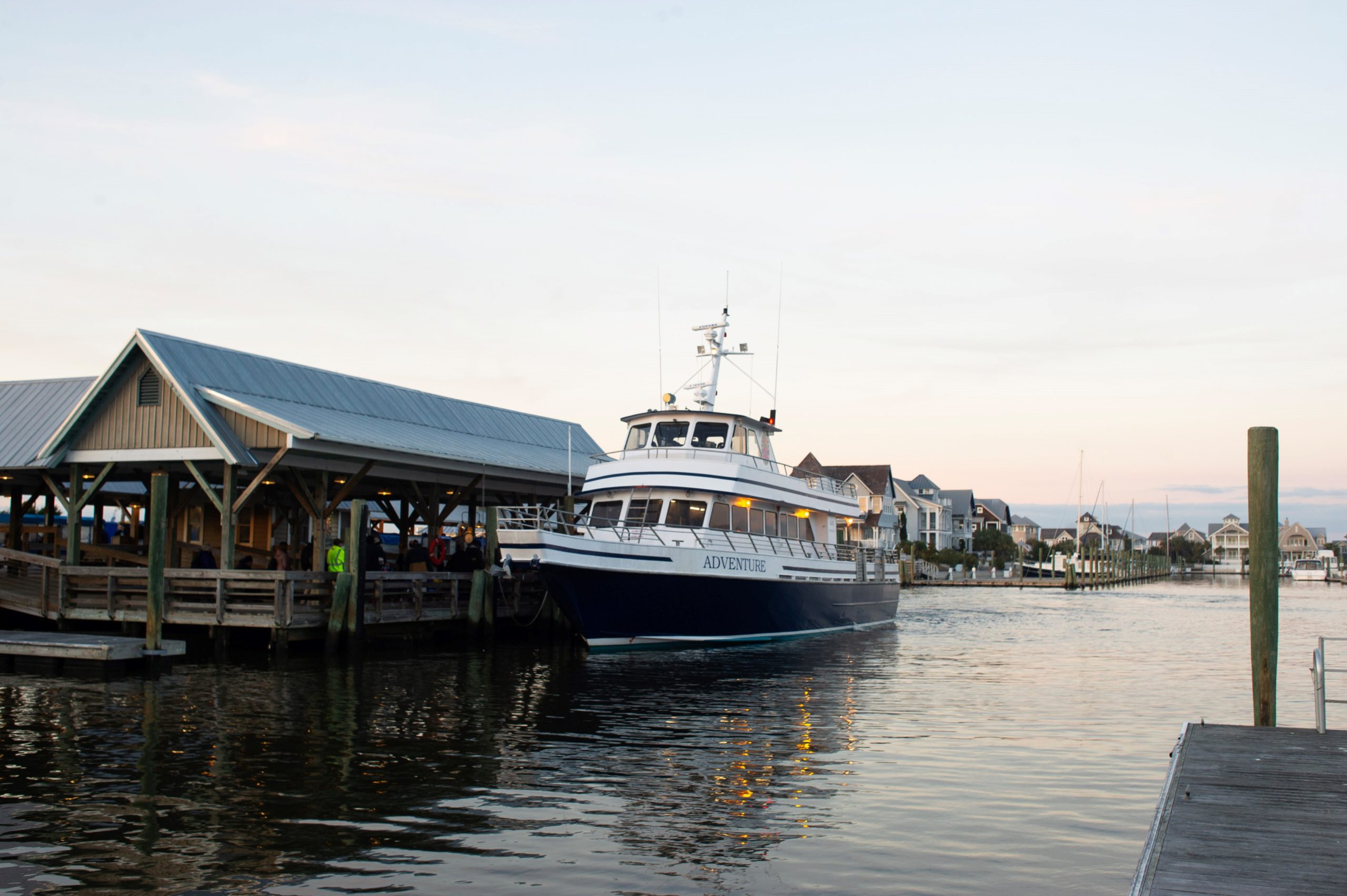
BALD HEAD ISLAND — A lawsuit surrounding the Bald Head Island ferry sale just became the new chapter in a decade-long saga.
After announcing the sale of the ferry system to a private company last spring, owner Bald Head Island Limited gave the Village of Bald Head Island a chance to purchase the transportation service four months later — and the village turned it down.
READ MORE: Utilities commission will regulate entire ferry system, calls assets “de facto monopolies”
ALSO: Bald Head Island ferry selling to private company after public deal stalls
However, the village maintains it still has the right to purchase the ferry under a 1999 right-of-first-refusal agreement. BHIL disputes this, saying the agreement was never valid and its offer was a “good faith” measure, rather than a necessity.
Now, BHIL is asking the court to rule on the matter.
Bald Head Island steward and landowner George P. Mitchell owned the ferry system, the sole public transportation mode to the island. After his death in 2013, BHIL set out to settle Mitchell’s estate and divest various assets, ferry included.
BHIL’s goal was to sell the ferry to a public entity; the North Carolina General Assembly created the Bald Head Island Transportation Authority in 2017 and mandated it to purchase the ferry for $47 million. However, that deal was derailed by Local Government Commission leaders and the Village of Bald Head Island.
The village cited many problems with the deal — the system’s appraisals, lack of village representation on the authority — and claimed it should buy the ferry system itself, but BHIL never entertained the bid until last fall.
In May 2022, BHIL agreed to sell it to Raleigh-based investment company SharpVue Capital for $56 million. The transfer awaits North Carolina Utilities Commission approval.
With the deal pending, BHIL decided to give the village one shot at obtaining the ferry system.
In a Sept. 6 letter to village Mayor Peter Quinn, BHIL provided an offer for the village to purchase the property under the same $56-million agreement given to SharpVue.
Only valid for two months, the offer essentially allowed the village to exercise its rights under a 1999 right-of-first-refusal agreement, which never took effect. The ROFR stipulated its contents must be approved by the utilities commission; it never was. It is unclear why it never made it to the NCUC.
Still, BHIL offered to honor the deal. The suit states BHIL actions were “in good faith and in an attempt to avoid future doubt and litigation.” However, the offer was not an acknowledgement that the ROFR agreement was valid.
After two months of correspondence, the village declined the offer on Nov. 2. It maintains BHIL did not follow the stipulations outlined in the ROFR. It claimed the agreement was binding, despite the lack of NCUC signature.
BHIL disputed the village’s claims in a follow-up on Dec. 19 and said the time for the village to purchase the ferry assets had passed. BHIL asked the village to state, in public and in writing, that it declined to exercise any rights it had under the 1999 agreement and those rights have terminated.
The village refused to do so.
The Right of First Refusal
The ROFR between the village and BHIL was drafted, signed and delivered to Brunswick County Register of Deeds in 1999. In the event BHIL was to sell the ferry, it granted the village 60 days to purchase it, along with supplemental assets unrelated to the ferry. The price would be set at the same rate as a third-party buyer.
According to Port City Daily reporting, the village agreed to waive its rights in the ROFR in September 2020, but that waiver expired Aug. 31, 2021.
The following month, BHIL CEO Chad Paul said the agreement was dead on arrival, despite the village’s stance that it was valid.
“I’m not worried about the right of first refusal being a problem,” he said then. “Does the village throw a lawsuit out there on it? Sure. But I don’t think it’ll stand up to muster very long.”
In its recently filed suit BHIL’s position is that the ROFR agreement was never valid. A stipulation mandated the contract be approved by the utilities commission. In May 2021, the NCUC confirmed it had no record of signing off on the agreement.
When the transportation authority was created, it had an obligation to purchase the ferry, yet BHIL did not have to sell it to the authority.
However, BHIL agreed the best steward would be the public entity, made up of representatives from Brunswick County, Southport, the North Carolina Department of Transportation, the Village of Bald Head Island, and the North Carolina General Assembly.
The village disagreed.
In a letter to the Local Government Commission, which had to sign off on the authority’s bond to pay for the ferry, the village cited potential increases to ferry fees, alleged one-sided consulting documents, the authority’s apparent lack of an official credit rating, and concerns about overpaying for the system and not being able to pay for improvements without raising fares.
However, raising rates would require NCUC approval. While the ferry and tram have been regulated by the NCUC since 1993, the commission recently ruled to include the barge and parking components.
The village submitted in March 2021 its own higher bid for the system — $54 million — to compete with the authority’s deal. Though a public entity, the ferry’s village residents would be the sole controllers if purchased, which raised concerns among other stakeholders like Southport and Brunswick County.
The offer was dismissed by BHIL, which still wanted to comply with the state mandate and sell to the transportation authority.
The deal again stalled when it reached the LGC, with State Treasurer Dale Folwell and State Auditor Beth Wood also questioning its merits. Wood criticized the two commissioned appraisals that went into the sale price.
The BHIL-BHITA deal never made it on the LGC agenda.
Tired of waiting, BHIL moved forward to sell to a private company in May 2022. The price is $56 million, plus $11.2 million in other assets and businesses formerly owned by BHIL.
Not over yet
After the sale announcement in May 2022, BHIL, SharpVue and the village representatives met to discuss the transaction. According to the lawsuit, the village ended discussions after two months.
On Sept. 6, BHIL notified the village it had 60 days to exercise its rights under the 1999 ROFL and purchase the ferry system for $56 million. However, BHIL excluded the supplemental assets unrelated to the ferry system from the ROFR and said the agreement would still need NCUC approval.
The village responded Sept. 20 by stating it was entitled to all assets under the ROFR and claiming it was still valid. It also asked for additional information, including the offer to SharpVue and all appraisals, reports and studies pertaining to the properties.
Eight days later, BHIL provided the asset purchase agreement, but refused to hand over other requested items because the 1999 ROFR “does not require such delivery.” In return, BHIL gave the village permission to conduct its own appraisals and studies at the ferry facilities, which it claims never happened.
The village responded on Nov. 2.
“The Village cannot accept the terms proposed in your correspondence,” the letter, signed by Mayor Quinn, stated.
The letter claimed the village could not complete its due diligence since the asset purchase agreement with SharpVue did not include requested information, such as the sale price and specific assets to be sold. BHIL maintains it provided information as required under the ROFR.
The letter also stated the village was not given a “timely” notification that BHIL received an acceptable offer to purchase.
BHIL claims the village denied the deal because they would be directly contradicting their previous stance: the village claimed the $47 million deal between BHIL and the transportation authority exceeded fair market value.
Though the village denied the deal, it wrote back on Dec. 28 it is not revoking its rights.
“BHIL and BHIT cannot unilaterally force the village to acknowledge the termination of its rights under the ROFR, which remains a valid and binding agreement,” the letter states.
Intervention
Following the village’s denial, BHIL is now moving on. Essentially, the lawsuit is about restoring integrity to its deal with SharpVue.
BHIL is seeking legal action due to the village’s “baseless, continuing insistence” over the last five years that it has the authority to purchase the assets. The lawsuit requests the court to rule the village had no purchase rights and BHIL had no obligation to sell under the ROFR because it was never approved by the NCUC.
BHIL is also asking the court to remove “the cloud on title,” or doubt on the purchase, which it says was created by the village’s protests of the sale.
According to the suit, SharpVue’s attempts to secure title insurance for the ferry purchase have so far been thwarted due to the village’s claims. Plus, the utilities commission still has to grant its approval.
“Should the pending sale to SharpVue fail to close by reason of the Village’s failure to cooperate in removal of the 1999 agreement from the public record, sellers will pursue legal claims against the village for considerable monetary damages,” reads a Dec. 19 letter signed by BHIL CEO Chad Paul.
In a Dec. 28 follow-up, the village replied it would defend its rights under the ROFR agreement, “through litigation if necessary.”
Responding to BHIL’s filing, village spokesperson Carin Faulkner said “the village will review the declaratory judgment claim and timely respond.”
Catch up on Port City Daily’s coverage about the Bald Head Island ferry sale:
- Bald Head Island board, told four years ago to purchase ferry system, asks for help
- Second appraisal of ferry assets shaves about $3M off value as Bald Head seeks its own bonds
- ‘Playing out the clock’: Bald Head village formally initiates bond process to purchase ferry system
- Savior or sabotage? Village faces pressure from Brunswick, Southport in Bald Head ferry sale
- After objecting to state acquisition, Bald Head Village Council wants ferry for itself
- State treasurer asks Bald Head Limited to donate $47 million ferry system, company denies request
- Trouble in paradise: Bald Head Island Council objects to private-to-public ferry sale
- Deep Dive: Inside the three-year, unique, $47 million private-public Bald Head Island ferry transaction
- Two years in, Bald Head Island Transportation Authority still negotiating ferry acquisition
Reach journalist Brenna Flanagan at brenna@localdailymedia.com
Want to read more from PCD? Subscribe now and then sign up for our newsletter, Wilmington Wire, and get the headlines delivered to your inbox every morning.
