


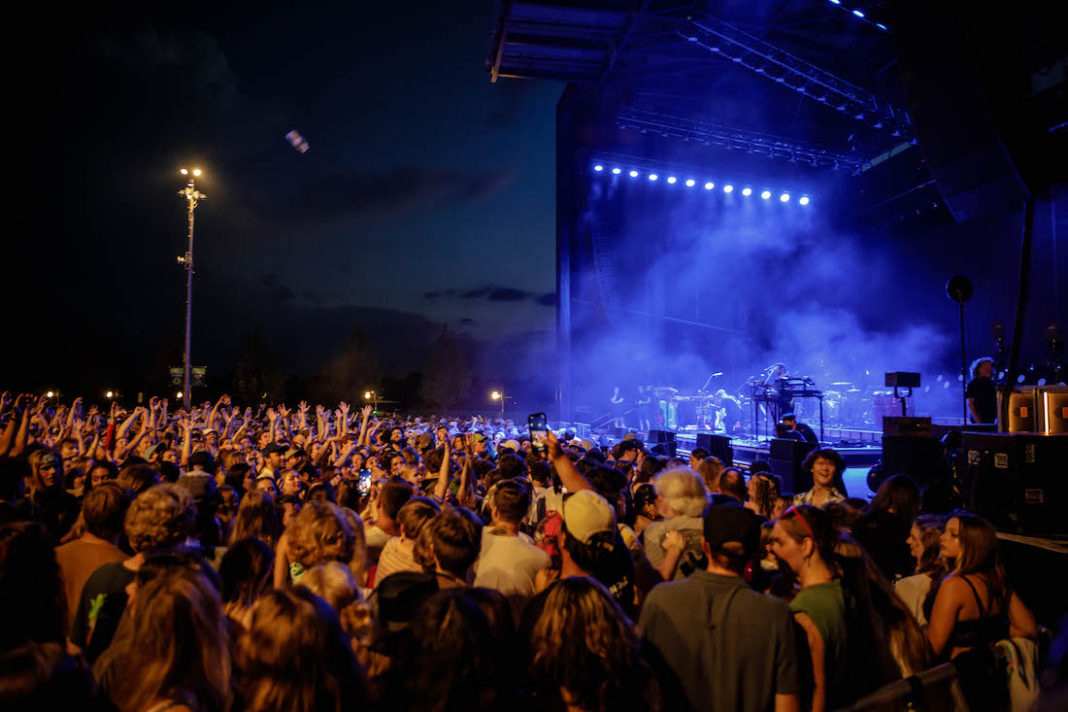
WILMINGTON — More in-person tickets will become the norm for every show booked at local Live Nation venues, according to its general manager Ryan Belcher.
Belcher spoke to Wilmington City Council Monday at its agenda review briefing saying Wilmington is one of three markets to begin reserving more tickets for box-office sales only.
READ MORE: Hundreds of tickets to be released to sold-out GFLA shows, available at box office only
“The music demand is strong here,” he said.
The move comes after hundreds of people flocked to purchase roughly 800 tickets to sold-out Greenfield Lake Amphitheater concerts on Saturday.
By 10 a.m., 150 people snaked the sidewalk in front of the venue to score a seat to high-demand shows, many of whom weren’t able to access tickets because of how quickly concerts maxed out due to online sales. To assuage grumblings from the public, Live Nation’s goal was to put more tickets into locals’ hands.
It’s a move that Belcher said the company has been working on over the last month. The model will be utilized at both venues, including Riverfront Park’s Live Oak Bank Pavilion, throughout the rest of the concert season.
Mayor Bill Saffo asked how many more tickets it will result in being available in-person and whether it would be denoted on Live Nation’s website for buyers to see.
“It could be 1,000 tickets, it could be a couple hundred tickets,” Belcher said.
Every concert will be different, and public notification will mostly happen through Live Nation’s local social media accounts.
Recent Live Nation’s ticketing demographics determined 33% of buyers from its two Wilmington venues came from three Cape Fear counties, with 67% of tickets sold in various zip codes outside the area. That’s up from when Belcher last reported to council in January that the 2022 season had 59% of buyers living outside of the Wilmington area.
Half of Greenfield Lake’s 18 concerts are at capacity. Roughly 20 more will be announced this year, Belcher said.
Around 21 shows have been booked at Live Oak Bank Pavilion, with almost half sold out. The venue is approved for 30 shows a year.
Altogether that puts Live Nation bringing in 70 shows for the 2023 concert season.
Holding back more in-person tickets means reduced fees for buyers as well. Though an online fee is scrapped, there is still a service fee for purchases made face-to-face.
Prices for four Indigo Girls tickets, available in person Saturday, show a breakdown of:
- $45 face-value ticket
- $6 service fee per ticket
- $.0.42 tax per ticket
By comparison, when purchasing four tickets online, it included:
- $45 face-value ticket
- Processing fee of $5.36
- Service fee of $7.75 per ticket
- $0.55 tax per ticket (which include fees)
Ticket fees online increase when the price rises, according to demand and resells. For instance, sold-out Indigo Girls’ tickets are listed for the GFLA show at $204 each through Live Nation’s verified resellers. It includes a $39.27 service fee and $2.95 order processing fee.
Belcher confirmed to council additional in-person tickets will be for a variety of shows and seats at both venues. Though GFLA is general admission only, Live Oak Bank Pavilion’s concerts often include sectioned seating and general admission for lawn.
“We’ve opened up the VIP deck as well,” Belcher said, referring to the Riverfront Park pavilion. “The VIP deck will typically have season ticket holders, but you can get a VIP, like an add-on to a ticket. We’ve limited that number to only 26.”
Councilmember Charlie Rivenbark wanted to know if the local box-off tickets are secured on the honor system for Pender, Brunswick and New Hanover residents.
“The reality is someone from Arkansas isn’t coming to the box office to pick up tickets,” Belcher said. “So we’re not checking IDs or anything like that.”
However, Belcher used examples of in-person ticket releases for Phish and Dave Matthews Band, saying everyone he spoke with in line were from Wilmington — “with the exception of one from Myrtle Beach. So those are the folks that are showing up.”
“So there is no foolproof way?” Rivenbark asked. “It’s not that I’ve got a problem with somebody coming from Little Rock, Arkansas. The problem is what Cliff was referring to: People buy them and then turn around and resell it.”
Councilmember Clifford Barnett inquired as to whether there was a way to stop scalpers at a local level. Though not a part of Belcher’s reach, he said Live Nation is working on it nationally.
“They are meeting with policymakers to try to do some reform on limiting bots and scalpers,” he said. “Those are the worst thing for ticket prices. Essentially, those will just all get bought up and then, before it even can go on sale to the public, those prices are significantly more when bots are involved.”
The only North Carolina laws to stop scalpers currently surround in-person ticket buys, not online sales. Bots and scalpers online often scoop up thousands at a time. Belcher confirmed both local venues sold tickets to buyers from every state in the nation last year.
Councilmember Neil Anderson questioned some of Live Nation’s secondary reselling practices, which began when Ticketmaster merged with the company in 2010. He echoed complaints that have been waged by live music fans: Five minutes after a concert goes on sale, people can’t find face-value tickets — only those available at higher prices from Live Nation’s verified resells.
“So the suspicion — as you’ve heard, I’m sure — is that you’re not even selling those tickets the first time, you’re selling them at that higher price,” Anderson surmised.
“I can assure you that that is not the case,” Belcher responded.
The in-person ticket-buys are limited to four per person; online sales normally have an eight-per-show limit.
In-person tickets aren’t delivered as paper printouts, part of Ticketmaster’s concert-going experience decades ago. At Live Nation’s box office, tickets are obtained electronically via text that syncs to the Live Nation app. Those tickets can still be resold on third-party sites or on Live Nation’s verified reseller platform, for which it collects the fees for both initial sales and resales.
On Saturday, Live Nation released 100 tickets to eight sold-out shows at Greenfield Lake Amphitheater. Anderson was curious how a concert can sell out and Live Nation releases more tickets.
“I got an earful this weekend that you were just overcrowding,” he said. “In other words, we’re doing this to appease people, but the place is sold out, so how can there be 100 more seats at a venue that holds 900 people?”
Greenfield Lake is advertised on the city website to hold 1,200.
“I will never mess with the capacity thing for safety reasons,” Belcher clarified, adding the concert tickets were held back in advance. “The reality is, we release tickets fairly often — most of the time it’s from a band that holds back a certain amount, then they don’t want to use them, those tickets get, obviously, released back out.”
READ MORE: Has Live Nation priced concert-goers out of big-ticket shows?
Councilmember Luke Waddell wanted verification that the window to secure the in-person tickets would be generous for buyers.
Belcher said the tickets will be released at the box office the same day a concert goes on sale. All that remain unsold will then go online after the box-office closes for the day.
Diversifying shows, vendor markets, food trucks
Access to tickets weren’t the only concerns local leaders had for Belcher. Diversifying shows remained important to councilmember Kevin Spears.
“For a lot of the talent, we get complaints saying ‘too much soft rock,’ ‘too much country,’” Spears said. “I don’t know if the three counties outside of Wilmington are influencing what talent is brought into Wilmington, and I did hear you mention diversity when you first came to the microphone, but I’m just curious as to the selection process of the entertainment.”
Multiple factors play into booking decisions: a band or musician’s availability, touring routes, Live Nation historical data to determine what sells, and whether an artist wants to come to Wilmington.
Of the 38 shows announced for Wilmington so far this year, the majority includes rock — which encompasses various sub-genres, from indie to jam bands — and country. Only a handful of R&B artists have been booked (Boyz II Men and Allen Taylor, for example), with some jazz, world and reggae acts.
“Citizens feel like you’re playing it safe,” Spears said. “Because it is Wilmington, you’re booking acts that are definitely going to bring bodies to the amphitheaters, but there’s an investment and the return on investment.”
Belcher said with more announcements coming, he believes the management company will “check some boxes” to add an assortment of more artists. Spears suggested they ask citizens firsthand who they want to see, which Belcher was clear Live Nation hears from constantly.
“They’ll comment who they don’t want to see when we announce a band,” he said. “But the general public is very vocal on letting us know what they want.”
He pointed to surveys that go out to from Live Nation after concerts asking for consumer feedback on the experience. Last year Greenfield Lake Amphitheater ranked the first in Live Nation’s portfolio of more than 250 venues at 98% positive feedback.
The pavilion downtown ranked in the top 80%, Belcher said.
One of the foremost complaints Anderson hears about is in regard to the centrally located sound booth tent at Live Oak Bank Pavilion, which blocks viewership.
“Is there any solution there?” he asked. “We didn’t put a ton of grade in the lawn, so it’s a problem.”
Live Nation has a few plans working to create a lower visual profile of the booth, and by the end of the year Belcher said he hopes to have a fix in place.
Another concern of Anderson’s came with food trucks. Live Nation runs its own food trucks in the two venues and brings in third-party locals as well.
Anderson specified an incident during a show last year when he attempted to get food from a Live Nation truck. But it didn’t have a license to operate, so it was closed.
“There was zero food — none,” Anderson said. “I mean, not even concessions selling hot dogs. So you’ve got all these people hammering beers and you got nothing. I mean zip. And that’s inexcusable.”
Belcher said the issue has been remedied. Live Nation added more food to concessions at GFLA, and are ensuring its company food trucks are always parked and permitted. Plus, he said they are strengthening local relationships and promoting food trucks it works with for each show on its social media platforms.
“Our social media for Wilmington has a better reach than our counterparts and engagement than our counterparts in Raleigh and Charlotte, in much bigger markets,” he said.
Yet, food trucks can drop out if they think a show won’t be well-attended.
“We don’t force them to come,” Belcher said.
Live Nation functions on a warning system when vendors don’t follow through on scheduled events, but it hasn’t had to ban anyone yet, Belcher added.
Anderson claimed he has experienced inconsistencies with some Live Oak Bank Pavilion shows having nine trucks and other times only three, causing unmanageable lines. Improvements have been made on that front, Belcher responded, with the goal to have equitable food-and-beverage ratio to attendance.
“Things happen, especially with small operators that are running a food truck,” Anderson said. “Food truck may go down, a cook doesn’t show up. … all of a sudden people are upset about it. And, unfortunately, you’re the ones getting blamed for it. And we are too.”
The council pointed to an Azalea Festival mixup last year as an example. A food truck vendor claimed to be pre-booked for one of the festival concerts but was turned away upon arrival; Live Nation and the city maintain the vendor didn’t show.
CATCH UP: Local food trucks turned away from Azalea Fest concerts causes stir
Belcher said the vendor apologized and has worked with Live Nation since.
“Never apologized to us, but that’s fine,” Mayor Saffo said.
Spears chimed in about constituents fretting that Greenfield Lake Amphitheater is losing its “homegrown-type” feel.
“Neil brings up a good point about the food trucks,” he said. “You bring the entertainment, you’ve taken over the venue, and now you supply the food trucks as well. It feels a little like a monopoly.”
Plans are on the horizon to engage more locals this year across the board, according to Belcher. Live Nation is starting vendor markets ahead of some shows on GFLA campus, including this weekend’s two-night Lukas Nelson concert. An artisan market will be set up featuring locals selling art and homemade wares — a platform free of charge to vendors who sign up.
INTERVIEW: Coming through the fire: Lukas Nelson talks latest album ahead of Wilmington concerts
As well, Live Nation worked with eight local breweries at both venues last year and sold over 18,000 cans of local beer, Belcher reported. At Greenfield Lake, he noted they will continue to work with Front Street Brewery that did “almost all of the shows.”
Other businesses highlighted were Casa Blanca Roasters’ coffee served backstage, as well as band catering from Salt + Charm if needed.
Heather Wood, the operations manager of Greenfield Lake Amphitheater, presented to council the community involvement and civic engagements that have taken place at the venues over the course of the year.
She said Live Nation worked with local organizations to raise money and awareness for nonprofits including the Domestic Violence Shelter and Services Inc. and the Cape Fear Tree Alliance. The company also participated in multiple cleanups around Greenfield Lake with Plastic Ocean Project and Cape Fear River Watch, and helped with a sweep along U.S. Highway 421, as well as at Archie Blue Community Park.
“We’ve also donated over 487 pounds of leftover catering food to the Good Shepherd Center,” Wood said.
Between both venues, there have been more than 25,000 pounds of waste composted and 70,000-plus pounds of recycled material. It donated more than 1,500 pounds of clothes and accessories to Vintage Values, a resale store for the Domestic Violence Shelter and Services.
“And we’ve saved over 22,220 water bottles and our overall diversion rate is 84.22%,” Wood added.
The diversion rate is the portion of waste Live Nation avoided sending to the landfill.
“We were third and fifth in the country, year one, and we were third and sixth in the country this year for our diversion rates compared to all other Live Nation venues,” Wood said.
Tips or comments? Email [email protected].
Want to read more from PCD? Subscribe now and then sign up for our morning newsletter, Wilmington Wire, and get the headlines delivered to your inbox every morning.
