


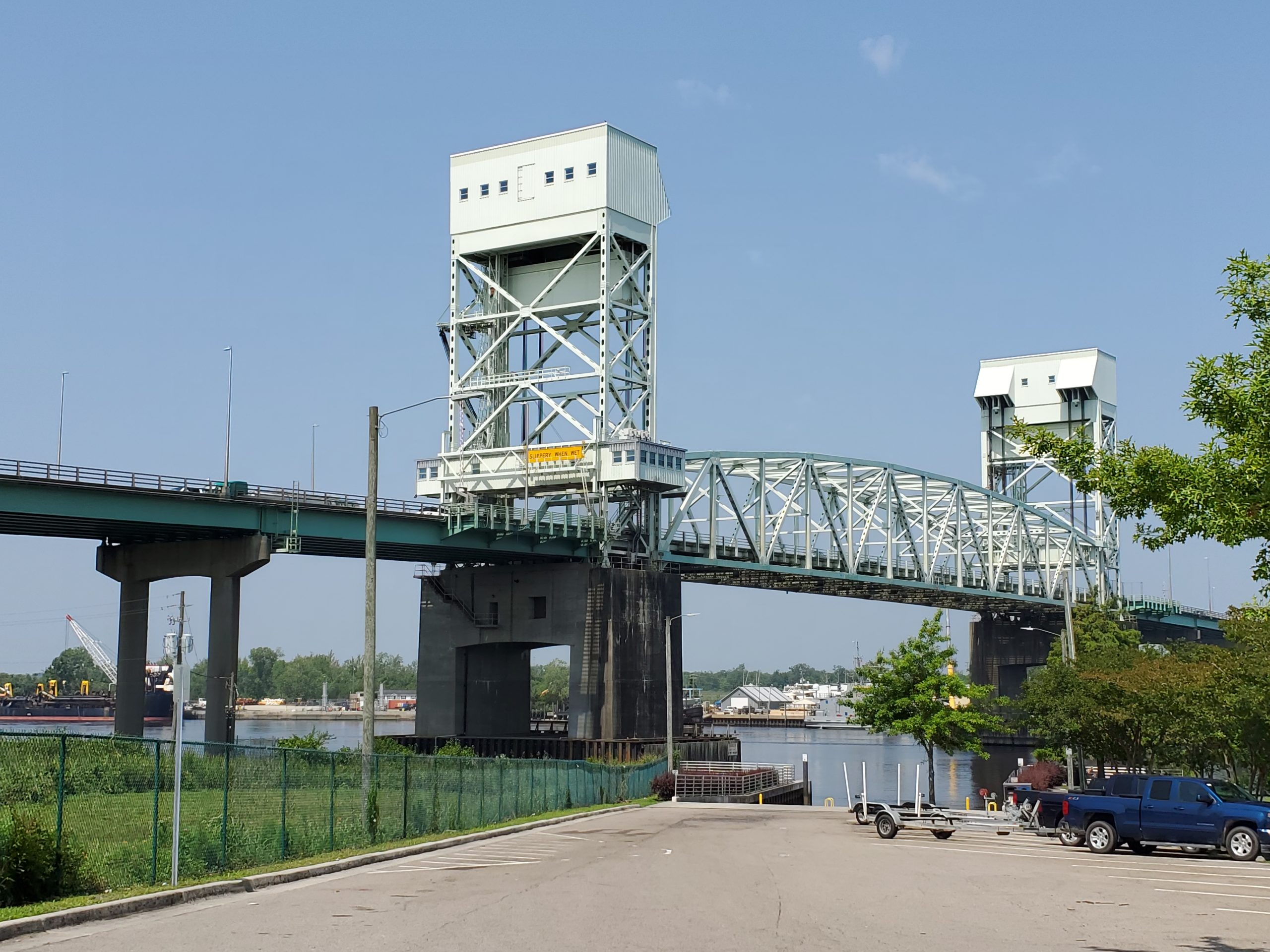
WILMINGTON — A new committee has formed from the Wilmington Urban Area Metropolitan Planning Organization to assess potential funding mechanisms for large-scale projects regionwide, including the Cape Fear Memorial Bridge replacement. Some are even suggesting a tri-county bond referendum, mimicking recent transportation legislation passed in North Carolina’s largest city.
READ MORE: CFM Bridge grant review complete, finalized agreement to come
ALSO: Cape Fear Memorial Bridge: NCDOT engineer says tolling only current option to fund $800M gap
WMPO’s Alternative Funding Subcommittee convened for its first meeting Monday, consisting of Pender County Commissioner Brad George, WMPO Executive Director Mike Kozlosky, Wrightsville Beach Alderman Hank Miller (ex-officio), New Hanover County Commissioner Dane Scalise, Wilmington City Councilman Luke Waddell, Brunswick County Commissioner Frank Williams and North Carolina Department of Transportation Division 3 representative Landon Zimmer.
“The intent of the subcommittee is to see if there is an appetite to explore alternative funding options,” Kozlosky said, speaking to transportation project needs in WMPO’s three-county, 29-town jurisdiction. “We formed this committee to provide a recommendation to the board on any potential funding options we might see as viable in this region.”
WMPO is looking at ways to fund multiple project needs. Though, the crossing from Brunswick into New Hanover county is top-of-mind for many.
“No one seems to like tolls, but we haven’t discussed other options and we got to have a bridge,” said Williams, who was voted in as chair at the top of the meeting. “For Brunswick County, this is also about more than the Cape Fear bridge. It’s about the Carolina Bays Parkway and 211 widening long-term.”
Reaching its end of life, the Cape Fear Memorial Bridge comes with a $1.1-billion price tag, to be constructed into a six-lane, 135-foot structure. The bridge has more than doubled in price from $450 million last year and now has a $770-million funding gap.
Around $242 million of it is covered by a federal grant that was unpaused last week by the Trump administration. As well, NCDOT is putting $85 million toward the bridge after it ranked in the top 10 on the State Transportation Improvement Program (STIP) prioritization list, when including its cost with a toll.
A tolling option has been bucked by many elected officials, including Wilmington city council member Waddell, who has gone on the record stating a toll is just another tax on constituents. City council voted unanimously in 2024 on a resolution against a toll; other municipalities, including in Leland and Navassa, also passed ones in a similar vein.
However, all options put forth Monday would essentially be a tax of some sort on area residents and a few, such as a local sales tax referendum and transportation bond, would have to be agreed to by voters.
The subcommittee was shown eight fiscal measures, also presented to WMPO last June, to cover its project needs. It included a ¼-cent local option sales tax, a ¼-cent local option sales tax for transit, a transportation bond, vehicle registration fees, motor vehicle license tax, motor vehicle license tax for transit, vehicle rental tax and a toll.
The suggested alternative funds could bring in through 2050 anywhere from $5 million in Brunswick County if instituting a motor vehicle license tax, for example, to $1 billion annually in New Hanover for a ¼-cent local sales tax.
Allison Fluitt with McKinley Horn told the subcommittee that New Hanover already uses the ¼-cent local sales tax and noted there is also a statewide ½-cent option. However, it’s only for counties that operate with eligible public transportation systems and WAVE, the Cape Fear’s public transit system, doesn’t meet the metric. The ½-cent option has been passed in Mecklenburg, Wake, Forsyth, Durham, Orange and Guilford counties to date.
Fluitt added certain funding measures also may not be applicable in some WMPO jurisdictions. For example, a vehcile rental tax only can apply in areas that have car-rental locations. A slide presented from Fluitt indicated New Hanover would be the only benefactor at $59.43 million, which some subcommittee members noted wouldn’t be enough funding in the end to help with big projects like a bridge replacement.
The WMPO is assessing alternative funding, due to a decline NCDOT faces in gas taxes and minor growth at the DMV. Currently, motor fuels tax makes up 47% in funding, followed by DMV fees at 21%, Highway Use Tax at 24%, and the rest is covered up by general sales tax transfers. Starting this year, NCDOT receives 6% of general sales taxes as well, a relatively new measure passed by lawmakers.
The legislature is taking other steps to correct funding issues, such as studying a mileage-based tax, lifting caps on public-private partnerships, expanding user fees and tolling, and targeting rideshare fees.
Still, Fluitt said there is roughly a $7-billion gap through traditional funding methods for projects in New Hanover, Pender and Brunswick counties. She pointed to Cape Fear Navigating Change 2050, a document that estimates revenues and funding needs for tri-county projects in the next 25 years. Kozlosky expects it to be adopted later in the year by WMPO.
David Ferrell and Chase Horton, with lobbying/law firm Maynard Nexsen, pointed to a new test-case that could be explored as an option for the region. The North Carolina General Assembly passed the Projects for Advancing Vehicle-Infrastructure Enhancements (PAVE) Act this year for the Charlotte-Mecklenburg area. Sponsored by Tricia Cotham, it received bipartisan support, 102-6.
Mecklenburg County and its municipalities are asking voters to approve a 1-cent sales tax increase (excluding groceries) to fund transportation projects. Mecklenburg is the first county in the state allowed to increase its local sales tax option to 1%, which triggered legislature approval.
This will usher in around $20 billion in the next 30 years to cover Mecklenburg’s costs for its light rail, microtransit services, road expansion needs, and bike and pedestrian projects. Specifics include rail service going into Iredell County — with expansion possibly to Lake Norman — and bus service into Matthews. The money would break down to 60% going to the public transit system and 40% going to individual participating municipalities to use on their preferred projects.
The PAVE Act was approved by legislators with guardrails in place as well. For instance, there is a newly formed 27-member transportation authority board, made up of locals in varied fields of expertise, and the Charlotte Area Transit operations were rolled into the authority. Plus, there are timelines in the legislation for completion of the light rail redline and the municipalities receive their funding amount based on local road mileage use. It was signed into law by Gov. Josh Stein and could serve as a model for other counties.
If the referendum passes, the funding it creates cannot be used to improve STIP scores at the NCDOT, according to Horton. The STIP is a 10-year plan that ranks and determines the agency’s construction and funding needs for transportation projects across North Carolina.
Horton said PAVE could be considered a blueprint when garnering ideas on how to pay for the new Cape Fear Memorial Bridge, which has only 30% of its costs covered so far. Waddell asked Horton what the numbers could look like locally if the region proposed a similar plan to PAVE.
“Somewhere between $100 to $115 or $120 million a year in revenue,” he estimated.
Waddell and Zimmer were in favor of getting ahead of the game and looking into the logistics of pursuing a three-county referendum. Zimmer said while the mechanism may not leverage STIP, it could open up resources to get other projects moving forward.
“Our area is full of a lot of tourists and students and that doesn’t get counted in the STIP program,” Zimmer said. “We have to figure out a way to get more of our fair share. … It’s not getting better in the future. Gas tax is flattening, projects are getting more expensive and bridges are not really looked at in the STIP well.”
He also suggested if anything is put forward to voters that the group avoid “¼-cents” language in its campaigning. A ¼-cents transit sales tax was proposed to New Hanover County voters in 2022 and failed by a 6% margin.
“Maybe do some polling, but I would do ½-cents or penny sales tax,” he suggested. “¼-cents sounds like a quarter.”
Williams agreed it needed to be marketed in a way that had mass appeal. Kozlosky said the Charlotte Regional Business Alliance was putting forth $3 million in campaigning for the passage of the 2025 bond referendum ushered in by the PAVE Act.
Williams thought adding in projects of high importance in each local region could prompt better response and suggested his fellow subcommittee members start thinking about what could be included.
“For something to pass countywide in Brunswick County, it’s got to be about more than just the Cape Fear Bridge because if you live in Calabash, you cross that bridge maybe twice a year, so it has got to have some things that appeal to people on that end of the county,” Williams said. “Pender County, same thing.”
Pender County’s Hampstead Bypass and Burgaw Bypass would likely appeal to those on the other side of New Hanover, Brad George indicated.
Ferrell also suggested reaching out to folks in Mecklenburg County to learn more about its process and logistics in creating the legislation. Mecklenburg County has been working on its draft since 2019.
“We don’t have six years,” Waddell said; the Cape Fear Memorial Bridge is considered functionally obsolete. “We need a real sense of purpose and to set a timeline quickly on how we want to proceed.”
Zimmer anticipated the most realistic date a referendum could be brought forth to voters in this region would be fall 2027, though Koslosky was clear Monday’s meeting was only the beginning of the conversation.
New Hanover County Commissioner Scalise was most concerned about public education and input. In his view, it was the most important aspect to assessing how the WMPO should move forward with any funding option suggested.
“We really ought to get engagement from the communities we serve and ask people in New Hanover, Pender and Brunswick what they think,” Scalise said. “I don’t want to just make a decision because it seems like a good option. We need to ask: ‘Hey, how do you want to pay for your infrastructure projects — do you want it be A, do you want it be B, do you want it be C?’”
He suggested polling and gauging interest with various entities. A regional survey was also recommended.
Wrapping up multiple projects in the tri-county into one referendum left a lot of questions unanswered otherwise. For instance, if the bond passed in New Hanover and Brunswick but not in Pender, would the two-thirds still get their money? Or would it be an all-or-nothing scenario?
Horton said it really depends on how legislators wrote the law.
In the immediate future, the subcommittee suggested WMPO staff look at all the alternative funding options presented and pare down which seemed the most viable to move forward with. The committee will meet again on Aug. 27 at 2 p.m. to hear suggestions and will continue to meet as needed until a final recommendation goes to the WMPO board.
Want to read more from PCD? Subscribe now and then sign up for our morning newsletter, Wilmington Wire, and get the headlines delivered to your inbox every morning.
