


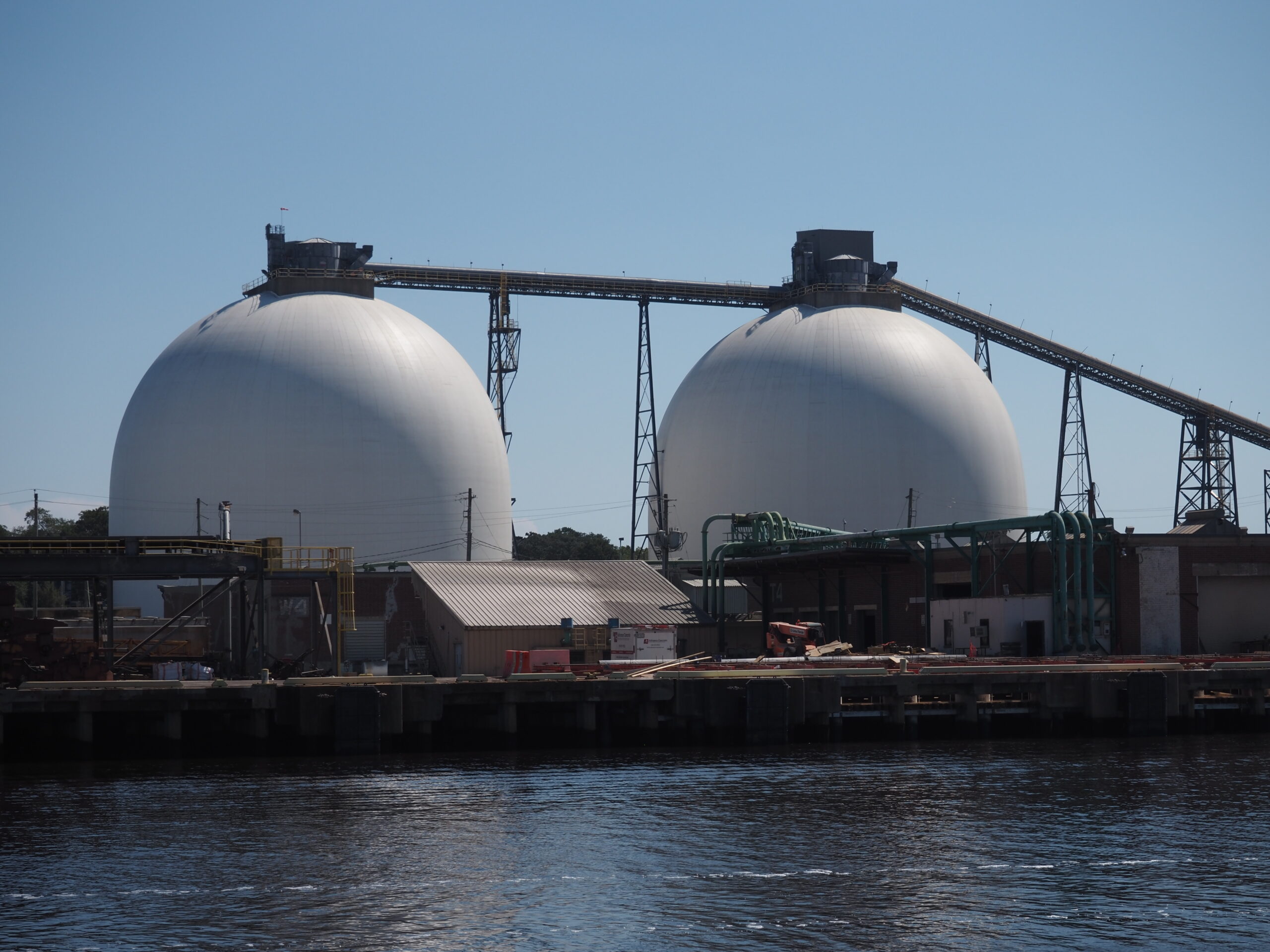
WILMINGTON — State regulators are to begin enforcing new air quality requirements at two Port of Wilmington facilities after finalizing plans to control industrial dust following years of community concerns.
READ MORE: NCDEQ requires Chemours to expand PFAS well-testing to thousands in Cape Fear
ALSO: Brunswick commissioners respond to calls for clean water, apply for grant
The North Carolina Department of Environmental Quality’s Division of Air Quality approved dust control plans for wood pellet manufacturer Enviva and wood-chipping company Basaga International. The new regulations follow two confirmed complaints in the last year from nearby Sunset Park residents about wood-dust pollution.
Enviva has been manufacturing wood pellets since 2011 in North Carolina and is known in Wilmington for their large white dome storage facility at the Port of Wilmington. Though most citizen complaints are directed at Enviva, the state has identified Basaga, a wood-chipping facility operating at the port since 2022, as a “reoccuring source” of dust pollution as well.
In June 2024, NCDEQ required both companies to adopt fugitive dust-control plans. “Fugitive dust” is the term for particulate matter that becomes airborne from non-point sources, meaning it does not come out of a traditional vent or stack. At the Port of Wilmington, this dust primarily consists of small wood particles escaping during the loading and handling of Enviva’s wood pellets and Basaga’s wood-chip processing.
Wood dust can lead to short-term health problems, including respiratory irritation that can pose a heightened risk for people with conditions like asthma, but long-term effects are still being studied.
The newly approved plans by DEQ outline a step-by-step procedure for Enviva and Basaga International employees to prevent wood dust from leaving the Port of Wilmington site.
Key to Enviva’s plan is enhanced monitoring during ship loading, where associates must record wind speed and direction every three hours. If winds from the west exceed 10 miles per hour, a second observer must be deployed to watch closely for dust. If any fugitive dust is observed leaving the property or if a citizen complaint is received, employees are immediately required to stop work until the dust source is investigated and fully mitigated.
Furthermore, the company must maintain a detailed fugitive dust complaint log of all incidents and actions taken, with the entire plan subject to an annual review by DEQ. The plan also imposes a two-year record-keeping requirement for all operational documentation and stipulates Enviva must cross-reference on-site dust observations with official wind data from the Wilmington International Airport.
“Enviva has been proud to be part of the Wilmington community since 2016,” a spokesperson for the company told Port City Daily. “Over the years, we have continued to build relationships, listen to feedback, and take action to be a responsible and engaged neighbor. Enviva remains committed to being a strong partner in the communities where we live and work.”
The Basaga International dust-control plan is strictly focused on controlling emissions from its wood chipping operations. The plan centers on reducing dust at the source, primarily through the regular application of water or chemical suppressants to stockpiles and work areas to cut back the likelihood of particulates going into the air. This may involve stopping chipping activity when weather like high winds makes dust control difficult. Like Enviva, the company is required to keep detailed records of all incidents and actions, and the entire plan is subject to annual DEQ review.
Port City Daily reached out to Basaga International for comment on the implementation of the dust control plans but did not received a response by press.
Ivy Miller, a resident of Sunset Park, has dealt with the persistent problem of fugitive wood dust for years. She and a neighbor have sent nearly 50 complaints to NCDEQ over the last decade, including letters to the attorney general’s office, which she said have gone unanswered.
“It’s definitely not fun,” Miller explained. “It makes you not want to sit outside, but at some point, you feel pressure you’re going to give up because there’s nobody really holding anybody accountable.”
Miller and her neighbors have dealt with the wood dust accumulating on their homes, in their yards and coating their vehicles. She and other neighbors have also experienced health issues, including heavy sinuses and congestion, which they attribute to the exposure.
Miller explained the dust decreased for a few months when NCDEQ first issued requirements for the management plans in June 2024, but the particulates still continue to pollute the neighborhood.
“There were weeks where we didn’t see anything, but, suddenly, there’d be like two or three days in a row where you see sawdust every morning,” Miller stated. “You wake up and the car, you can see it’s just covered.”
As far as the dust management plans go, Miller is not convinced they will solve the problem.
“I just honestly don’t really think they care,” Miller said about the companies. “Enviva has tried to give us money through gift certificates for Winnie’s [Tavern] down the road and car washes and house washes and I’ve told them, ‘No, I want you to figure out the problem because I moved here before you guys did, and you’re ruining our environment.’”
According to an NCDEQ spokesperson, both Enviva and Basaga will be required to be in compliance with their respective fugitive dust control plans by Oct. 18. The agency will monitor compliance through inspections spurred by new complaints.
NCDEQ has not assessed any civil penalties against Enviva in the last year, but has previously for air quality violations.
The Enviva plant in Sampson County has received five air quality violations from NCDEQ since opening in 2016 for emitting too much carbon monoxide and volatile organic compounds, resulting in fines in excess of $148,000.
Widely considered the world’s largest wood pellet producer, Enviva operates four plants in North Carolina collectively generating roughly 2.3-million metric tons of wood pellets annually. They are shipped overseas, primarily through the Port of Wilmington. These plants — located in Hertford County, Northampton County, Sampson County, and Richmond County — have all undergone or sought capacity increases since they began operation.
Most notably, the Northampton plant received an expansion permit from NCDEQ in 2019 to boost its production to 780,000 tons of pellets per year, while the Hertford County plant was permitted in 2023 to increase its capacity to 630,000 tons per year. These expansions are coupled with the required installation of new pollution control devices, such as regenerative thermal oxidizers, which destroy air pollutants using heat.
The wood pellet industry is sustained by large subsidies provided by the United Kingdom and the European Union. The UK and EU, starting with a 2009 Renewable Energy Directive, classify the burning of wood pellets as a renewable and zero-carbon energy source, allowing European utility companies to access billions in financial incentives. Although the U.S. also classifies wood pellets as renewable biomass, it provides no comparable subsidies, driving the domestic industry to focus on European exports.
The renewable classification propels international demand, as evidenced by the fact that nearly all wood pellets produced by Enviva are exported to power plants overseas. As a result of this system, Enviva has received approximately $7.7 billion in cumulative net revenue from the start of its public reporting in 2014 through the end of 2023.
In addition to the foreign incentives, North Carolina has provided taxpayer-backed funds to attract and retain Enviva’s operations. State and county economic development grants, including Job Development Investment Grants and One North Carolina Fund awards, total over $7 million for the company’s North Carolina plants since 2011.
However, these revenue streams did not prevent the company from collapsing under its own debt. Enviva filed for Chapter 11 bankruptcy in March 2024 to restructure about $1 billion. The company’s financial issues stemmed from unfavorable contracts with overseas utility companies and operational issues at its plants. No longer a publicly traded company, Enviva emerged as a private entity in December 2024, having eliminated more than $1 billion in debt and secured new financing from private equity firm American Industrial Partners Capital Fund VIII.
Despite the subsidies powering the industry, the environmental classification justifying them remains controversial. Environmental educator and conservationist Andy Wood explained that claims of “renewable” and “carbon-neutral” wood pellet biomass energy are not entirely accurate. While trees eventually do grow back, he said it can take 50 years or longer for a forest to re-absorb the amount of carbon released into the atmosphere from burning wood pellets.
“It’s harming the climate in two ways: One, burning wood pellets releases more carbon dioxide than burning natural gas or coal,” Wood stated. “The other is, we’re burning trees that, when left to their homes, sequester existing carbon dioxide out of the atmosphere. So we’re cutting ourselves twice — and we are paying a company to do it.”
Wood, along with other environmental advocates from the Dogwood Alliance, the Southern Forest Conservation Coalition, the Alliance for Cape Fear Trees, and Save Sledge Forest, held an informational tour for the public on the Cape Fear River recently to discuss Enviva’s operations locally and in the state. Environmental advocates have held similar cruises in the past — Port City Daily last attended in 2021.
Anita Cunningham, executive director of the Southern Forest Conservation Coalition and resident of Robeson County near the Enviva facility, spoke during the tour about the impact of the Enviva plant in Robeson County. Cunningham also serves as the co-director of the NC Climate Solutions Coalition and was appointed in 2024 to serve on the White House Environmental Justice Advisory Council.
She previously led grassroots opposition through the Robeson County Cooperative for Sustainable Development, achieving a victory by successfully stopping the proposed Active Energy wood pellet plant (a company distinct from Enviva) in Lumberton in 2022.
Cunningham explained the Robeson community’s struggles with persistent noise pollution from tree debarking as well as particulate matter expelled from the Enviva plant.
“If [particulates] covers their yards, their homes, cars, plants and flowers,” Cunningham stated. “It’s gonna be harmful to you and your community, your health and welfare and your ability to live freely and enjoy your life at your home.”
Have tips or suggestions for Charlie Fossen? Email charlie@localdailymedia.com
Want to read more from PCD? Subscribe now and then sign up for our morning newsletter, Wilmington Wire, and get the headlines delivered to your inbox every morning.
