


WILMINGTON — The Wilmington City Council is already contemplating a property tax rate increase to take effect this July, which could be in the range of 4 cents to complete capital projects and boost personnel pay — and that doesn’t include potential budget increases still to come.
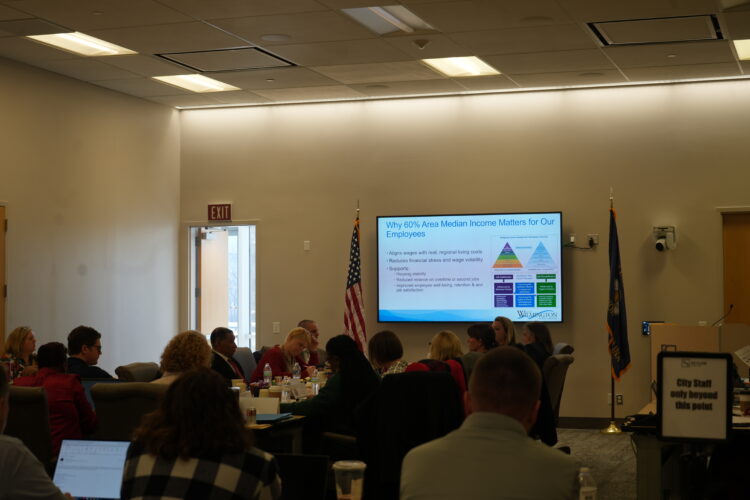
On Friday, city staff provided council with an update on its recommendation to provide all employees with a “livable wage” next fiscal year, after presenting its concept at council’s first budget session in late November. The goal is to bring each city employee to at least 60% of the area median income, which is $75,885.
Now, at the second session, and with three new council members and a new city manager onboard, staff have more concrete numbers on the costs associated with raising the city’s base salary from $37,980 to $45,531.
City Manager Becky Hawke said the “worst-case scenario” to cover the increase, a $14.6-million expense, would be 4.1 cents added to the current tax rate of 28.25 cents. Based on Wilmington’s average home price this change would amount to an additional $183 annually on a homeowner’s tax bill.
Hawke said the cost to cover the salary changes, if approved by council, will “only go down” from 4.1 cents.
“We are committing to it not going up,” Hawke said.
Hawke and her right-hand man Dennis LaCaria, chief of staff, said they were currently working on a reorganization of city departments and chains of command. Though no one will lose their job as a result, Hawke clarified, the process could highlight vacant positions the city no longer needs and, thus, their salary could be put toward the pay raises.
Council member Cassidy Santaguida asked what the best-case scenario would be for the tax rate.
“I would be thrilled to bring you 3 cents,” Hawke replied.
Most council members expressed support for adopting the livable wage philosophy, including Mayor Pro Tem Kevin Spears. Still, he expressed frustration with the city’s inability to make headway on pay issues in previous budget cycles, despite raising wages (7% on average) last year.
The difference in former budget cycles, Hawke said, is the city was starting from a “losing proposition” because of how low the existing pay rates are.
“If somebody is making $38,000 a year and they get a 9% pay increase, and the headline is a 9% pay increase, people may say, ‘That’s a huge pay increase’ — but 9% of $38,000 a year is a pittance,” Hawke said.
With the recommended change, the lowest-paid city employee would make more than $45,000 a year. A person with this salary would still struggle to afford the average one-bedroom apartment in Wilmington, which stacks up at more than $1,400, though would qualify for federal rental assistance programs.
The positions benefitting the most at the city would include facilities technicians, groundsworkers, housekeepers, trash collectors and more that make less than $40,000 annually; many positions overlap with those experiencing the highest level of turnover or vacancies. Public works, for example, has the highest turnover rate in the agency, 21.7% compared to the city’s overall rate of 16.8%.
Moving the lowest-paid employees to higher salary ranges would also require pushing up other positions. According to staff, 74% of staff would earn at least 80% of the area median income, or $60,708, if council adopted the pay scale changes, compared to just 47% now.
The gains would be most pronounced with first responders, who have lobbied for higher wages to retain staff over the last several budget cycles. Under the proposed changes, 70% of them would make more than 80% AMI, an improvement from just 39% now. The average first responder increase, according to the city, would be 19.3%.
Though no council members brought it up as an issue, Hawke assured council and staff that the move was not a “money grab” for the city’s top brass. She said any employee making more than $75,000 would have their salary adjustments limited to a $15,000 increase.
Ultimately, with a livable wage, Hawke hopes to establish the city as an employer of choice and example for surrounding businesses.
“We do believe that this strengthens our local workforce and that it encourages stable wage adjustments for the entire region … we recognize what the cost of living is doing in this area, and we’re keeping up with it as best we can,” Hawke said.
Staff’s recommendation is to implement the new pay scales, with whatever final tax rate adjustment is needed, for the next fiscal year. This would bring pay into competitive territory immediately and then allow council to make cost-of-living and merit increases to keep pace in the future.
Another option would be to phase in the increase, half this next year and half in FY 2027-2028. Council member Santaguida asked staff to bring back what the phases may look like.
“We have to be able to tell how the sausage gets made to our citizens, our decisions about why we’re doing what we’re doing, and so I just want to be clear that we make sure that we’re communicating that,” council member Chakema Clinton-Quintana said.
Hawke agreed, noting the pay raises weren’t the only budget items staff were planning on bringing forward. She mentioned there could be potential budget implications in street paving and transit-related costs. Hawke is vice-chair of the Cape Fear Public Transportation Authority, controlling Wave Transit; at the board’s December meeting, she said she would like to explore how much funding it would take from local governments to retain and improve the public bus system’s reliability.
While there aren’t details on those items yet, staff has done the math on the city’s current capital improvement plan, with several planned projects falling short on funds. The city estimates a gap between $51 million and $63 million.
Staff split projects in a non-negotiable category for core infrastructure the city could not afford not to do and negotiables for projects that could be delayed or abandoned. Some projects are part of the 2014 transportation bond that has yet to be completed.
Non-negotiables include:
- CFCC bulkhead
- Front Street Bridge Rehab
- Pine Grove Bridge Replacement
- EDA grant package for bulkhead replacements
Negotiable projects with shortfalls include:
- Independence Screen Wall
- Bradley Creek Kayak Launch
- Water Street Park
- Lions Bridge Reconstruction in Greenfield Lake
- Pine Grove North
- Pine Grove South
- Wrightsville Avenue Sidewalks and Roundabout
- Towles Road Emergency Access
There is a potential for the projects to obtain grants or cost-sharing agreements to lower the city’s cost, though neither would completely absolve the city of its shortfall.
Staff presented several options for council to consider, including using existing debt to cover some of the projects; this would cover the non-negotiables only. The only way to cover all the projects and keep them on a relatively the same timeline would be to increase the tax rate, however.
Staff say an additional 0.61 cents would do the trick, resulting in the average homeowner paying $2.26 more a month.
Council member David Joyner questioned if the current council needed to follow through on the transportation bond projects if they were no longer a priority for the affected community after more than a decade.
Hawke said council could choose to remove any projects it no longer wanted to pursue. Though the transportation bond was passed by voters, as long as the money is used for transportation projects (the 2014 bond money has been completely depleted), the city does not necessarily have to follow through on specific projects.
Hawke clarified the move would be a “political” decision among council members with potential political consequences.
Spears thought Joyner brought up a good point, but wanted to caution against signaling to any community members that they weren’t important.
“There’s a part of this community that feels they are being pushed out,” Spears said.
Spears also took issue with the optics of the city recently agreeing to buy land for a new park while its capital improvement plan lacked funding. Hawke clarified the new park would go in the next five-year plan and thus wasn’t competing with the current projects. Council voted earlier this week to spend $1 million toward a 25-acre land purchase on Greenville Loop Road, in a potential joint partnership with the county and The Endowment. However, the city would maintain and build the park, estimated require at least another $10 million investment,
The city is currently three years into its current CIP, which has experienced funding issues over the last two budget cycles.
Part of the problem, Hawke said, was that the city was pulling money from the CIP to cover maintenance costs, such as street paving, when “best practice” says paving costs should be in a separate fund.
“We’ve been riding the same horses unsuccessfully,” LaCaria said.
Additionally, the CIP was approved with a dedication of 1.5 cents of the tax rate; after the property revaluation last year, that amount was downsized along with the tax rate and, thus, diluted to 0.75 cents. Hawke said council would need to be aware of this effect for the next revaluation.
None of the council members condoned the tax increase for the CIP nor spurned it; the next budget session will occur in March.
In the meantime, LaCaria said staff is working on an online public dashboard, updated monthly, for the community to track the progress of capital projects. He said the plan was to send it live in the next 90 days.
Tips or comments? Reach out to journalist Brenna Flanagan here.
At Port City Daily, we aim to keep locals informed on top-of-mind news facing the tri-county region. To support our work and help us reach more people in 2026, please, consider helping one of two ways: Subscribe here or make a one-time contribution here.
We appreciate your ongoing support.
