


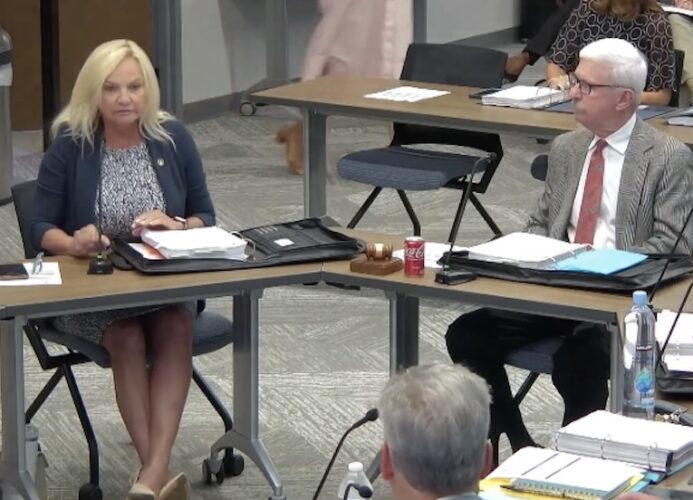
NEW HANOVER COUNTY — After county commissioners didn’t pick up coverage to fund nurses at every New Hanover County school in their 2025-2026 budget, the board reversed course at this week’s agenda review meeting to continue the policy.
READ MORE: NHC cuts $36M and 70 people to downsize tax rate, abandons pre-K, food co-op
The change came after the public spoke against the county ridding 14 nurses this school year, as first reported by WHQR, a media partner to Port City Daily. Rather than have a nurse at all schools, half the district would have shared them, primarily in elementary grades.
Parents even started a petition to ask commissioners for a budget amendment, noting their children’s complex medical needs could be dangerous for daily school enrollment if a nurse isn’t available at all times.
Roughly $1.6 million in funding will return to the positions, which commissioners unanimously agreed to in supplemental support Thursday. The county hires the nurses through the Department of Health and Human Services. According to a county spokesperson, it will be paid for through the Mental Health and Substance Use Disorder Fund, a $50-million pot funded from the sale of New Hanover Regional Medical Center to Novant.
“The entire commission is concerned about the health and safety of our children,” Commissioner Rob Zapple said at the meeting. “This is a small way to enhance that and going back to the policy we set forth four years ago.”
Fourteen nurses were cut from the schools this year when the county commissioners voted on a 30.6 tax rate in June, shearing $36 million overall from its budget. Republicans Bill Rivenbark, LeAnn Pierce and Dane Scalise voted in favor of the budget, with Zapple and Stephanie Walker dissenting.
On Thursday, Vice Chair Pierce reframed the narrative regarding the budget cut, stating the county was funding school nurses at the state standard before the pandemic. The state requires one school nurse for every 750 students — to equal around 33 in New Hanover County.
She said American Rescue Plan Act funding expired for increased nurses, which prompted the fiscal change.
“It’s not that we didn’t want [more nurses,] it’s that the money ran out,” Pierce said. “So it wasn’t a budget cut that forced that. … This wasn’t some hurtful thing we were trying to do to the nurses or the county; it was what it was before we received Covid money.”
The county began using ARPA funding for the nurses in 2022, with the county accessing $746,000 in federal funds through 2025 to help pay for the costs. The county doled out around $16 million in the same timeframe.

In 2025, the county received $21,397 from ARPA and paid its share of $4.6 million from the Mental Health and Substance Use Disorder Fund. According to PCD’s county budget reporting from June, County Manager Chris Coudriet tried to avoid pulling from the fund this year, as continuing recurring expenses would deplete it in roughly five years.
As of June, the MHSUD fund is down to $44 million and New Hanover County budgeted $8.9 million for fiscal year 2026, according to internal emails at the county.
Pre-pandemic, while schools didn’t have nurses at every location, Coudriet iterated to commissioners Thursday they did go above the state standard for many years.
The health department provided data that indicated in 2017 and 2018, 36 were funded for $2.1- and $2.2-million respectively, when only 35 were needed according to state stipulations. It increased again in 2019 to 38 nurses, with $2.5 million budgeted, when 34 were required.
“Anybody who had a child in 2018 or 19, they think there was a nurse in every school and that’s not the way it’s always been — and that’s what I used when I voted against it,” Rivenbark said of his budget vote Thursday. “Then I found out we have tons of kids with type 1 diabetes. I’m certainly not turning a blind eye to it.”
In a letter sent to Julie Varnam, NHCS assistant superintendent of support services, from Jocelyn Graham, school health manager from the county’s Department of Health and Human Services, there were 150,000 visits to school health rooms recorded last year. Of that, roughly 95% resulted in students returning to classrooms, which Graham noted was an “excellent indicator of effective in-school care.”
Around 6,000 visits included specialized medical procedures with 2,800 resulting in emergency medical action plans for the most at-risk students.
More granular data indicated almost 1,200 students in elementary, middle and high schools had severe allergy- or asthma-related health plans and close to 100 for diabetes.
Aside from allergies and asthma tracking high for one-on-one care, injuries and illness were among the most treated. However, mental health and nutrition needs also were managed.
Walker, who served on the school board before running for a commissioner seat, argued the state standards weren’t necessarily the best approach. She said the needs of the local schools often “far exceed” state funding and shouldn’t be the only metric commissioners strive to meet.
“New Hanover County is better than that,” Walker said, adding there was money in the county to afford them. “Pandemic or not, it’s important to have full-time nurses.”
Some school board members agreed with this assessment, as they discussed it briefly at their own agenda review meeting earlier this week.
“This is what our county commission has done to us,” board member Tim Merrick said. “It was not our choice to cut nurses.”
Fellow board member Judy Justice believed the state and county allotments needed to change and encouraged constituents to reach out to elected officials to advocate for more funding for public schools.
Many did, according to Commissioner Chair Rivenbark, who said he received around 150 emails from the community-at-large.
“One lady said: ‘I hope you have kids or grandkids in school and I hope they don’t have a nurse and I hope they get sick,” Rivenbark said. “That’s the kind of emails we are receiving.”
Other constituents also reached out, according to internal emails open for public view at the county terminal. PCD withheld names due to some including sensitive health information of children. One person called the lack of funds for school nurses “the most egregious shortfall,” while another worried her child, who needs insulin twice daily, would be in peril.
“Without a dedicated school nurse, I am worried about what could happen during a medical emergency,” she wrote. “Currently, our school shares a nurse with 3 other schools, and there is NO medical professional on campus 2 days per week.”
Another wrote that leaving at-risk “defenseless children” without medical care available at all times was unacceptable — but more so avoidable due to funding commissioners could approve.
“Especially those with chronic and very serious conditions,” she wrote. “These children CAN NOT care for themselves and medical emergencies can happen in the matter of minutes. Their families are tax-paying citizens of your county, and these children have the right to proper care — especially when the funds to amend this issue are available. The lack of care for these children will lead to serious injury or worse, and ultimately will bring lawsuits for the county. … At the Commissioners meeting on August 18, 2025 it was brought before the Board that there is ample money in the county to do a budget amendment and release all funds needed to reinstate our school nurses and make this right if it was the will of the Board.”
She was referring to Zapple’s comment about the state paying back the county for the sale of the Cape Fear Community College building on Third Street, used for its nursing program. A little more than $11 million was returned to the county to go into the general fund.
“I want to point this out and see if we might be able to use this money to pay for school nurses, which are desperately needed as we begin this school season,” Zapple said at last week’s commissioner meeting.
Coudriet responded if it was at the will of the board, a motion could be made to do so in the future.
Fast forward to Thursday’s meeting, Zapple made a motion to restore nurse funding to the Covid-19 era needs and added it should be budgeted for in the future. Upon a second by Pierce, it passed unanimously.
Superintendent Chris Barnes published a message after the vote on Thursday, thanking the commissioners and calling nurses more than just a means for medical treatment. He referred to them as “trusted allies” that help with guidance for families’ and children’s well-being countywide.
“This step ensures that every student will have access to the care, comfort, and support they deserve each day,” Barnes wrote. “Someone recently said: ‘If you care for our community, the best way to help it is to protect the children.’ Today’s decision reflects that truth in such a meaningful way.”
Want to read more from PCD? Subscribe now and then sign up for our morning newsletter, Wilmington Wire, and get the headlines delivered to your inbox every morning.
