


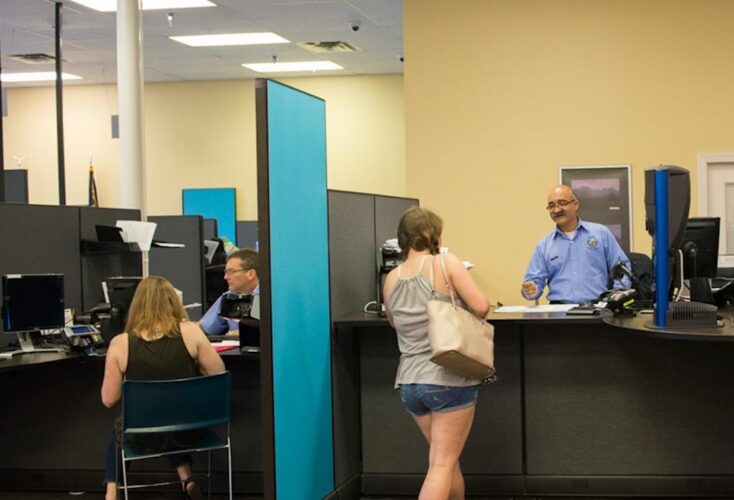
SOUTHEASTERN N.C. — A recent report from the state auditor’s office broke down reams of data and pointed to staffing problems at local drivers license offices among other systemic issues at the agency.
READ MORE: 2 years past expiration, drivers can still use NC license under new law — but why?
The staffing figures in the Aug. 4 audit, compiled by economists at North Carolina State University and the University of North Carolina at Greensboro, rank staffing levels at the division’s 113 license office locations from worst to best. They indicate some Cape Fear offices are severely understaffed.
The Shallotte license office — the only one in Brunswick County — has a service area of about 95,000 people, but only two examiners working there. This makes it the second-worst staffed office in the state. The south Wilmington office ranks 11, with six examiners for a 217,000 service population, equating to more than 36,000 people per examiner.
The Burgaw office has about 24,771 people per examiner in its service area and the north Wilmington office fared better, with only 17,458 people per examiner.
The division has also not been able to fill all of its examiner positions, due to attracting and retaining staff, with examiners facing burnout and making an average salary below $50,000. There are about 160 examiner positions open right now, along with 97 out of 142 temporary ones remaining unfilled. A survey in the report notes 43% of employees felt unsupported.
The audit points out staffing levels at offices have deteriorated over the last decade. Though the state’s population has climbed 29% in the past 15 years, only 10% more examiners work in license offices. Since 2019, less than a third of the DMV’s requests to add more examiners were sent to the state budget office by its parent agency, the North Carolina Department of Transportation.
In the same time frame, average visit durations at the DMV increased more than 15%, to an hour and 15 minutes. The number of visits that take more than two-and-half hours more than doubled in the same time frame.
The Burgaw office, despite being better staffed on paper than the south Wilmington or Shallotte locations, has the second-longest wait times in the state. In 2019 visits typically took less than an hour. According to the audit, these days they typically take more than 90 minutes and the number of visits that take more than two-and-half hours has more-than doubled. All told it takes about 72% longer to visit the location.
The Shallotte office saw a more mild increase in visit times, 8.3%. The north Wilmington office is up 12.9% and the south office is up 13.8%.
The General Assembly has improved some funding, in a stopgap budget, to hire 40 more examiners in the next fiscal year and an additional 21 the following fiscal year to the tune of $4.2 million in recurring funding.
Port City Daily asked if the auditor’s office has had any conversations with legislators, specifically those representing the Cape Fear. Brianna Kraemer, a spokesperson for Boliek’s office, said only positive feedback has been given and it expects “conversations on how to move forward to continue in the interim.”
The main point in the performance audit, and the one recommendation NCDOT disagreed with, is an argument for spinning off the DMV as an independent agency. The auditor’s office labeled the relationship between the NCDOT and DMV as dysfunctional. The DMV does not control its own budget requests to the state legislature and was mostly excluded from the performance milestones in the NCDOT’s strategic plan, but the agency generates 30% of the department’s revenue, about $2.2 billion.
Beside splitting off the DMV, the report recommends the agency adopt its own strategic plan, a staffing plan to fix its shortage over the course of a few years, formally track performance and service metrics, and work with an expert to improve the customer’s experience.
The auditor’s office produced a report in 2018 that made a similar recommendation for the DMV to develop its own strategy.
NCDOT leadership, in their response to the audit, pushed back against separating the DMV. The department noted they share a mission to reduce traffic deaths and injuries, unwinding the relationship would be expensive, and the NCDOT can provide direct oversight of the agency’s operations.
Examining DMV operations was a campaign promise made by State Auditor Dave Boliek, who assumed office in January. Performance audits only offer recommendations and do not look for accounting issues, such as a traditional financial audit.
The audit did not address the operations of license plate agencies. LPA locations offer non-driving-related services, like registrations and title transfers. Many are privately operated by contractors and a litany have been closed down across the state for contract violations in recent years.
There have been a number of closures in the Cape Fear area, temporary and permanent, for reasons ranging from violations to contracts ending and retirements.
Kraemer told Port City Daily the plate agencies are a subject the office is considering following up on.
Want to read more from PCD? Subscribe now and then sign up for our morning newsletter, Wilmington Wire, and get the headlines delivered to your inbox every morning.
