


OAK ISLAND — A heated debate on the balance of environmental concerns and development was evident in a Brunswick County beach town earlier in the week.
READ MORE: More tree protection on the table in Oak Island
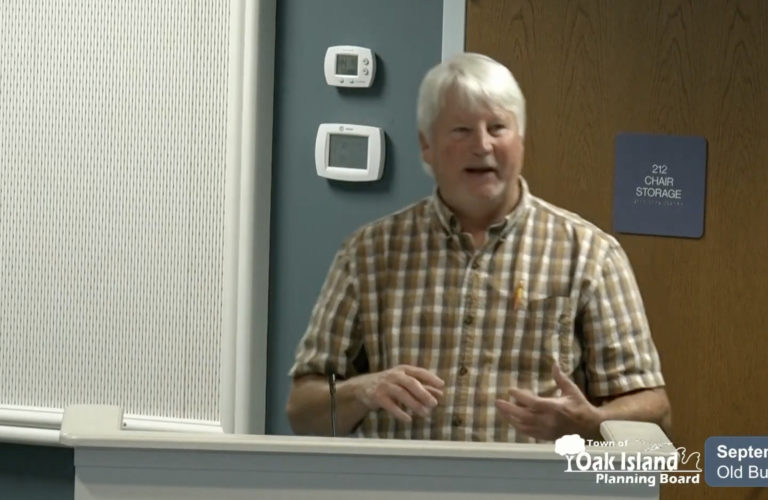
Town forester Richard Patterson called for changes to Oak Island’s tree and vegetation program at a planning board meeting Tuesday. Chair Terri Cartner immediately signaled opposition to his request.
Cartner explained that a stakeholder working group — members of the planning board, environmental advisory committee, and developers — for months had formed proposed amendments to the town’s tree and vegetation policy, covered in chapter 32 of Oak Island’s code of ordinances.
According to the town ordinances, Chapter 32 was devised in 2009 and last formally amended in July 2020. The town began working to alter its tree protection rules last year, which culminated in the stakeholder working group’s proposal presented in a planning board meeting in August. The updated verbiage clarifies definitions, responsibilities of the town forester, and tree protection standards during development.
“I want to say as chair of this board that I am opposed to having this item come up for discussion. I believe it sets a dangerous precedent,” Cartner said. “To go back now and seek to rework something that so many worked so hard on is not only a shame, but in my opinion disrespectful at best.”
Patterson offered a sharp rebuke: “That all sounded very well, except that document was riddled with mistakes and unworkability.”
The forester believes the town’s proposed amendments fail to provide adequate space between new trees, heritage tree protection, and appropriate instruction to developers. He asserted he was the one to originally initiate the change in the tree ordinance a year ago, yet the town’s efforts had failed to protect the island’s trees.
“It’s not working,” Patterson said. “We’re having dead trees all over; we’re having excessive numbers of trees.”
Patterson argued current ordinances fail to clarify appropriate conduct for developers. One of his suggested changes involved eliminating current rules on soil disturbance in the critical root zone, the delicate area surrounding a root. The current guidelines allow soil disturbances of 2 inches around the zone, which he believes can lead to harming roots.
“We would never ever recommend that,” Patterson said.
He said any reference to soil disturbance around the critical root zone should be removed. Patterson also believes new large trees need more space.
“In your recommendations, the contractor could go in and take 2 inches of dirt off the critical root zone,” he said.
Town ordinances currently mandate that new large trees are planted at least 10 feet from existing trees. He wants to change the distance to 20 feet. He argued they need the extra space for optimum sun exposure and growth.
Vice chair Kerri McCullough hoped for a compromise on spacing, viewing the 20-foot distance proposal as unrealistic given the island’s limited area. Patterson said he was unwilling to settle on his proposal.
“Drive down Pelican [Drive], and see where they’ve planted live oaks 4 feet apart. Most of them are about dead now, it looks like,” Patterson said. “Even if they did grow, they’re going to shade each other out.”
The forester also wants to change the town’s definition of a heritage tree — a tree considered particularly valuable for its age, rarity, or size. The current definition puts them at a minimum of 30 inches in diameter at breast height (dbh), — measured at 4.5 feet above the ground. Patterson wants to change it to 22 inches dbh, to include more trees for protection. Heritage trees have stricter criteria required for removal.
Board member Melanie Morgan asserted the current and proposed tree preservation rules were too uncompromising. She argued some residents might want to build a pool or an extra living space for a grandparent; excessive tree protections inhibit private property rights.
“Whether it’s a heritage tree, or a specimen tree, whatever you want to call it.” Morgan said. “Are we going to say that property owners can’t choose to do things on their property, that the tree is more important?”
Board member David Purser said he believed strict tree preservation did not reflect the will of the majority.
“I feel a lot of this is being written by a special interest group of people who want to save trees,” Purser said. “Buyers do not want trees, they do not want maintenance. They are coming to the beach to relax, enjoy their time here, sight see, and they do not want trees on their lots — but they do want palm trees.”
Board member Gene Brooks voiced frustration with repeated debates over tree management policy.
He noted the town government had hired a consulting firm to carry out a tree canopy study, but it has yet to be concluded. He suggested its findings to be considered before further discussion.
“Why wouldn’t you wait until what we paid for?” Brooks asked. “We’re plowing the same field over and over again — this is redundant.”
The tree canopy assessment is being conducted under a grant program with the North Carolina Forest Service by urban forestry consulting firm PlanIT Geo. Communications manager Michael Emory told Port City Daily the grant is a 50% match with funds from the Forest Service and the town’s portion is $4,907.13.
The final draft is expected in October.
The planning committee did not take formal action on tree policy at the meeting. They concluded the nearly three-hour discussion with an agreement to reconvene after the study is completed.
Tips or comments? Email journalist Peter Castagno at peter@localdailymedia.com.
Want to read more from PCD? Subscribe now and then sign up for our morning newsletter, Wilmington Wire, and get the headlines delivered to your inbox every morning.
