


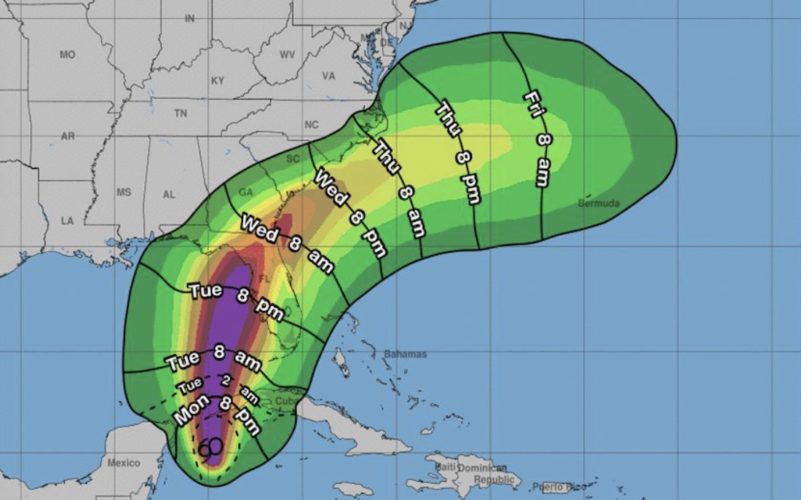
SOUTHEASTERN N.C. — As Tropical Storm Idalia (pronounced ee-DAL-ya) gains strength, it’s expected to land on the west coast of Florida Wednesday, according to the National Hurricane Center.
READ MORE: NC legislators seek to streamline federal funding following major disasters
ALSO: NCDOT upping hurricane preparedness with new system to track flooded roads
Weather conditions could worsen along the coast of the Carolinas, including heavy rainfall and tropical storm-force winds by mid-week.
Idalia’s center was detected near the Pinar Del Rio province of Cuba on Monday morning, with 74 mile-per-hour winds and traveling 8 miles per hour. It’s forecast to become a hurricane, fueled by the warm waters of the Gulf of Mexico.
The National Hurricane Center is expecting a Category 3 with 115 mile-per-hour winds. Its projected path and landing is in a cone of uncertainty that spreads from Tampa north to Tallahassee.
Thereafter, it will move across the state, up the coast and travel into the Atlantic off the North Carolina shoreline by the end of the week.
All impacts of the storm are dependent upon its track, but the National Weather Service has Idalia potentially bringing 39 miles-per-hour or greater winds to the eastern Carolinas by Wednesday afternoon into Thursday. There is a slight risk of tornadoes as well.
Rainfall could be 6 to 8 inches in coastal communities and lead to flooding, especially in low-lying areas and during high tide. Though the National Weather Service doesn’t forecast a significant surge at this time, minor to moderate river flooding can be expected.
Thursday, Aug. 30, is also a full moon, when tides rise and fall more than normal; as a result, king tides are expected in the area Tuesday, Aug. 29, through Saturday, Sept. 2, which could add to flooding.
Officials advise motorists to not drive through standing water, nor wade in it as it could contain contaminants or present other hazards.
Dangerous marine conditions and rip currents are anticipated, compounded by Hurricane Franklin, slated to pass Bermuda Wednesday.
Mid-August through October is the busiest time for hurricane season, which takes place June through November; its peak is Sept. 10.
Upon storms approaching, residents are advised to tie down outdoor items and secure boats or other moveable objects. Cutting back trees and foliage will also minimize damage to property.
To build an emergency safety kit, below is a list of items to consider:
- Water — Include 1 gallon of water per person per day for at least three days, both for drinking and sanitation. Though preparing for up to a week is recommended.
- Food — Have at least a three day supply of non-perishable food. This can range from canned goods to beef jerky, granola bars to applesauce. Though preparing for up to a week is recommended.
- Radio — In order to keep tabs on the latest situation, be sure to have a battery-powered or hand cranked radio, and an NOAA weather radio with tone alert.
- Flashlight
- First aid kit — A first aid kit should include items such as bandages, antiseptic, antihistamines, burn gel, pain relievers, antacids, laxatives, and anti-diarrhea medication.
- Extra batteries or power bank
- Whistle — A whistle can be used to signal for help in the event you become trapped.
- Dust mask, duct tape and plastic sheeting — Should you find yourself exposed, or need to shelter in place, these simple supplies can help protect you from the elements, as well as airborne contaminants.
- Moist towelettes, garbage bags and plastic ties — For personal sanitation use.
- Wrench or pliers — Keep these handy to turn off potentially dangerous utilities like gas lines.
- Manual can opener
- Cell phones and chargers with a backup battery
- Medications — Organize and protect your prescriptions, over-the-counter drugs, and vitamins to prepare for an emergency.
- Families with infants/small children — A week’s worth of diapers and formula, and games and toys for entertainment need to be considered.
- Important family documents — Insurance policies, ID, and bank account records should be saved electronically or in a waterproof, portable container.
- Fuel — Fill up your vehicle and additional cans to run generators; however, the only safe place to use a generator is outside and far from any occupied dwelling.
- Pet — Have extra food and water for your pet
- Cash or traveler’s checks
- Sleeping bag or blankets
- Changes of clothes
- Hygiene items — toothbrush, toothpaste, soap and deodorant
Read more about putting an emergency plan in place here.
Have tips or comments? Email [email protected]
Want to read more from PCD? Subscribe now and then sign up for our newsletter, Wilmington Wire, and get the headlines delivered to your inbox every morning.
