


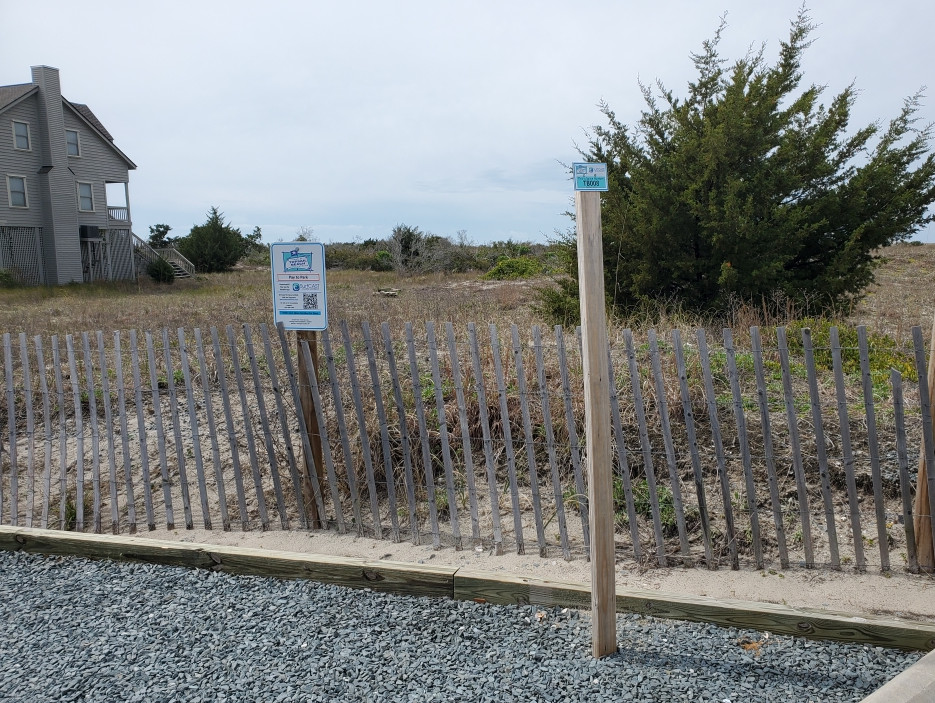
TOPSAIL BEACH — Expanded parking in Topsail Beach continues to be worked through after a handful of commissioner meetings and a public hearing were held over the last few months.
Around a dozen people spoke at the March 31 hearing, many in support for the boost of income more paid parking would bring to the region. Others opposed the areas suggested to charge motorists.
READ MORE: Topsail in favor of additional paid parking spaces
ALSO: Topsail Beach considers adding paid parking on tight timeline
Nothing is finalized and no votes have been taken by commissioners since the idea was first floated at the beginning of the year. Details still have to be hashed out, according to town manager Doug Shipley.
Shipley presented the scope a few weeks ago, proposing 438 paid parking spaces located in almost 30 beachside and soundside parking areas, two lots and some rights-of-way. Staff is asking commissioners at its April 12 meeting to continue the discussion, taking into account public feedback to finesse particulars.
The town manager was clear the plan needs more analysis.
“We are not traffic engineers, parking engineers — engineers, period,” he said at the public hearing. “We may have missed some things, points to be adjusted.”
Currently, only 27 parking spaces are paid on the south end of the beach, adjacent to Serenity Point. It brought the town $83,306 in 2022 revenue.
Topsail Beach officials asked staff in January to look at boosting its townwide parking program, preferably by the start of the season, which was March 1. This pocket of money would be beneficial to help fund some of the town’s long-term needs and offset tax increases.
(Utilizing the funds for more than merely paying for parking needs would require approval through the state legislature. The General Assembly has granted this for towns including Wrightsville Beach, Surf City and just a few weeks ago Oak Island.)
As is, residential areas and the business district would include free parking. This includes rights-of-way parking in commercial areas.
“We don’t want to restrict people coming to businesses,” Shipley said at the meeting. “They are already spending money with you.”
However, an area he wants to “tighten up” includes rights-of-way areas, specifically to determine the depth of certain streets and whether it could accommodate vehicles. In essence, some places determined as free parking zones still could be amended to no parking (a map to see what is currently suggested as paid can be accessed here).
Implementing the plan would require two zoning changes, going from business to residential, in order to make parking areas uniform.
Shipley said the staff divided the town by Anderson Boulevard.
“Anything on Anderson east to the ocean is restricted parking in the right-of-way,” Shipley said. “West of Anderson is free parking unless it’s in the business district.”
This doesn’t include private roads, which the town has no jurisdiction over.
Per the advice of a representative from Otto Connect, which currently oversees the paid spaces in Topsail, the town is looking to restrict rights-of-way parking at beach accesses. Shipley said people will try to avoid paying if they see 10 feet away they can otherwise access “spaces” for free.
“If we do not restrict the right-of-way,” Shipley said, “we might as well not charge for parking in public beach accesses.”
Applause broke out in the room from attendees against the plan. Topsail Beach is the last of the three communities along the 26-mile Topsail Island to consider implementing townwide paid-parking measures.
The town assessed upfitting two potential paid lots — the Brame lot near the Pender EMS and Fire Station 4 and the Spencer lot across from town hall. Staff received two estimates to transform each — “very rough estimates,” Shipley clarified — including clearing, grading, adding rock and installing wheel stops. The Spencer lot came out to at least $34,500 and the Brame lot was roughly $62,000; while the latter wouldn’t need grading, its cost is driven up by the addition of a driveway.
“So that’s $100,000 on two lots,” Shipley said. “And then $63,000 on signage.”
Yet, those are one-time fees.
He estimated the town would need to create 639 signs to communicate with motorists where they can and cannot park.
As well, commissioners would have to change or strengthen ordinances. Notably, a few would have to address rights-of-way, overnight parking, and fines for breaking parking rules (fees could be $50 to $250).
“We’d have to get ordinances straight,” he said. “Some have no teeth.”
Contractor Gregory Hannah spoke on behalf of multiple residents who couldn’t attend the public hearing. They all questioned the decision to turn two of the town-owned lots into paid parking. Topsail purchased them over the last two decades for a combined $1.7 million.
“You said the town needed the Brame lot for a new fire department and we supported it for a new fire department,” Hannah said. “But now it’s no longer used for that stated purpose — why?”
Shipley clarified to Port City Daily the goal is eventually to use it in that capacity.
“However, we don’t have the funding for a new fire department yet and only procured preliminary renditions of a fire station for the lot. It will take several years to obtain funding needed to get the design and construction plans,” he wrote in an email.
Buying the lots was only the first step, and utilizing them in the meantime for parking would generate extra income.
Hannah was also concerned with the costs associated with water pooling already in those areas.
“What about water runoff?” he asked. “During king tides, the whole lot floods.”
Other residents spoke in favor of the plan, particularly when it came to shouldering the financial burden of beach upkeep with those who visit the island annually.
“Put some of that contribution from our day visitors who come here,” resident Ray Costa spoke in support. “We pay for the cost of maintaining our beaches; we pay for the cost of maintaining our accesses. … Day trippers have contributed nothing extra.”
“There could be an argument that day trippers who are residents of Pender County who pay county and state taxes and that money comes to this town [are contributing,]” Shipley said.
Every summer, staff estimates Topsail Beach has up to 9,000 people come through weekly. Those who visit would have to pay daily fees or buy weekly passes to park, but could not purchase a seasonal pass.
“Residents should be able to apply for and receive one free public parking permit, similar to a handicap parking permit that they can place on their dash, so that it can be transferred to guests or tourists if they rent their homes,” Michele Rivest, who lives two hours away but owns a home on south Topsail, wrote to commissioners.
Free passes would not be offered in the current proposal, Shipley confirmed. Rather, the town would charge somewhere between $50 and $100 — the figure has yet to be decided — and residents would be allowed one per property.
“And here’s our reasoning for that,” he said. “The proposal has about 400 parking spaces; we have about 1,400 residents or property owners. We’ve had this conversation internally and know not everyone’s gonna park on the same day at the same time, but it does restrict the revenue. And if we’re going to do this for the revenue, we need to maximize our ability to get that revenue.”
Shipley recounted an argument he heard in support of this approach, similar to other business practices.
“Residents currently do not get free ability to put their boat in the water at the marina — they have to pay,” Shipley explained. “Residents currently do not get a beach pass to drive on the beach in the wintertime — they have to pay.”
Those who wish to purchase a pass would have to present a water bill with their Topsail Beach address. The pass would be attached to the resident’s license plate number.
Staff decided against hanging decals that could be passed off from renter to renter. It increases the possibility of being lost and having to charge $25 for replacements. Shipley recognized this could bring in more revenue, but from an administrative standpoint, he said it would be “a nightmare” to have to replace them constantly.
After assessing beachside parking spaces and rights-of-way issues this year, monetizing the soundside accesses could be phased-in, Shipley suggested to commissioners. He said that could come a year or more down the road.
It would require the North Carolina Department of Transportation to add driveways to the soundside lots, as the state agency owns the property, not the town. Those expenses would be a part of phases two or three, Shipley said.
“More than 75% of the roads are the state’s, who maintain them,” Shipley said. “If they become our roads — Anderson, Bridges, Channel and cross streets — think what that would cost if the town had to pay for that.”
He added Topsail would have to look at ensuring handicap needs are up to regulation, too; the mandate is one for every 25 spaces. That would increase with more paid parking bolstered in town.
A total cost has not been configured yet for launching the program fully or the amount of total revenue it could bring to the town. The latter would fluctuate, though Shipley calculated an early return on investment, roughly $120,000, for paid beach accesses only, approximately 178 spaces.
Town leaders may amend the plan before proceeding. For example, if they decide to only move forward only with public beach accesses, paid parking could start by July 1 — a “best-case scenario,” Shipley indicated.
“It just depends on what — if any — part of the plan the commissioners decide they want to implement,” he said.
The Topsail commissioners will take up the issue again at its Wednesday meeting at 6 p.m. and address public comments.
Tips or comments? Email info@localdailymedia.com.
Want to read more from PCD? Subscribe now and then sign up for our morning newsletter, Wilmington Wire, and get the headlines delivered to your inbox every morning.
