



BALD HEAD ISLAND — The Village of Bald Head Island has adjusted its plan to trap and kill coyotes that are believed to have preyed on more than 2,000 sea turtle eggs this season.
With the installation of two new Councilmembers this month, the Village announced Tuesday plans to move ahead with its previously approved coyote management plan will be stalled, pending future action by the new board.
Related: Bald Head Island releases more info on plan to trap and kill coyotes to protect sea turtles eggs
Meanwhile, those opposed to the Village’s response to the issue have organized a Change.org petition — with 7,171 signatures as of Saturday — and are planning a protest in downtown Southport.
Winners, losers
Why is the village choosing the lives of one species over the lives of another?
Loggerhead sea turtles are designated as an endangered species in the northeast Atlantic Ocean. Coyotes are native to the United States but non-native to North Carolina. Research by N.C. Wildlife Research Commission shows in-state sightings of coyotes rapidly spread in the state after 1980, with their first appearance in Brunswick County in 1990 and in 2000 in New Hanover County. Public perception of coyotes often ends up polarized. Wildlife biologist Dr. Rachael Urbanek helped conduct a coyote interaction and management survey last year, analyzing the responses from more than 400 New Hanover County taxpayers.
“You tend to get some extremes sometimes, of people saying, ‘no leave them alone,’ to ‘kill them all,’” Urbanek said.
However, survey respondents in New Hanover County felt mostly neutral toward coyotes, she said. Support of having coyotes live in the community dropped the closer coyotes were hypothetically positioned to respondent’s property, results show. A majority of respondents said they had not seen a coyote in the county or on their property; 26% reported they had definitely seen one in the county and 29% had definitely seen one on their property.
Of those who observed a coyote, a 67% majority witnessed normal coyote behaviors, whereas 11% witnessed coyote behaviors that may cause concern (e.g. sightings in proximity to children’s play areas pets, acting aggressively toward adults in daylight).
It’s reasonable for a majority of survey respondents, 61%, to assume coyote populations are increasing, Urbanek said. Urbanek said her team was pleased to see a majority of survey respondents were in favor of public education of coyotes, which can help communities pursue informed management plans rather than reactive plans.
Predator management is typical to protect endangered species, particularly before nesting season, to give the vulnerable species a greater chance to thrive, Urbanek said.
“The problem with removing coyotes is that coyotes are always around to replace that area,” she said. Removing problem coyotes, as was the plan in Bald Head Island, is a matter of triage, according to Urbanek. Coyote populations are sure to rebound after one season of targeted management, which means community management plans to protect endangered species should be considered on a long-term rather than a short-term basis.
Sea turtles enjoyed a record-breaking nesting season on Bald Head this summer, according to the Conservancy, which tracked 170 nests this year compared to its previous 1986 record of 143. Accordingly, this year’s predation numbers came as no surprise to Urbanek.
“Coyotes are smart. So that’s just a feast waiting to happen,” she said. “Just like any wild animal, they’re going to spend as little energy as possible to get more energy.”
The situation on Bald Head Island is a difficult cost-benefit dilemma, Urbanek said. Ultimately, she said the benefit of protecting sea turtles outweighs the cost of removing coyotes, though the consequences aren’t pleasant. Human urbanization beginning in the early 1900s is the root of the issue, she said.
“We got rid of all of our top predators. And we’ve been developing our land and we’ve been changing the habitat and removing habitat left and right,” she said. “So we’re going to continue having these issues. And it’s unfortunate.”
Trapping
Trapping coyotes is legal during the state’s short trapping season, Dec. 1 to Feb. 28.
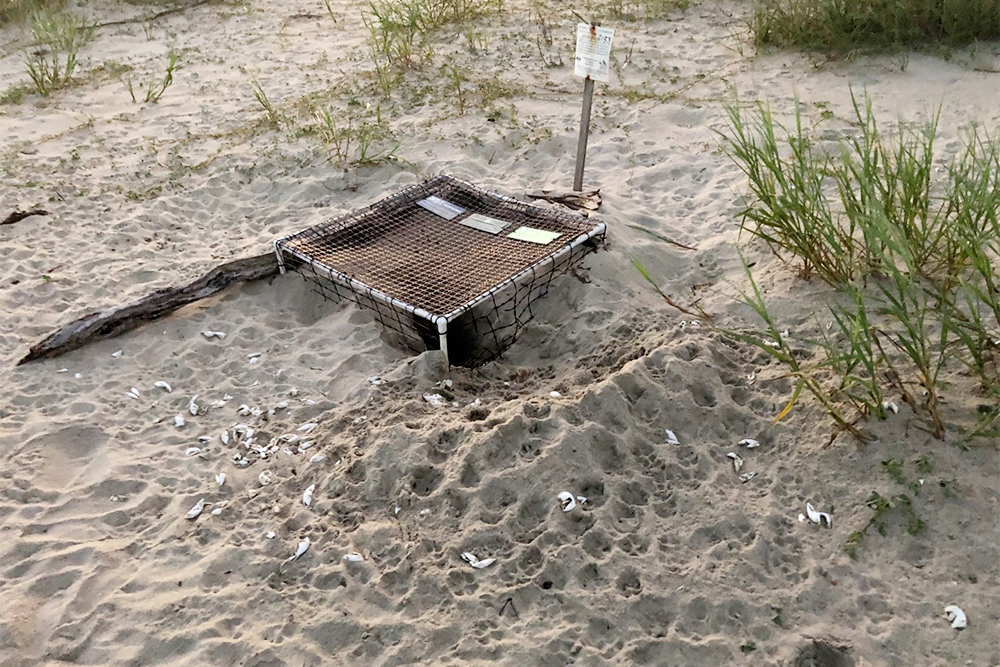
This summer nesting season, the Bald Head Island Conservancy estimated coyotes preyed on 2,088 sea turtle eggs, making up approximately 12% of the season’s total eggs. A 2018 UNC-Chapel Hill study showed that sea turtles use the earth’s magnetic field to find their way back to the same beaches. Conservancy staffers preemptively updated its metal cages in 2017 to plastic ones with the understanding that metal cages may interfere with hatchlings.
Conservancy interns and staffers spent hundreds of hours attempting to deter coyotes from preying on sea turtle eggs this summer. Given the scale of eggs lost, the Conservancy suspects the coyote population increased and individual coyotes have developed behaviors to access nests. Presented with the issue from the Conservancy in July, Village Council directed staff to obtain a depredation permit.
After securing the permit, the Village then hired a local trapper for $3,680 at a September 20 work session. At first, the Village planned to euthanize trapped coyotes with a gunshot to the head using a small-caliber firearm, according to Village spokesperson Carin Faulkner. Last month, the Village decided to use a veterinarian to euthanize trapped coyotes instead, Faulkner said. The trap footholds will have a rubber grip — not metal as has been suggested on social media.
Tuesday, the Village shared in a Village Voice message that additional time is needed to bring recently elected Councilmembers up to speed. Previous plans meant the Village’s trapper could begin work as early as Jan. 1, visiting the island a total of six days and five nights during trapping season, checking foothold traps daily, in accordance with state law. With a decision now pending the new board’s future action, the Village has until March 1 if it chooses to continue its trapping plans.
“We’re still discussing, we’re looking at every aspect of it,” Faulkner said. “We have some time. We may push it out even further because of the new board member aspect of it.”
Councilmembers-elect Peter Quinn and Michael Brown are set to be sworn in Dec. 13 (sitting Councilmember Kit Adcock was re-elected).
Petition, protest
At last month’s meeting, mayor pro tem Kit Adcock said the Village needed to study coyotes further before taking action. She said the issue was “outrageous,” according to the State Port Pilot, after failing to get Council support to form a committee to study the issue further.
A protest is planned Dec. 15 at 11 a.m. Protest organizer, Caroline Miller, said the group originally planned to meet at Deep Point Marina in Southport, but was later informed by Southport Police Chief that protesting at that location would be considered trespassing (the marina is slated to be acquired by the public Bald Head Island Transportation Authority, but is currently still private; the authority was set up by the state in 2017, but is still negotiating a purchase of the ferry system).
Instead of protesting at Deep Point Marina, Miller said protesters will set up just outside of it. Wildlife experts will be on-site with educational booths, she said, focusing on informing the public. The group’s position is boiled down to four main points, according to Miller: 1) killing the coyotes is “cruel and inhumane” 2) there’s a concern for trapping non-targeted wildlife 3) domestic animals could be at risk 4) removing coyotes for one season will be “completely ineffective.”
“Other than the moral issue, the science behind this is that it’s been proven over and over again that it does not work,” Miller said, referencing research that shows coyotes populations bounce back after being targeted.
“We do not need to resort to killing them,” she said.
Send tips and comments to Johanna Ferebee at johanna@localvoicemedia.com
