


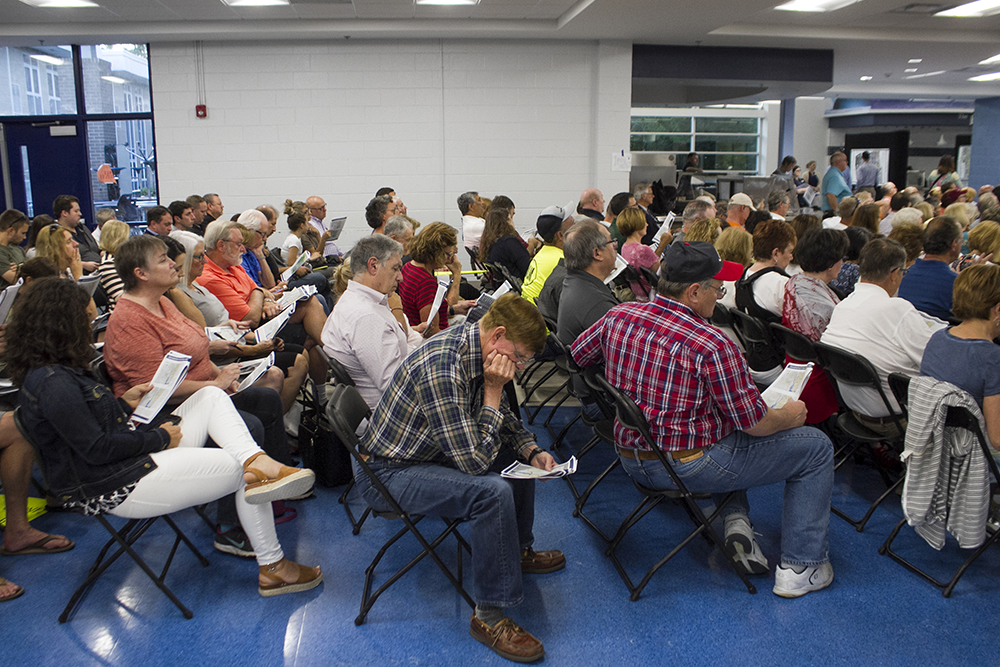
SOUTHEASTERN, N.C. — One month after filing a lawsuit against the state for its Final Environmental Impact Statement on the Mid-Currituck Bridge, the Southern Environmental Law Center (SELC) submitted 71 pages of fact-checking of and allegations against the state’s recent work on the Cape Fear Crossing project.
Written by four of SELC’s attorneys, the group’s “comments” read more like a legal complaint.
Related: Florence flooded their homes, so they’re rebuilding. Now a billion-dollar bridge looms
Citing case law, and submitting its report “on behalf of” state and local environmental organizations, SELC asserts the North Carolina Department of Transportation (NCDOT) “obscures findings” with its “misleading and inaccurate” Draft Environmental Impact Statement (DEIS) on Cape Fear Crossing.
NCDOT disagrees.
“NCDOT does not agree with the SELC’s assessment that the DEIS misrepresents impacts to the human and natural environment,” NCDOT spokesperson said Thursday. “Additional analyses will continue throughout project development, which will include further public involvement to inform additional avoidance and minimization measures.”
If SELC’s findings are correct, it would be nearly impossible for Cape Fear Crossing to (legally) move ahead in its current form. To date, NCDOT has spent $10.2 million studying the planned $1 billion Wilmington-Brunswick County bridge crossing. Last year, the department spent $609,645 studying it.
This year, NCDOT has spent $382,131, with the publication of its 1,009-page Draft Environmental Impact Statement (DEIS) in late March marking the furthest along the project has made it since its inception in the 1990s. That leaves approximately $1.3 million in remaining funding, which the department is authorized to spend on preliminary engineering data, according to figures provided by NCDOT.
SELC: State’s report is ‘riddled with myriad errors, omissions, and misrepresentations’
NCDOT’s findings are so inherently flawed, the SELC alleges, one of its attorneys said it is not unreasonable to seriously question whether any political or economic influence was involved. (In March, an NCDOT deputy division engineer said the state’s process was not subject to outside influence.)
“It’s certainly possible,” Ramona McGee, SELC’s staff attorney who co-wrote the report, said Thursday.
“There’s a lot of questions about why certain information is missing and why certain decisions were made. Because those decisions do not seem to be supported by the data or by common sense or logic or local support,” McGee said. “So it does invite that question of, what other actors are there behind the scenes that might have been pushing this project?”
An NCDOT representative announced on WHQR’s Coastline Wednesday that the state’s preliminary route selection — initially expected this summer — would be delayed. The next day, NCDOT issued a press release, stating the public hearings were “such a success” that the department would push back its decision until the end of the year. (NCDOT did not directly answer a question asking whether SELC’s comments influenced the department’s decision to delay.)
The department is legally obligated to respond to any and all comments received, totaling over 3,000 – including SELC’s – in a 60-day period.
SELC’s comments conclude by affirming:
“The DEIS is riddled with myriad errors, omissions, and misrepresentations regarding the project’s environmental effects, financial viability, traffic forecasts, and community impacts. The sheer volume of unstudied and undisclosed information demonstrates that NCDOT has failed to the ‘hard look’ at the environmental consequences of its projects required by [the National Environmental Policy Act].”
Boiled down, McGee said NCDOT completely failed to follow the National Environmental Policy Act (NEPA), a law it ought to be well-versed in since it commonly produces these studies for its projects.
“It’s inexcusable,” McGee said. “It was really just a poor environmental process, and we really needed to dig in and find out what went wrong here.”
If SELC’s conclusions are correct, are the DEIS’ authors that ill-equipped, or is the state gaslighting the public? McGee said some of the DEIS’ failings can be attributed to limited resources, but many moments don’t make sense.
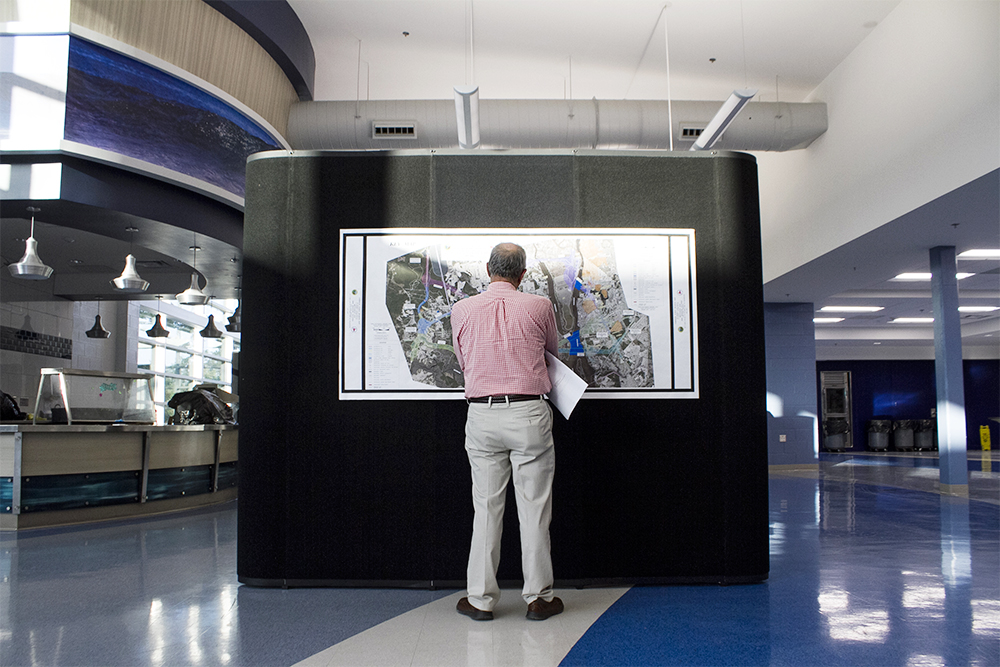
Red flags for SELC
SELC describes state consultants as “plowing ahead” — planning route alternatives, without actually having established a purpose and need for the project. Settled on in September 2010, the literal reason for the project was crafted (poorly at that, SELC’s comments argue) after it was being planned, rather than the other way around.
“The Statement of Purpose and Need for the Cape Fear Crossing appears to be nothing more than a post-hoc justification for an already-conceived project, rather than a prompt for alternative solutions to meet an established need,” SELC’s comments state.
Cape Fear Crossing’s “purpose and need” statement claims increased hurricane evacuation times as a justification for a new bridge. Yet, as SELC points out, NCDOT’s DEIS omits its consultant’s primary conclusion of its Hurricane Evacuation Analysis: the six route alternatives “do not solve the area’s worst regional bottleneck evacuation congestion.”
Catch up on Port City Daily’s series on the project: NCDOT can’t stop development and Brunswick and Leland are one step removed from a seat at the table
In its sea level rise assessment, NCDOT leans on outdated, 2013 data published by the U.S. Army Corps of Engineers, despite the availability of more recent information from the National Oceanic and Atmospheric Administration. The assessment “misleadingly references the more recent data — indicating NCDOT knew of its existence,” SELC states.
SELC finds study methods skewed and obscured old data, ignoring higher sea level rise scenarios. The Army Corp’s “website interface makes it difficult for the user to overlook the option to use the updated NOAA 2017 data.”
In its analyis, SELC finds that in 2014 NCDOT’s merger team “mysteriously” removed alternatives F and P — which would have crossed through Wilmington’s historic district. For over a decade, SELC states NCDOT has been aware of the project’s potential impacts to low-income and minority communities, but has “seemingly disregarded” them in forming its route alternatives.
Conversations with “local planners” are cited in the DEIS, despite the lack of disclosure of such interviews or availability of technical reports to document them. Only a “cursory review” of environmental impacts is presented, SELC argues, with “omissions and oversights” regarding air, water, and wildlife quality. (The DEIS found water and air quality would “not” be negatively impacted).
Brunswick County NAACP, in its Cape Fear Crossing comments, states the DEIS fails to meaningfully present mitigation options for minority populations affected by a new bridge and fails to acknowledge hundreds of acres of cultural and historic resources in the Gullah Geechee Cultural Heritage Corridor.
The DEIS ignores the impact of a new bridge near communities still recovering from Hurricane Florence, SELC points out.
“The entire DEIS process is tainted by NCDOT’s poor approach to disclosure and transparency,” SELC’s comments state. “NCDOT has failed to provide details to the public that informed its decisionmaking process, and at times, has even misinformed the public.”

NCDOT to fully respond
With the deadline lifted, NCDOT is continuing to take all comment received seriously, an NCDOT spokesperson said Thursday.
Asked whether SELC intends to file a suit on behalf of its environmental partners or citizen group, McGee said not yet. SELC’s Mid-Currituck Bridge suit was filed in response to the state’s final (not draft) environmental impact statement. A comparable final statement for the Cape Fear Crossing was anticipated from NCDOT in Spring 2020, but will now likely be pushed back at least a few months.
NCDOT’s spokesperson said the DEIS is final. However, added studies, including “updated traffic studies, community impact studies, etc.” are ongoing, according to NCDOT. These updates will be summarized in the forthcoming Final Environmental Impact Statement.
Joanne Donaghue, an organizer of the grassroots Brunswick County group CFC3, said her group has not yet engaged in serious discussions with SELC about filing a suit.
“It’s too early to say,” Donaghue said Friday. “We’re not ruling it out.”
NCDOT said in a statement the potential for litigation surrounding Cape Fear Crossing is a legitimate concern:
“Additional delay increases project costs, and delaying decision-making in an increasingly developed area of the state is a concern. The project has been identified in local and regional transportation plans for decades, with local governments acknowledging it would address a growing need in an increasingly congested area of the state.”
A last-minute, resident-created route option, “Modified V-AW,” is also being assessed now, according to NCDOT. The option was initially disregarded.
Last month, Brunswick County Chairman Frank Williams referenced “ongoing uncertainty surrounding property values” near route alternatives as one reason, among many, he hoped would prompt the merger team to select a route quickly. Developments in the bridge’s general path cannot be stopped, after a precedent-setting 2016 N.C. Supreme Court case until the specific route decision is final. Delays, paired with nonstop development in the project’s path, are a major concern for NCDOT:
“The longer the project is delayed, the more development that will occur, making impacts to communities an even bigger concern.”
View SELC’s full comments to NCDOT below:
SELC Comments to NCDOT on Cape Fear Crossing DEIS by Johanna Ferebee on Scribd
Send tips and comments to Johanna Ferebee at [email protected]
