


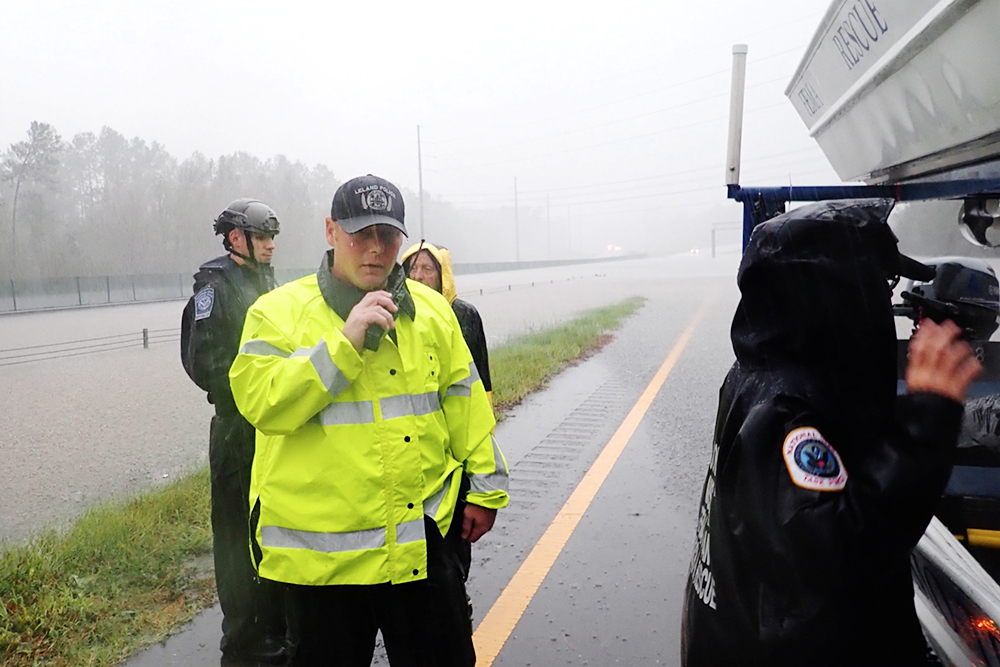
LELAND — One month after Hurricane Florence passed through southeastern North Carolina, Leland is reflecting on how it responded to unprecedented conditions.
In total, the town avoided major structural damage and health hazards compared to neighboring communities.
RELATED: Two Leland development projects put on hold amid flooding concerns
The town helped nearly 600 people evacuate and rescued over 100. There were no recorded deaths as a result of the storm.
During town meetings over the last two weeks, assistant town manager Niel Brooks has offered a presentation of the town’s response to the storm. After previewing a video that shows damage and first responder’s cooperative efforts, Brooks broke down the numbers.
First responders
After significant flooding settled into the region, Brunswick County was divided into three isolated islands. Leland’s Town Hall became northern Brunswick County’s hub for first responders. Brooks said Town Hall — which never lost power — served as a “bunkroom” for 42 Leland first responders and 27 Missouri Task Force 1 responders for 10 nights.
“We really tried to open up the doors for everyone,” Brooks said.
With 330 total calls for service, volume peaked on Sept. 14. A majority of those calls were made by individuals seeking to be rescued. With collaborative assistance from Missouri Task Force 1, the Leland Police and Fire Department, 180 rescues were conducted.
Though the Stoney Creek neighborhood was hit with “complete and total destruction,” Brooks said no major flooding was observed in neighborhoods built in the last 10 to 20 years.
“Fortunately a lot of our newer neighborhoods fared very well,” Brooks said.
In total, $5.3 million in property damage has been assessed for residents of Stoney Creek, Planters Walk and Snee Farm with $11.5 million estimated in replacement costs.
Repairs, wastewater system
Though the storm caused major damage elsewhere, Town Hall will not need any repairs, Brooks said. Based on preliminary damage assessments, the town could take on $303,156 to repair its various park facilities.
Only $9,429 in repairs have been assessed for the town’s wastewater system, something Brooks said he was pleased with. Compared to neighboring communities in the Cape Fear region, Leland avoided a major sewer disaster other didn’t.
During the storm, over 5.25 million gallons of untreated wastewater spilled into the Cape Fear River after generator failures at Cape Fear Public Utility Authority’s Southside Wastewater Treatment plant. In Carolina Beach, 17.7 million gallons of treated and untreated wastewater spilled into the river from the town’s plant off Dow Road. On top of the plant spill, approximately 226,320 gallons of wastewater spilled out of Carolina Beach’s manholes and pump stations last month.
“We did have a few overflows that were of the level to have to be reported but when you see a quarter of a million gallons of sewer over in New Hanover County, you see a million gallons plus, and we’re talking in the tens of thousands that we lost,” Brooks said. “So I’m very happy about that.”
According to discharge releases, approximately 20,000 gallons of wastewater spilled as a result of Hurricane Florence: 8,000 gallons spilled in Magnolia Greens, 5,000 gallons overflowed from a lift station near Sturgeon Creek, 5,500 gallons spilled from two separate locations in Brunswick Forest and early last week, 1,500 gallons spilled from the same lift station on Sturgeon Creek.
To prevent spills during the storm, Brooks said town employees worked tirelessly to prevent avoidable hazards. At lift stations #1 and #18, Brooks said staffers were on sight physically manning the machines.
“We actually had to have folks out there flipping switches,” he said.
Communication
In reflecting on the town’s communication efforts at the height of the storm, Brooks said the use of social media was more vital than anticipated. Though calls were rolling in, Leland was also logging and responding to requests for service through Facebook messenger.
“We had people that said, ‘Help, the water is rising at my house,’ sending that to us in Facebook messenger,” he said. “In a situation like this, it was very useful for those folks who had no other way to communicate.”
Leland’s Mayor, Brenda Bozeman, reflected on the united approach the town, Brunswick County and visiting agencies embodied while helping those most in need.
“When I think about Stoney Creek and Planters Walk, my heart just broke and it broke in several pieces,” Bozeman said.”But seeing all the love and the compassion of people from everywhere coming together, its like it filled in those cracks in my heart.”
Send tips and comments to Johanna Ferebee at [email protected]
