



WILMINGTON — The City of Wilmington employs more than 1,000 workers, from police officers to wastewater treatment operators but, according to a recent benchmarking survey, Wilmington’s hourly employees are underpaid when compared to similar municipalities.
Director of Human Resources Alvin Ragland gave a presentation on the results of the study, which was conducted earlier this year.
The decision to hold the incentives survey was in response to high turnover rates for city workers. City-wide, there is a turnover rate of 12 percent.
The study analyzed 12 different municipalities as, well as the Cape Fear Public Utilities Authority and New Hanover County. Cities studied included Asheville, Cary, Charlotte, Durham, Fayetteville, Greensboro, Greenville, High Point, Jacksonville, Raleigh, and Winston-Salem.
While hourly salaries are below the averages across the board, compensation for salaried employees “align to benchmark,” Ragland said.
Hourly employees within the N1 and N2 range, a scale used to classify different hourly employees on the city’s payroll, were generally paid 15 percent below the benchmark starting range. For example, these employees would include solid waste workers, stormwater workers, and grounds technicians, Ragland said.
To exemplify this pay discrepancy, an N2 employee who is paid the minimum rate for that category can expect to make $23,462 in Wilmington, compared to the starting minimum of $26,000 in the benchmark cities.
Public Safety Employees
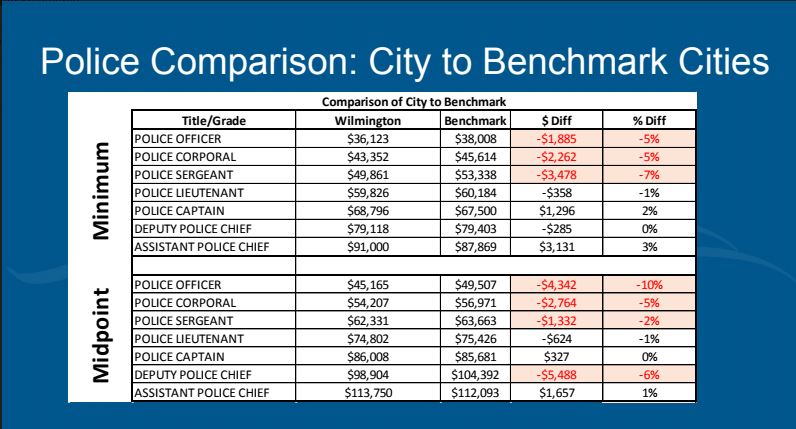
When compared to other cities Police Officers in Wilmington make 5 percent less than the minimum benchmark starting pay.
This means a police officer in Wilmington at the lowest point of the spectrum can expect to make $36,123 annually, while the benchmark minimum was $38,008. In fact, the pay range for police employees when compared to the benchmarking did not reach or exceed the average minimum until the level of police captain was reached.
The story for the Fire Department is similar to that of the police department in Wilmington. The lowest earning firefighters in Wilmington making $32,251 compared to the benchmark of $33,936. The pay rate for a master firefighter, which equates to six years of experience, was the most underpaid with a 10 percent difference from the benchmark and the City of Wilmington.
More than just pay
The findings from the benchmarking study showed more than just pay as a tool for employee retention. Educational incentives, step progression, career path, hazard pay, bilingual pay, and paid parental leave were other items analyzed and included on the report.
In Wilmington, educational incentives, or an award-based pay adjustment for earning a degree, is currently available for police employees. In cities such as Asheville, education incentives are available to all city employees, but this is an expectation, not the rule since the majority of other localities only offer these incentives to police and fire employees.
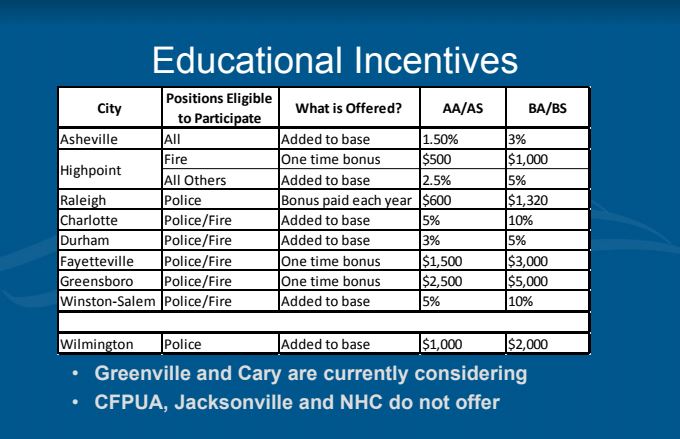
Paid parental leave was an item that came up, not just for female employees but males as well, Ragland said. This would allow a new parent time off to attend to a newborn or newly adopted child if approved; six of the 13 benchmark communities offer this to employees.
What’s next?
Now that the city has the results from the study, what happens next is still undecided. Ragland said he hopes to have recommendations and a strategy ready for City Council’s consideration by Jan. 31.
Ragland presented the council with a preliminary pay range scale adjusted to align with benchmark data. The city would have to conduct a cost analysis and prepare a multi-year strategy to, “Identify potential career paths, review position descriptions, and review position classifications,” according to the presentation.
