


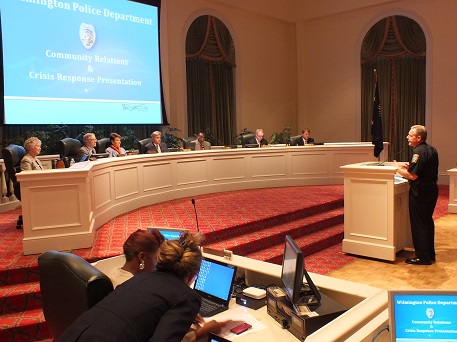
Fulfilling a request from Councilman Earl Sheridan, Wilmington Police Chief Ralph Evangelous presented an overview of his department’s policies and procedures—specifically those on community relations—at Tuesday’s meeting of Wilmington City Council.
Sheridan had asked for the presentation in light of the recent protests in Ferguson, Missouri, and other high-profile incidents involving questions of departments’ use-of-force policies. Specifically, Sheridan asked for info on that policy, community relations training and department demographics, among other requests.
Evangelous, who last week was revealed to be a finalist for the top cop job in Savannah, Georgia, addressed each topic Sheridan had requested and fielded questions from council that included his position on releasing information to the media and the public, as well as perceptions of departments appearing “too militaristic.”
Regarding use-of-force, Evangelous noted that last year, less than 3 percent of his department’s calls for service involved any use of force. The department received seven use-of-force complaints, and of nine investigations conducted, none were “sustained,” Evangelous said.
Sheridan asked if statistics for this year, thus far, are available. Evangelous replied that year-end numbers would provide a better comparison, but he noted that this year is looking better than last year.
“We had a tough year last year,” Evangelous said. “We had a lot of activity and a lot of violence in the community. Things have settled down a lot out there. 2013 was a really abnormal year for us.”
Mayor Bill Saffo asked the department’s procedures for releasing information, offering that perceptions are that info is sometimes being withheld.
“That’s a tough one,” the chief said, “because the public wants to know what’s going on, and they want to know now.”
Evangelous said there are challenges in doing so when outside agencies are investigating a case. But, he said, “Our position is we’ve got to get information out, at least the basics of what occurred, in order to quiet down any rumors that might be out there. I firmly believe we’ve got to get the information out.”
Evangelous also noted, again in response to Saffo, the department’s approach to processing crime scenes, as Saffo had asked if bodies are allowed to be left uncovered for hours at a time. While Evangelous said there is no set protocol, he said that, “generally, we never leave a body uncovered when we start to process.”
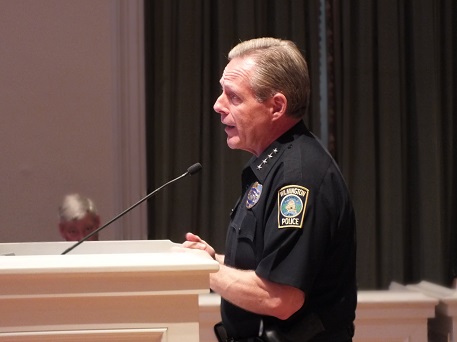
“We have to be cognizant: This is someone’s child,” he said. “This is someone’s relative here, no matter what they did or didn’t do.” Not acknowledging that, he added, incites people to react.
Regarding agencies’ use of surplus military equipment and vehicles, Evangelous explained the program that allows it and said acquisitions for Wilmington have consisted of three helicopters—used for the interagency SABLE program—and helicopter equipment, spare parts and night vision goggles, as well as several rifles.
Evangelous emphasized the need for departments to keep up with firepower found on the streets, showing a clip from a video that gang members made featuring weapons that Evangelous said are expensive and were likely stolen.
Related story: Two gang members arrested, charged with attempted murder in December shooting
“As violent criminals arm themselves with more lethal weapons, law enforcement must be prepared to meet the challenge,” Evangelous said.
Sheridan asked about a case this year when he said a military-style vehicle appeared in response to a shooting in Wilmington’s Creekwood community. Evangelous said that was due to the department relinquishing control to the New Hanover County Sheriff’s Office, which was responding to a shooting of one of its deputies. Evangelous said the vehicle was theirs.
Evangelous also commented on officer body cameras, noting that 37 cameras are currently used and that future plans call for equipping every officer—at a cost of $899 per unit. But he cautioned that the cameras would result in hours of footage that would prove challenging to process and review.
“It’s not a panacea,” he said of the cameras. “It’s not as great as people think they are, and there’s a lot more work to make these things efficient.
“It’s not insurmountable, but I say we’ve got to take a breath and work our way through it,” he said.
Evangelous touched on the department’s demographics as well, as Sheridan had asked for statistics regarding minorities in leadership positions and the department overall. Of five captains, he said one is African-American, and out of 13 lieutenants, he said are African-American women.
Evangelous noted challenges in recruiting African-Americans and females to the force—a challenge he said is experienced nationwide.
Also mentioned were several new community policing initiatives that Evangelous said are currently in the works. They include development of a community review team, a community response team and “Police 101,” a program for residents of the Wilmington Housing Authority.
When council was asked for questions, Laura Padgett noted a training event in which a retired general was listed as guest speaker, asking if that contributed to the militaristic perception of departments.
“I’m glad you brought that up,” Evangelous replied, noting that the general was a resident in the area and approached the department about speaking on leadership. He said the general explained how soldiers in Afghanistan had to transition from combat operations to community policing, “to win the hearts and minds of the villagers,” he said.
“It was pretty telling,” he added. “You could close your eyes and say you were talking about the police department, because they weren’t there to blow up things or to kill people; they were there to win their hearts, minds and souls.
“And how that transitions to what we have to do—to stop that ‘us against them’ and make it more ‘we’—he just kind of gave us the whole overview of (how) interacting, treating people with respect and dignity, really makes a difference,” Evangelous said.
Past story: Councilman requests presentation from PD in light of Missouri protests
Jonathan Spiers is a reporter for Port City Daily. He can be reached at (910) 772-6313 or [email protected]. On Twitter: @jrspiers
